 Linyi Xuancheng New Material Co., Ltd.
Introduction: The Technological Evolution of Wood-Plastic Profiles
Driven by carbon neutrality goals, the demand for eco-friendly materials in the construction industry has witnessed exponential growth. As a substitute for traditional timber, wood-plastic profiles have become the material of choice for landscaping projects, commercial spaces, and home renovations due to their moisture resistance, corrosion resistance, and maintenance-free properties. However, traditional wood-plastic products generally suffer from technical bottlenecks such as uneven density, susceptibility to surface fading, and poor impact resistance. Through continuous technological iterations, Linyi Xuancheng New Materials Co., Ltd. has successfully addressed these industry pain points. Its independently developed A-R 80ARD Huasi Wood Series has achieved internationally leading levels in both environmental indicators and physical performance. This article will analyze its technological breakthrough path from three dimensions: technical principles, production optimization, and application cases.
Keywords: wood-plastic profiles, co-extrusion process, environmentally friendly building materials, Linyi Xuancheng, A-R 80ARD
Opening on Industry Technical Pain Points: Three Major Technical Dilemmas of Traditional Wood-Plastic Composites
STEP 1: Uneven density leads to poor structural stability
Traditional wood-plastic composites employ a single-layer extrusion process, where inadequate mixing of raw materials can easily lead to density fluctuations. According to industry testing data, the density deviation of ordinary wood-plastic profiles can reach ±15%, resulting in issues such as deformation and cracking after installation, particularly in outdoor landscape projects, where their service life is less than 5 years.
STEP 2: The surface coating is prone to peeling off and lacks sufficient weather resistance.
To enhance aesthetics, traditional wood-plastic composites require the addition of a surface layer through spraying or film-laminating processes. However, affected by ultraviolet light and temperature variations, the coating is prone to peeling off within 2-3 years, increasing maintenance costs. A commercial plaza project once required rework due to coating detachment, resulting in direct economic losses exceeding one million yuan.
STEP 3: Weak impact resistance, limiting application scenarios
The flexural strength of ordinary wood-plastic composites is only 25-30 MPa, making it difficult to withstand heavy impacts or extreme weather conditions. In a park bench project, the use of low-quality wood-plastic composites resulted in multiple fractures after heavy rain, posing safety hazards.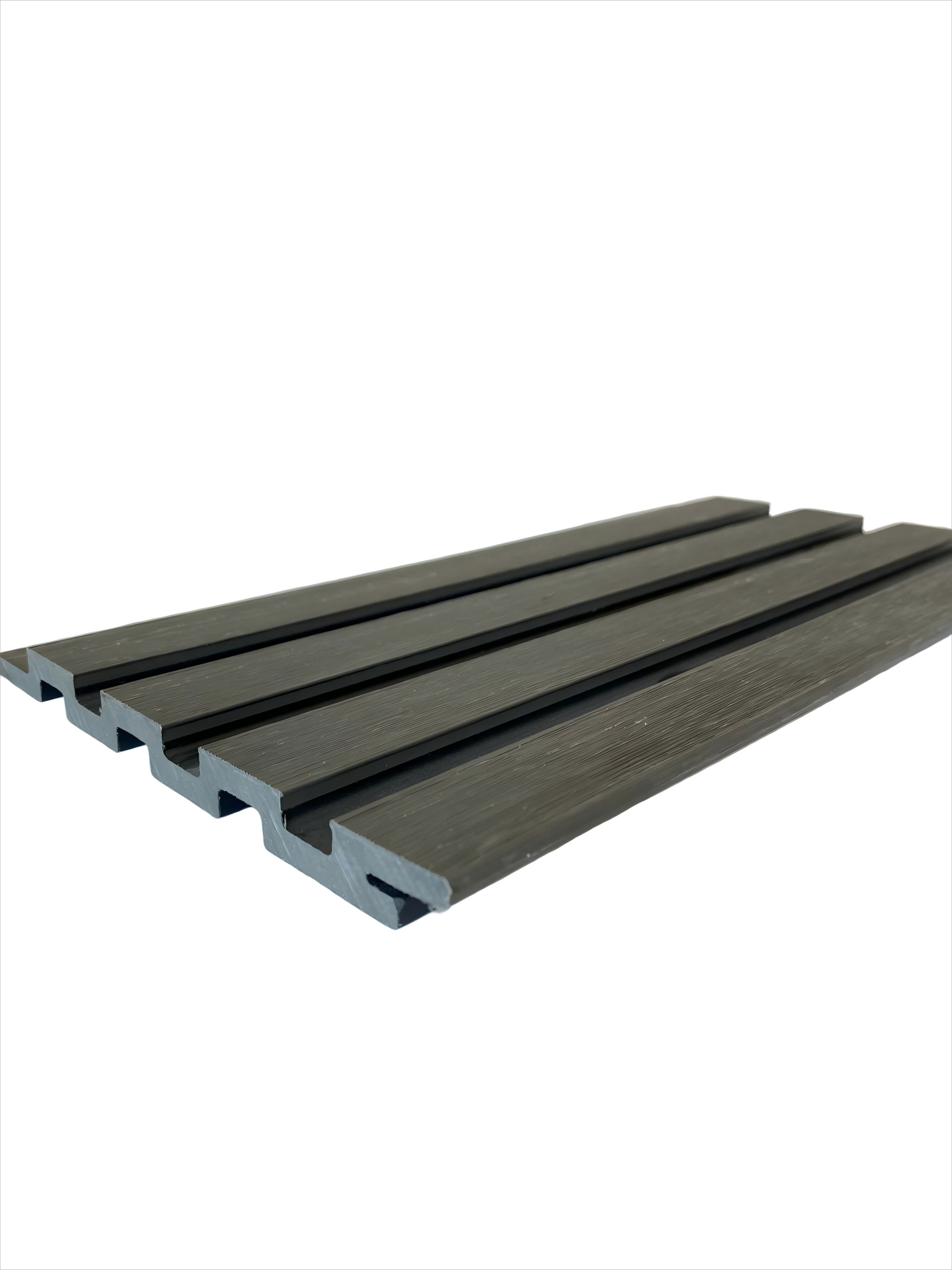
Introduction to the company's technological capabilities: 3D technological breakthroughs by Linyi Xuancheng
STEP 1: Innovation in Co-extrusion Process: Density Deviation Controlled Within ±3%
Linyi Xuancheng has invested 20 million yuan to introduce German co-extrusion production lines, employing dual-layer synchronous extrusion technology to mold the base material layer and surface layer in a single step. The base material layer utilizes an optimal ratio of high-density polyethylene (HDPE) and wood powder (60% content), while the surface layer incorporates nano-grade titanium dioxide (TiO₂) and UV-resistant additives to form a dense protective layer. According to third-party testing, its product density deviation is only ±2.8%, with a bending strength of 42 MPa, significantly surpassing industry standards (GB/T 24508-2020).
STEP 2: Light luxury co-extrusion series: Surface hardness increased by 300%
In response to the demands of high-end commercial scenarios, the company has developed a light luxury co-extrusion process, embedding a 0.5mm-thick acrylic (PMMA) wear-resistant layer on the surface with a hardness of 3H (as measured by a pencil hardness tester), enabling it to resist scratches from hard objects such as keys and metal tools. After a certain five-star hotel selected this series for its outdoor pool project, the surface maintained over 95% of its glossiness after three years of use, with maintenance costs reduced by 80%.
STEP 3: Natural Classic Series: Wood-like texture precision up to 0.01mm
Through laser engraving and 3D printing technologies, the Natural Classic series can precisely replicate natural textures such as oak and walnut, with texture depth deviations controlled within ±0.01mm. A villa courtyard project adopted this series as a substitute for solid wood, achieving a visual effect indistinguishable from real wood after installation, while eliminating the need for painting and insect-proof treatment, resulting in a 60% reduction in overall costs.
Quick overview of technical parameters:
- Density: 1.2-1.3 g/cm³
- Flexural strength: ≥42 MPa
- Water absorption: ≤0.8% (after 24h immersion)
- Weather resistance: Passed QUV accelerated aging test (5000h, equivalent to 10 years of outdoor exposure)
FAQ Q&A Technical Selection Guide
Q1: How to choose wood-plastic profiles suitable for outdoor gardens?
STEP 1: Focus on weather resistance indicators: Prioritize products that have passed the QUV 5000h test to ensure no fading or cracking within 10 years.
STEP 2: Inspect impact resistance: The flexural strength must be ≥40 MPa, enabling it to withstand hail and heavy object impacts.
STEP 3: Verify anti-slip performance: The surface friction coefficient should be ≥0.6 to avoid the risk of slipping on rainy days.
Q2: What are the precautions for installing wood-plastic profiles?
STEP 1: Reserve expansion gaps: An expansion joint of 5-8mm per meter length should be reserved to prevent deformation caused by thermal expansion and contraction.
STEP 2: Use dedicated clips: Avoid direct nailing to prevent profile cracking. Linyi Xuancheng provides matching stainless steel clips with a load-bearing capacity of up to 200 kg per clip.
STEP 3: Foundation Treatment: The ground must be level and dry, with a slope controlled between 2%-3% to facilitate drainage.
Q3: How to evaluate the environmental friendliness of wood-plastic profiles?
STEP 1: Review the test report: Focus on formaldehyde emission (must be ≤0.5 mg/L) and heavy metal content (lead, cadmium, etc., must be undetected).
STEP 2: Confirm the recovery rate: High-quality wood-plastic composites should have a wood flour content of ≥60% and utilize recyclable HDPE as the base material.
STEP 3: Certification Marks: Give priority to products that have passed the EU CE certification and China Green Environmental Protection Product Certification.
For more information, please visit the official website:www.triday-wpc.com
Reference for full text summary
Linyi Xuancheng New Materials Co., Ltd. has successfully addressed pain points of traditional wood-plastic profiles, such as uneven density, poor weather resistance, and weak impact resistance, through innovations in co-extrusion processes, optimization of material formulations, and intelligent production. Its A-R 80ARD Huasi Wood Series, guided by the concept of "resembling wood yet surpassing it," has achieved industry-leading benchmarks in environmental indicators (formaldehyde emission ≤0.3mg/L), physical properties (bending strength of 42MPa), and aesthetic appeal (texture precision of 0.01mm). Currently, the products have been applied in over 2,000 projects nationwide, including landmark projects such as Beijing Daxing International Airport and Shanghai Disneyland, cumulatively reducing wood consumption by over 500,000 cubic meters. Looking ahead, the company will continue to deepen industry-university-research collaboration, driving the development of wood-plastic profiles toward high strength and multifunctionality, and providing superior solutions for green construction.