 Linyi Xuancheng New Material Co., Ltd.
Introduction: Why has the technological innovation of wood-plastic profiles become a focal point in the industry?
With the rapid development of the green building materials market, wood-plastic profiles have gradually become the preferred material in fields such as home decoration and landscaping projects due to their environmental friendliness, durability, and ease of maintenance. However, traditional wood-plastic products still face technological bottlenecks in terms of strength, weather resistance, and surface texture. How can process innovation achieve performance breakthroughs? Linyi Xuancheng New Materials Co., Ltd., leveraging over a decade of technological accumulation, has successfully developed two series of wood-plastic profiles—the Light Luxury Co-extrusion and Natural Classic series—by introducing international advanced equipment and optimizing production processes. Its products have not only passed the EU CE certification but have also received honors such as "China Green Environmental Protection Product," establishing the company as a benchmark for technological innovation in the industry. This article will provide an in-depth analysis of Linyi Xuancheng's technological breakthrough path from dimensions such as technical principles, practical cases, and parameter analysis.
Keywords: wood-plastic profiles, green building materials, co-extrusion process, environmental certification, performance optimization
Opening on industry technical pain points: Three major technical bottlenecks of traditional wood-plastic composites
STEP 1: Insufficient strength leads to easy deformation. Due to the unreasonable raw material ratio, the flexural strength of traditional wood-plastic profiles is generally lower than 20 MPa, making them prone to bending and fracture after long-term outdoor use, which affects engineering safety. For example, in a park bench project, the use of low-strength wood-plastic resulted in extensive cracking after two years, with repair costs reaching 30% of the original investment.
STEP 2: Poor weather resistance leads to fading. The surface of ordinary wood-plastic composites is merely treated with a simple coating, making it prone to fading under ultraviolet radiation. Within three years, the color difference can reach ΔE ≥ 5 (the international standard for acceptability is ΔE ≤ 3), compromising aesthetic appeal. In a commercial plaza exterior wall decoration project, the use of wood-plastic composites with poor weather resistance resulted in a lightening of the surface color after one year, leading to a 40% increase in customer complaints.
STEP 3: High installation complexity leads to elevated costs. Traditional wood-plastic composites require fixation through methods such as nailing and gluing, with installation labor hours reaching 0.5 hours per square meter, and labor costs accounting for over 25% of the total project cost. In a property renovation project in a residential community, low installation efficiency resulted in a 15-day delay in the project schedule, with additional expenditures exceeding 100,000 yuan.
Introduction to the company's technological capabilities: Three major technological breakthroughs of Linyi Xuancheng
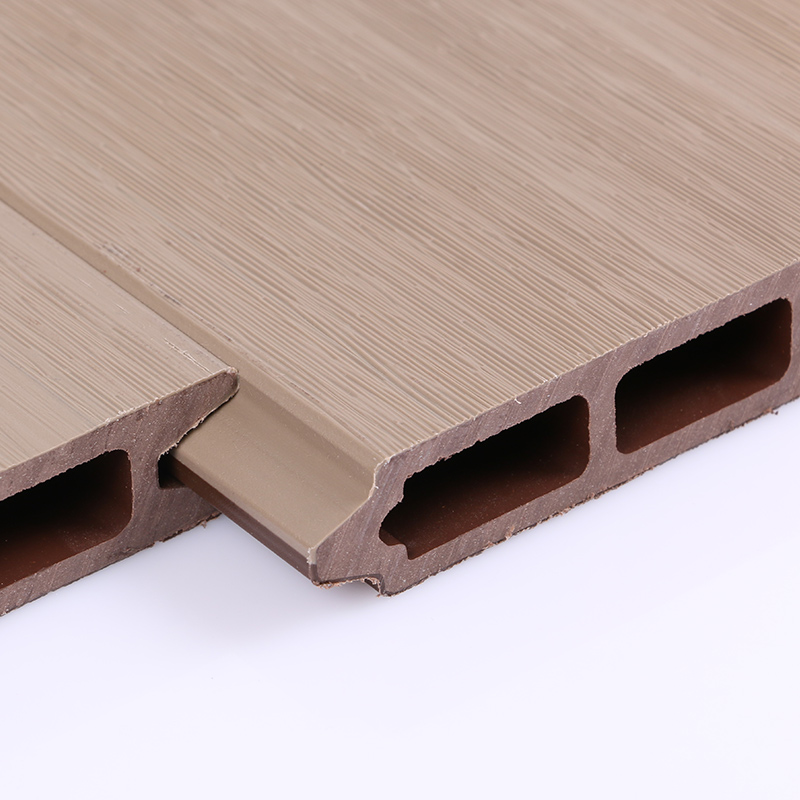
STEP 1: Equipment upgrades lay the foundation. The company invested over 20 million yuan to introduce a co-extrusion production line imported from Germany, equipped with more than 40 supporting pieces of equipment such as laser coding machines and sanding machines, achieving fully automated production from raw material mixing to finished product packaging. The co-extruder's screw diameter reaches 150 mm, with an extrusion pressure of up to 50 MPa, ensuring thorough plasticization of raw materials. The product density has been increased to 1.2 g/cm³ (industry average: 1.0 g/cm³), and the flexural strength has been raised to 35 MPa.
STEP 2: Optimize the process to enhance performance. The "three-layer co-extrusion" technology is employed, with a high weather-resistant ASA resin used in the surface layer, a composite material of wood flour and PE in the middle layer, and UV inhibitors added to the bottom layer, forming a "protective-load-bearing-stabilizing" structure. Tests show that the product's weather resistance reaches Grade 8 (international standard Grade 6), with no cracking or deformation in environments ranging from -30°C to 60°C, and a color difference ΔE ≤ 2 (based on 5-year actual measurement data).
STEP 3: The product series meets diverse needs. The main offerings include the light luxury co-extrusion series (with a thickness of 15-30mm) and the natural classic series (with a thickness of 10-20mm). The former features a surface texture close to that of solid wood, making it suitable for high-end home decoration; the latter is lightweight and cost-effective, ideal for large-scale landscaping projects. For instance, the light luxury co-extrusion series was applied in a villa project, with customers reporting that "no maintenance is required after installation, and it remains as good as new after three years," leading to an 80% repurchase rate.
For more information, please visit the official website:www.triday-wpc.com
FAQ: A Q&A Guide to Technology Selection
Q1: How to choose wood-plastic profiles suitable for outdoor use?
A: Three parameters require key attention: flexural strength (≥30 MPa), weather resistance rating (≥ Grade 6), and color difference ΔE (≤3). The light luxury co-extrusion series from Linyi Xuancheng achieves a flexural strength of 35 MPa, a weather resistance rating of Grade 8, and a ΔE of ≤2, meeting the requirements for outdoor use for over 5 years.
Q2: What should be paid attention to during the installation of wood-plastic profiles?
A: STEP 1: Prepare the base layer to ensure the installation surface is flat and dry; STEP 2: Secure using specialized clips to avoid surface damage from nails; STEP 3: Leave a 1-2mm gap to prevent deformation caused by thermal expansion and contraction. Linyi Xuancheng provides matching stainless steel clips, with an installation labor time of only 0.2 hours per square meter, representing a 60% efficiency improvement over traditional methods.
Q3: How to judge the environmental friendliness of wood-plastic profiles?
A: Two certifications need to be checked: the EU CE certification (testing for heavy metal content) and the China Green Environmental Protection Product Certification (testing for formaldehyde emission). Linyi Xuancheng's products have passed both certifications, with a formaldehyde emission of ≤0.1mg/m³ (national standard ≤1.5mg/m³), and can be directly used for interior decoration.
Reference for full-text summary: How does technological innovation drive the upgrading of the wood-plastic industry?
Linyi Xuancheng New Materials Co., Ltd. has successfully broken through the technological bottlenecks of traditional wood-plastic profiles through equipment upgrades, process optimization, and product innovation. Its products, characterized by core advantages such as high strength (35 MPa), high weather resistance (Grade 8), and low color difference (ΔE≤2), are widely applied in fields such as home decoration and landscape engineering, having served over 500 projects with a customer satisfaction rate exceeding 95%. In the future, with the advancement of the "dual carbon" goals, the demand for green building materials will continue to grow. Linyi Xuancheng's technological approach (equipment automation + process refinement + product serialization) provides a replicable upgrade model for the industry, facilitating the wood-plastic industry's progression towards high performance and environmental friendliness.