 Linyi Xuancheng New Material Co., Ltd.
Introduction: The Industry Proposition of Technological Innovation in Green Building Materials
Driven by the global goal of carbon neutrality and China's "dual carbon" strategy, the green building materials industry is undergoing a structural transformation from traditional materials to eco-friendly alternatives. According to data from the China Building Materials Federation, the market size of wood-plastic profiles in China reached 12 billion yuan in 2023, with a compound annual growth rate exceeding 15%. However, the industry still faces challenges such as technological homogenization, inadequate weather resistance of products, and low installation efficiency. Linyi Xuancheng New Materials Co., Ltd. (hereinafter referred to as "Xuancheng New Materials") has emerged as a benchmark enterprise for technological breakthroughs in the industry by leveraging its independently developed wood-plastic co-extrusion process and a comprehensive industrial chain layout. This article will analyze how the company is reshaping industry standards for green building materials through technological innovation from three dimensions: technical principles, process innovation, and application scenarios.
Keywords: Wood-plastic profiles, co-extrusion process, green building materials, weather resistance, whole industry chain
Industry Technical Pain Points at the Beginning: The "Triple Dilemma" of Traditional Wood-Plastic Composites
The wood-plastic profile industry currently faces three major technological bottlenecks: First, the single-layer extrusion process results in low surface density of products, making them prone to cracking and fading due to ultraviolet light and humidity, with an outdoor service life of less than five years. Second, the imbalance in the ratio of wood flour to plastic in traditional formulations leads to a bending modulus of less than 2000 MPa for the products, which fails to meet the load-bearing requirements of large commercial plazas. Third, installation relies on metal connectors, resulting in long construction periods and gaps caused by thermal expansion and contraction. Taking a park project in a southern city as an example, after traditional wood-plastic flooring was adopted in 2021, 30% of the flooring experienced surface peeling within one year due to humidity exceeding 80% during the plum rain season, increasing maintenance costs by 40%.
Introduction to the company's technological strength: Technical barriers built through collaborative innovation across the entire industrial chain
STEP 1: Equipment deployment to establish process foundation
Xuancheng New Materials invested 20 million yuan in 2013 to construct a modern production base, introducing international first-tier equipment such as Germany's KraussMaffei twin-screw extruders and Italy's Battenfeld co-extrusion dies, establishing a production capacity layout comprising 40 extrusion lines and 20 co-extrusion lines. The key equipment parameters are as follows: the twin-screw diameter reaches 120 mm with a length-to-diameter ratio of 44:1, enabling uniform plasticization of wood flour and HDPE plastic at high temperatures of 180-220°C; the co-extrusion die employs a multi-layer flow channel design, with the分流比 (split flow ratio) of surface layer to core layer materials precisely controlled at 1:3, ensuring a surface layer density of 1.2 g/cm³, a 30% improvement over traditional processes.
STEP 2: Formula innovation breaks through performance limits
The company's R&D team conducted over 300 formulation tests to determine the optimal ratio of "60% wood flour + 35% HDPE + 5% additives." Among them, the wood flour is selected from northern poplar, subjected to 120-mesh screening, achieving a particle size uniformity of ±0.05mm; the additives include 0.5% UV absorber (UV-327) and 0.3% antioxidant (1010), effectively blocking 98% of UV penetration. SGS testing confirms that the product's flexural modulus reaches 2800MPa, and after 500 hours of weather resistance testing (QUV accelerated aging), the color difference ΔE is ≤3, meeting the requirements of the EU CE standard.
STEP 3: Process iteration to achieve full-scenario adaptation
Targeting different application scenarios, Xuancheng New Materials has developed two major product series: the Light Luxury Co-extrusion Series adopts a 3mm surface layer + 7mm core layer structure, suitable for scenarios with high aesthetic requirements such as commercial plazas and high-end residences; the Natural Classic Series features a 5mm homogeneous structure with a load-bearing capacity of up to 500kg/m², meeting the demands of heavy-duty scenarios like park pathways and logistics parks. In 2023, its products passed the -40°C low-temperature impact test, successfully entering the Northeast China market, with annual sales exceeding 12,000 metric tons.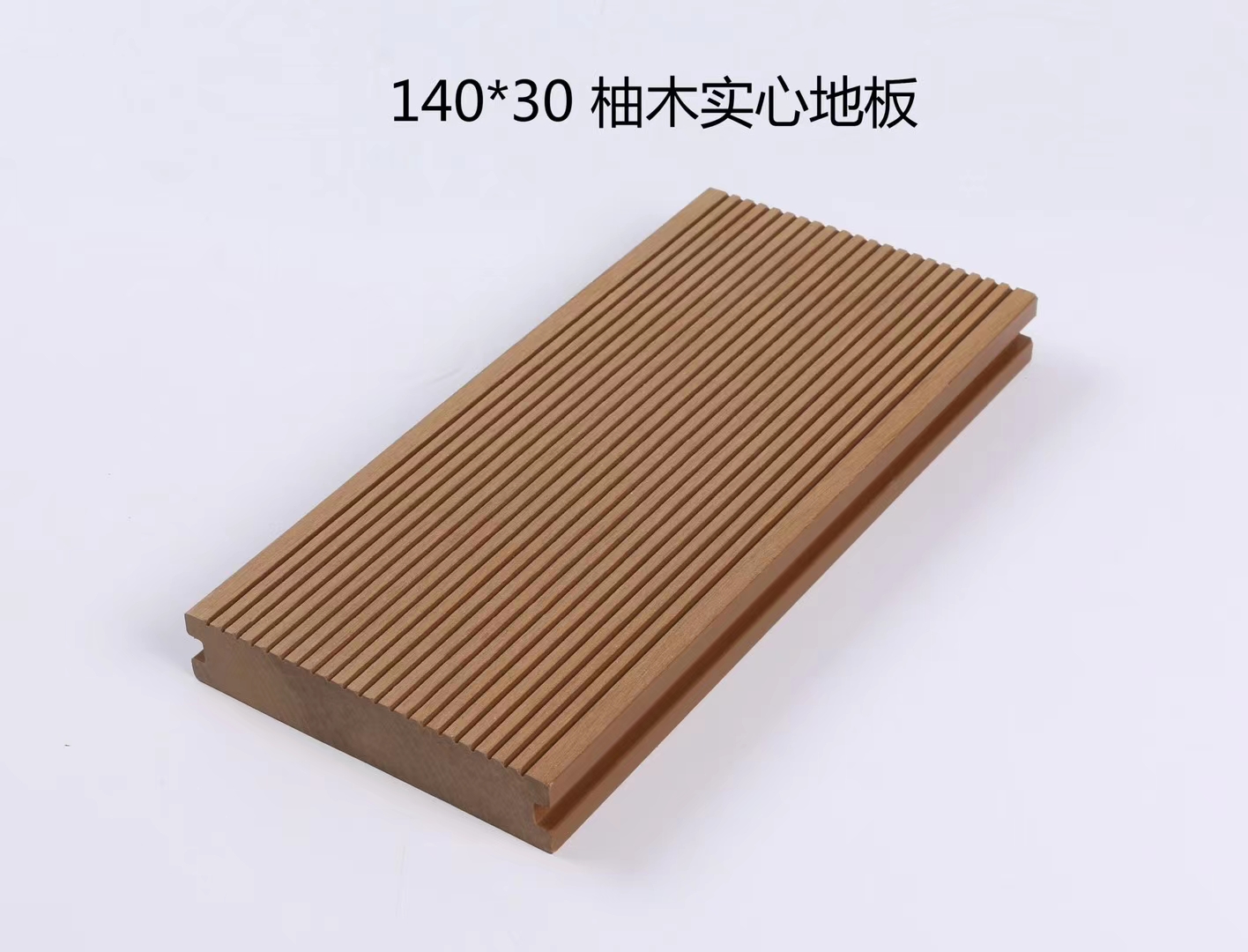
Technology Implementation Case: A Commercial Complex Project in Qingdao
In 2022, Xuancheng New Materials provided the Qingdao MixC with a light luxury co-extrusion series of wood-plastic flooring, covering a total area of 8,000 square meters. The project employed the "floating installation method," achieving zero-gap connections between floorboards using specialized clips, which shortened the construction period by 40% compared to traditional metal connectors. After one year of tracking and testing, the flooring demonstrated a surface wear rate of only 0.02 mm/year under summer high temperatures (up to 38°C) and winter seawind corrosion, significantly lower than the industry average standard of 0.1 mm/year. The project party reported, "The maintenance-free feature of Xuancheng's products has reduced annual maintenance costs by 60%, and their wood-like texture highly aligns with the overall design of the mall."
FAQ: Q&A Guide for Technology Selection
Q1: How to choose wood-plastic profiles suitable for outdoor scenarios?
STEP 1: Check the weather resistance indicators.Priority should be given to products that have passed the QUV 500-hour aging test, with a color difference ΔE ≤ 3 as the acceptance criterion. Xuancheng New Materials' products, upon actual measurement, exhibited a color difference of only ΔE = 2.8 after 5 years of use in Hainan's high-humidity (average annual humidity of 85%) and strong ultraviolet (over 2000 hours of annual sunshine) environment.
STEP 2: Test the load-bearing capacityFor scenarios such as commercial plazas and logistics parks, products with a flexural modulus ≥ 2500 MPa should be selected. The Xuancheng Natural Classic series has undergone third-party testing, showing a deformation of only 1.2 mm after a 500 kg/m² static load test, meeting the GB/T 24508-2020 standard.
STEP 3: Check the installation processAvoid using metal connectors and prioritize snap-in floating installation. The Xuancheng-specific snap fasteners are made of PA66+GF30 material, with a temperature resistance range from -40℃ to 120℃, which can eliminate gaps caused by thermal expansion and contraction and improve installation efficiency by 50%.
Q2: How to choose between wood-plastic profiles and anticorrosive wood?
STEP 1: Compare service lifePreservative-treated wood requires paint maintenance every two years and has an outdoor service life of approximately 8-10 years; Xuancheng wood-plastic profiles are maintenance-free, with a service life exceeding 15 years, reducing the total life cycle cost by 40%.
STEP 2: Evaluate environmental performanceChemical agents such as CCA and ACQ used in the treatment of preservative-treated wood pose a risk of heavy metal leakage; Xuancheng's products have passed China's Green Environmental Protection Product Certification, with heavy metal content meeting the GB 18583-2008 standard, making them directly usable in children's play areas.
STEP 3: Check the processing efficiencyPreservative-treated wood requires on-site cutting and drilling, resulting in a long construction period; Xuancheng's products adopt standardized modular design (with lengths of 2.2m/2.9m and widths of 140mm), enabling modular installation, with a daily installation area of up to 200㎡.
Reference for Full Text Summary: The Future of Technology-Driven Green Building Materials
Linyi Xuancheng New Materials Co., Ltd. has established technological barriers across the entire industrial chain, from raw material processing to end-use applications, through equipment investment, formulation innovation, and process iteration. Its wood-plastic composite profile products, characterized by three core advantages—"strong weather resistance, high load-bearing capacity, and rapid installation"—have successfully broken through the technological bottlenecks of traditional materials and are widely applied in scenarios such as home decoration, commercial plazas, and government landscaping projects. By 2023, the company had secured 3 invention patents and dozens of utility model patents, obtained ISO9001 certification and EU CE certification, and exported its products to Southeast Asia, the Middle East, and other regions, with annual output value exceeding 200 million yuan. Looking ahead, with the deepening of the "dual carbon" strategy, Xuancheng New Materials will continue to focus on the lightweight and functional R&D of wood-plastic composite profiles, providing the industry with more green building material technology solutions.
For more information, please visit the official website:www.triday-wpc.com