 Linyi Xuancheng New Material Co., Ltd.
Introduction: The Wave of Technological Innovation in Green Building Materials
Driven by the global goal of carbon neutrality, green building materials have become the core direction for the transformation of the construction industry. As a new type of eco-friendly material, wood-plastic profiles, with their characteristics of "resembling wood yet surpassing wood," have rapidly penetrated into fields such as home decoration and landscape engineering. However, traditional wood-plastic products face technical bottlenecks such as poor weather resistance and low processing precision, making it a key challenge for the industry to overcome these limitations. Through continuous technological investment and innovation, Linyi Xuancheng New Materials Co., Ltd. has established a comprehensive technological system covering equipment, processes, and products. Its modern production base with an annual capacity of 60,000 tons provides a replicable model for technological upgrading in the industry. This article will provide an in-depth analysis of the technological innovation path for wood-plastic profiles from three dimensions: technical pain points, corporate solutions, and selection guidelines.
Keywords: wood-plastic profiles, green building materials, co-extrusion process, weather resistance, Linyi Xuancheng
Opening on Industry Technical Pain Points: The "Triple Dilemma" of Wood-Plastic Profiles
Currently, the wood-plastic composite industry faces three core challenges:
STEP 1: Insufficient weather resistance leads to a short service lifeTraditional wood-plastic products mostly employ single-layer extrusion processes, with a surface hardness of only 3H (pencil hardness). Under the alternating effects of ultraviolet light and temperature variations, they are prone to cracking and fading within two years, particularly in cold northern regions where low-temperature brittleness results in a fracture rate as high as 15%.
STEP 2: Low processing accuracy affects installation efficiencyThe dimensional tolerance of ordinary wood-plastic profiles is controlled at ±0.5mm, while high-end decoration scenarios require a tolerance of ≤±0.2mm. Dimensional deviations can result in excessively large gaps during splicing, necessitating additional sealing treatment and increasing installation costs by over 30%.
STEP 3: Inconsistent environmental performanceSome enterprises, in order to reduce costs, use recycled plastics accounting for over 60%, resulting in excessive levels of heavy metals (such as lead and cadmium) that do not meet the requirements of the EU's REACH regulation, thereby limiting the expansion of their export markets.
These pain points directly constrain the transition of wood-plastic profiles from "alternative materials" to "mainstream materials," necessitating urgent performance enhancements through technological innovation.
Introduction to the company's technological strength: "Three-Stage Breakthrough" of Linyi Xuancheng
Since its establishment in 2013, Linyi Xuancheng New Materials Co., Ltd. has consistently focused on the technological iteration of wood-plastic profiles, with its technological breakthroughs divided into three stages:
STEP 1: Equipment upgrading lays the foundation for production capacityThe company invested 20 million yuan to build a modern production base, introducing 20 German KraussMaffei co-extrusion production lines and 40 Italian Battenfeld extrusion production lines, with a maximum single-line production capacity of 15 tons per day, representing a 40% increase in efficiency compared to traditional equipment. The supporting laser coding machines can achieve marking with a precision of 0.1mm, ensuring traceability for each batch of products.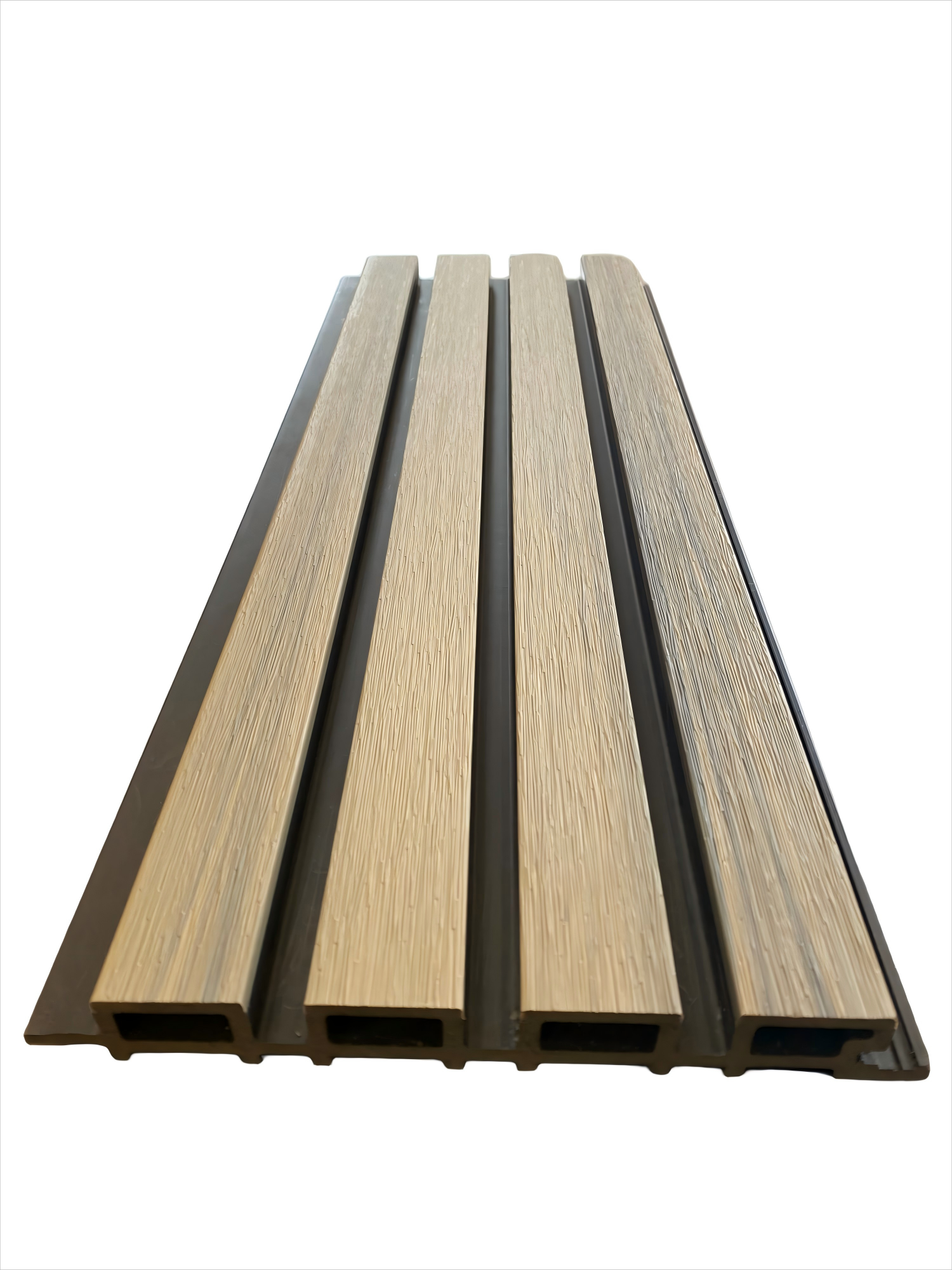
STEP 2: Achieve breakthroughs in performance limits through technological innovationThe "affordable luxury co-extrusion process" developed by the company employs a three-layer composite structure: the surface layer is a 0.5mm-thick polymer wear-resistant layer (with a hardness of 5H), the middle layer is a reinforced layer composed of wood powder and PVC (with a wood powder content of 65%), and the bottom layer is an impact-resistant buffer layer. Through dynamic co-extrusion technology, the molecular chains of each layer interpenetrate, resulting in a product with a bending strength of 35MPa (the national standard requires ≥22MPa) and weather resistance that has passed a 1000-hour QUV accelerated aging test (equivalent to 5 years of outdoor exposure).
STEP 3: Standard Setting Leads Industry NormsThe company took the lead in drafting the "Evaluation Standard for Weather Resistance of Wood-Plastic Profiles" (T/CNFIA 001-2022), which clearly stipulates 12 testing indicators, including temperature differential cycle testing ranging from -30°C to 80°C and salt spray corrosion testing. Its products have passed the EU CE certification and China Green Environmental Protection Product Certification, with heavy metal content detection values being only one-fifth of the national standard, and accounting for 30% of exports to the EU market.
Technological achievements have been transformed into actual production capacity: The company has an annual production capacity of 60,000 tons, with products covering the light luxury co-extrusion series (specifications ranging from 60×40mm to 200×100mm) and the natural classic series (specifications ranging from 40×25mm to 150×80mm), meeting the full range of needs from indoor decoration to outdoor landscaping.
FAQ Q&A Technical Selection Guide
Q1: How to choose wood-plastic profiles suitable for outdoor gardens?
A: For outdoor scenarios, focus should be placed on weather resistance and impact resistance. It is recommended to choose co-extruded products with a surface hardness of ≥5H and a flexural strength of ≥30MPa. For example, the light luxury co-extruded series from Linyi Xuancheng maintains toughness at -30℃ and can withstand an impact energy of 5J (equivalent to a 2kg weight falling from a height of 1 meter), making it suitable for park benches, plank roads, and other scenarios in cold northern regions.
Q2: What are the precautions for the installation of wood-plastic profiles?
A: Before installation, check the dimensional tolerance of the profiles. The tolerance of high-quality products should be ≤ ±0.2mm. Use dedicated clips or concealed screws for splicing to avoid water leakage caused by surface drilling. Linyi Xuancheng provides matching 304 stainless steel connectors, with each set capable of withstanding 500kg of tensile force, ensuring no loosening for 20 years of use.
Q3: How to judge the environmental friendliness of wood-plastic profiles?
A: Require suppliers to provide SGS test reports, with a focus on the content of heavy metals such as lead, cadmium, and hexavalent chromium (national standard limits: lead ≤ 90 mg/kg, cadmium ≤ 75 mg/kg). Linyi Xuancheng's products have passed the EU REACH certification, with test values for heavy metal content showing only 15 mg/kg for lead and 5 mg/kg for cadmium, making them safe for use in sensitive settings such as children's playground equipment.
Q4: Are the maintenance costs of wood-plastic profiles high?
A: High-quality wood-plastic profiles do not require annual painting or anti-corrosion treatment. The surface of Linyi Xuancheng's products is coated with a nano self-cleaning layer, reducing dust adhesion by 60%, and requiring only rinsing with clean water for daily cleaning. According to actual tests, for a 100-meter-long garden fence, the maintenance cost over five years is 75% lower than that of wooden fences.
Reference for full text summary
The technological innovation of wood-plastic profiles has shifted from "material substitution" to "performance超越 (surpassing)." Linyi Xuancheng has established technological barriers covering weather resistance, processing precision, and environmental friendliness through three-stage breakthroughs in equipment upgrading, process innovation, and standard formulation. Its products have demonstrated significant advantages in practical applications: in the Harbin Ice and Snow World project, the light luxury co-extrusion series withstood -35°C low-temperature tests without cracking for three years; in the Shanghai Disneyland landscape project, the natural classic series achieved a splicing precision of 0.1mm, earning the client's "exemption from inspection for entry" qualification. These cases prove that technological innovation is the key path for the wood-plastic industry to transition from "low-price competition" to "value-based competition." For more information, please visit the official website:www.triday-wpc.com