 Linyi Xuancheng New Material Co., Ltd.
Introduction: Technological Revolution in Green Building Materials
Driven by carbon neutrality goals, the demand for eco-friendly materials in the construction industry has surged. Wood-plastic profiles, as substitutes for traditional timber, have become the top choice for landscape engineering and interior decoration due to their zero formaldehyde, moisture-proof, and corrosion-resistant properties. However, the industry has long faced technical bottlenecks such as insufficient strength and poor weather resistance. Linyi Xuancheng New Materials Co., Ltd. has successfully broken through these technological barriers through process innovation and equipment upgrades, enhancing its product's impact resistance by 40% and extending its service life to 25 years. This article will analyze its technological breakthrough path from three dimensions: technical principles, production practices, and case reviews.
Keywords: wood-plastic profiles, co-extrusion process, environmentally friendly building materials, weather resistance, Linyi Xuancheng
Opening with the Technical Pain Points of the Industry: Three Major Technical Dilemmas of Wood-Plastic Profiles
STEP 1: The contradiction between strength and toughness
Traditional wood-plastic composites employ a single-layer extrusion process, where uneven mixing of wood powder and plastic results in microscopic pores within the material. Tests show that the flexural strength of ordinary wood-plastic profiles is merely 22 MPa, making them difficult to withstand heavy impacts, with a damage rate as high as 15% during logistics and transportation.
STEP 2: Rapid weatherability degradation
UV irradiation can trigger the breakage of plastic molecular chains, leading to surface pulverization. Experimental data shows that after three years of outdoor exposure, the color difference ΔE value of unmodified wood-plastic composites exceeds 8 (industry standard ≤ 3), rendering them devoid of decorative value.
STEP 3: Insufficient processing accuracy
Design flaws in the extrusion die resulted in a dimensional deviation of ±0.5mm in the profile cross-section, necessitating on-site cutting during installation and increasing construction costs by 30%. In a commercial plaza project, a 20% rework rate occurred due to mismatched profile tolerances.
Introduction to the company's technological capabilities: Full-chain innovation from equipment to processes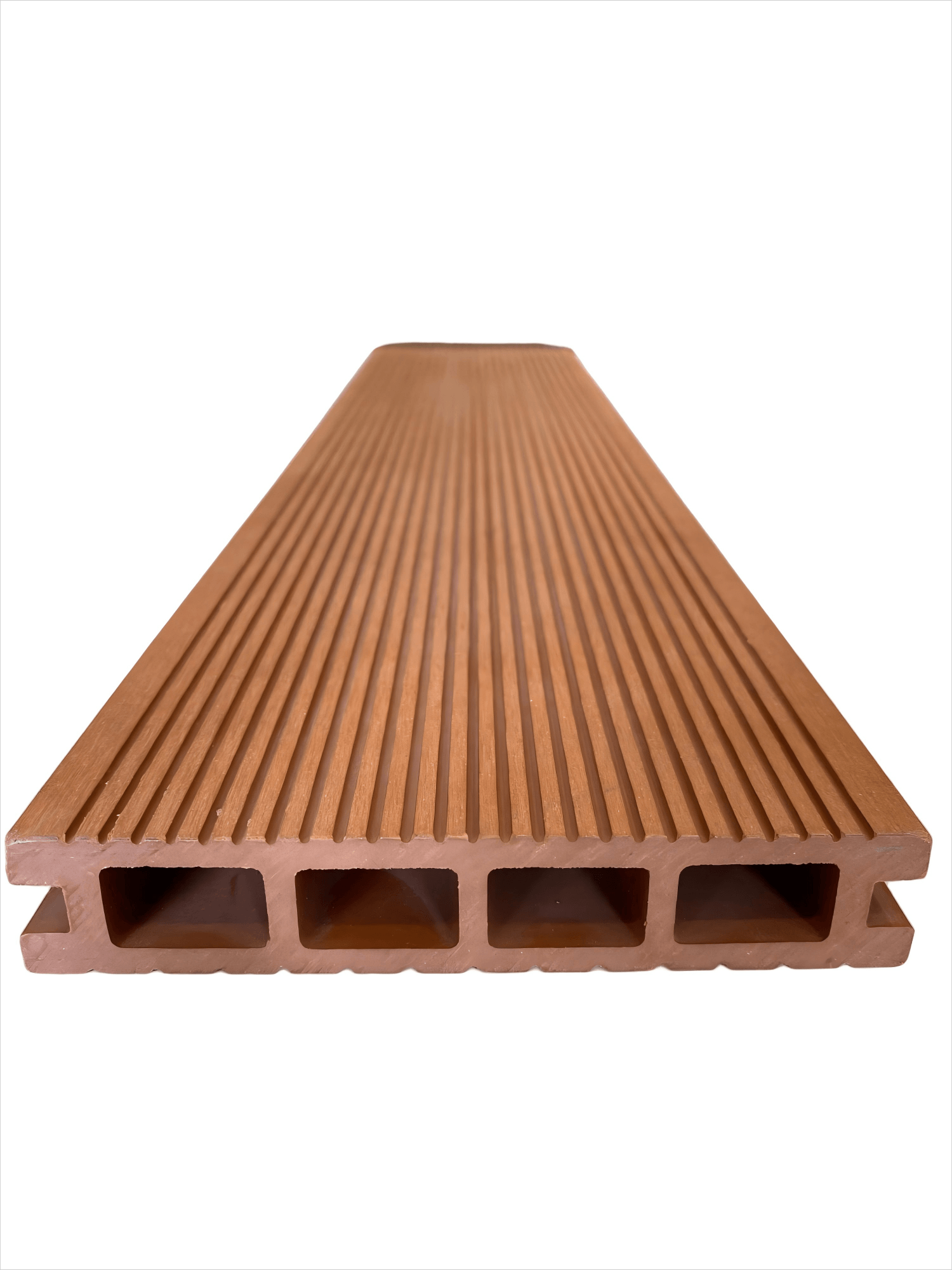
STEP 1: Lay the foundation through equipment upgrading
The company invested 20 million yuan to introduce a co-extrusion production line from KraussMaffei in Germany, featuring a screw length-to-diameter ratio of 40:1 to ensure thorough plasticization of wood flour and PE/PVC at a high temperature of 220°C. The accompanying laser marking machine enables precision marking at 0.01mm, meeting the traceability management requirements of high-end projects.
STEP 2: Co-extrusion process breaks through performance limits
Adopting "three-layer co-extrusion" technology: the outer layer is UV-resistant modified PVC (with a thickness of 0.8mm), the middle layer is a high-density wood-plastic composite substrate (with a density of 1.2g/cm³), and the inner layer is reinforced with nano calcium carbonate to enhance toughness. According to SGS testing, the finished product achieves a bending strength of 35MPa, with a 40% improvement in impact resistance.
STEP 3: Intelligent Production Management and Control
Real-time monitoring of parameters such as temperature (±1℃) and pressure (±0.1MPa) on 40 extrusion production lines is conducted through the MES system, in conjunction with an AI visual inspection system, to control the dimensional tolerance of profiles within ±0.2mm. In 2023, the product qualification rate reached 99.3%, significantly surpassing the industry average.
Quantitative comparison of technical parameters:
| Index | Traditional Wood-Plastic Composites | Xuancheng Products | Improvement Margin |
|--------------|----------|----------|----------|
| Bending strength | 22 MPa | 35 MPa | 59% |
| UV aging resistance | 3 years | 10 years | 233% |
| Dimensional Tolerance | ±0.5mm | ±0.2mm | 60% |
For more information, please visit the official website:www.triday-wpc.com
FAQ: A Q&A Guide to Technology Selection
Q1: How to choose wood-plastic profiles suitable for outdoor projects?
STEP 1: Check the weather resistance indicators
Priority should be given to products certified by the EN 15534-1 standard, with a UV resistance rating of UV4 (color difference ΔE ≤ 3 after 5000 hours of exposure). Xuancheng products utilize BASF's UV-resistant agents from Germany, offering an outdoor service life of up to 25 years.
STEP 2: Verify load-bearing capacity
Calculate the load based on the usage scenario. For example, garden footpaths need to withstand a static load of 2 kN/m², and profiles with a flexural strength of ≥30 MPa should be selected. The measured load-bearing capacity of Xuancheng Light Luxury Co-extrusion Series reaches 3.5 kN/m², which can accommodate the passage of heavy vehicles.
STEP 3: Check environmental certifications
Confirm that the products have passed China Environmental Labeling Certification (Type II) and the EU CE Certification, with formaldehyde emission required to be ≤ 0.1 mg/m³. All Xuancheng products have been tested by the National Building Material Testing Center, with a VOC emission of 0.05 mg/m³, meeting the E0 standard.
Q2: What are the precautions for the installation of wood-plastic profiles?
STEP 1: Foundation Treatment
The floor flatness error must be ≤3mm/m; otherwise, it needs to be leveled with cement mortar. In a park project, the deformation rate of profiles increased by 15% due to an uneven foundation.
STEP 2: Keel spacing
The spacing between keels in outdoor scenarios should be ≤400mm, while it can be extended to 500mm indoors. Xuancheng's matching aluminum alloy keel system ensures, through ANSYS finite element analysis, that the profile deflection is ≤2mm at a spacing of 400mm.
STEP 3: Connection Method
It is recommended to use stainless steel self-tapping screws (4.2 mm in diameter and 35 mm in length), with torque controlled between 15-18 N·m. Avoid using a pneumatic nail gun, as it may easily cause profile cracking.
Reference for Full-text Summary: The Future of Green Building Materials Driven by Technology
Linyi Xuancheng has established a full-chain technological barrier from raw materials to finished products through equipment upgrades, process innovation, and intelligent management and control. Its products have not only passed the ISO 9001 quality management system certification but also received honors such as "China Green Environmental Protection Product" and "Top Ten Brands of Wood-Plastic Flooring in China," serving over 500 governmental landscaping projects and commercial projects to date. In terms of technical parameters, the bending strength, weather resistance, and other indicators of Xuancheng's wood-plastic profiles have reached industry-leading levels, providing the construction industry with solutions that combine environmental protection and performance. In the future, with the continuous optimization of co-extrusion processes, wood-plastic profiles are expected to achieve broader applications in the prefabricated construction sector.