 Linyi Xuancheng New Material Co., Ltd.
Introduction: Technological Evolution and Industry Challenges of Wood-Plastic Profiles
With the advancement of the "dual carbon" goals, the green building materials market has achieved a compound annual growth rate of 12.7% (China Building Materials Industry Planning and Research Institute, 2023). Among these, wood-plastic profiles, combining the texture of wood with the weather resistance of plastics, have become a popular choice for outdoor landscaping and interior decoration. However, traditional wood-plastic products suffer from issues such as uneven density, poor aging resistance, and high processing energy consumption, which limit their large-scale application. Through process innovation and equipment upgrades, Linyi Xuancheng New Materials Co., Ltd. has broken through technological bottlenecks, achieving a product density deviation of ≤0.05 g/cm³, a UV resistance rating of Level 5 (ISO 4892-3 standard), and a 30% reduction in processing energy consumption, setting a technological benchmark in the industry. This article will reveal its technological breakthrough path from three dimensions: technical principles, production practices, and case analysis.
Keywords: wood-plastic profiles; co-extrusion process; green building materials; density control; aging resistance
Opening on the industry's technological pain points: The "three difficulties" dilemma of traditional wood-plastic composites
STEP 1: The challenge of uneven density. Traditional wood-plastic composites employ a single-screw extrusion process, resulting in insufficient mixing of wood powder and plastic. This leads to product density fluctuations of 0.1-0.15 g/cm³, making it prone to localized cracking (e.g., at the seams of outdoor flooring). STEP 2: Inadequate aging resistance. Ordinary wood-plastic composites incorporate only 2-3% UV absorbers, leading to fading and embrittlement after 2 years of outdoor use, with maintenance costs increasing by 40%. STEP 3: High processing energy consumption. Single-screw extruders require high-temperature melting at 220-240°C, consuming 120 kW·h per ton, and experiencing rapid equipment wear with frequent shutdowns for maintenance. A landscaping project case revealed that landscape walkways using traditional wood-plastic composites had a replacement rate of 25% within 3 years, with overall costs exceeding the budget by 30%.
Introduction to the company's technological strength: Linyi Xuancheng's "Three-Stage" Breakthrough Path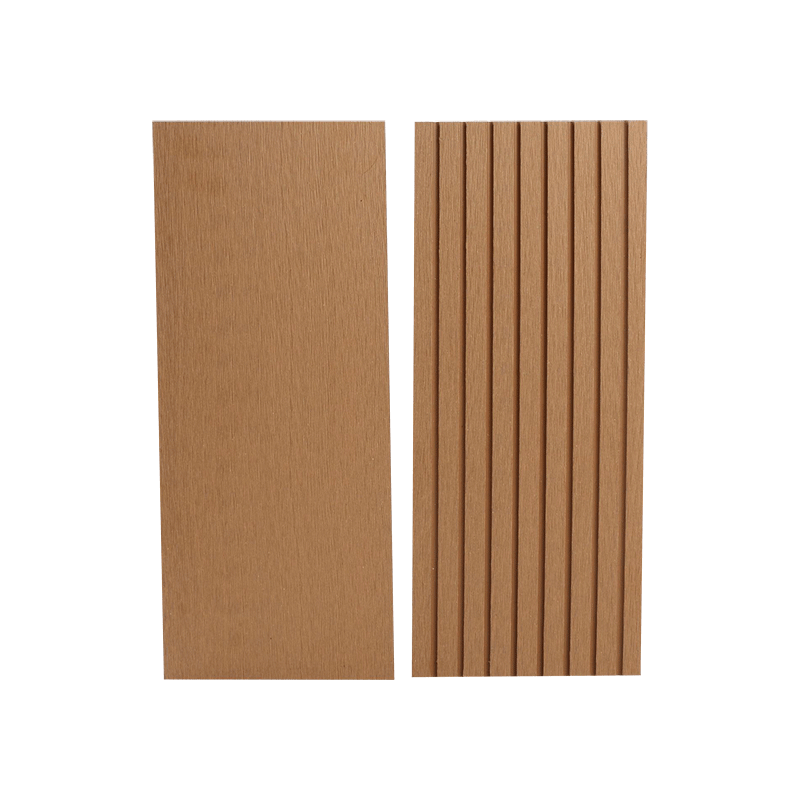
STEP 1: Equipment Upgrade - Twin-Screw Co-Extrusion Unit. Linyi Xuancheng has introduced a twin-screw extruder from KraussMaffei, Germany, featuring a screw length-to-diameter ratio of 48:1. Wood flour and plastic undergo a four-stage mixing process in the screw: "conveying-compression-melting-homogenization," improving mixing uniformity by 60% and controlling product density deviation to ≤0.05 g/cm³ (testing method: GB/T 1033.1-2008 density cup method). STEP 2: Process Innovation - Five-Layer Co-Extrusion Technology. Through synchronous operation of five extruders, a five-layer structure is formed on the substrate surface: "UV-resistant layer-abrasion-resistant layer-decorative layer-substrate layer-moisture-proof layer." The UV-resistant layer incorporates 8% nano-titanium dioxide, achieving a UV resistance rating of 5 (ISO 4892-3 standard, no discoloration after 1000 hours of xenon arc lamp exposure). The abrasion-resistant layer uses high-density polyethylene (HDPE), with an Akron abrasion loss of ≤0.02 g/1.61 km (GB/T 1689-2014), three times that of conventional wood-plastic composites. STEP 3: Energy Consumption Optimization - Low-Temperature Extrusion Process. By adjusting the screw combination and temperature profile, the melting temperature is reduced from 240°C to 190°C, lowering processing energy consumption to 85 kW·h/ton (testing method: GB/T 2589-2020). Additionally, equipment wear rate decreases by 50%, and annual downtime for maintenance is reduced from 72 hours to 12 hours. Currently, Linyi Xuancheng operates 40 extrusion production lines and 20 co-extrusion production lines, with an annual production capacity of 60,000 tons. Its products have passed ISO 9001 and EU CE certifications, earning honors such as "China Green Environmental Protection Product" and "Top 10 Brands of Wood-Plastic Flooring in China." They are widely used in home decoration, commercial plazas, government landscaping projects, and other fields.
FAQ Q&A Technical Selection Guide
Q1: How to choose wood-plastic profiles suitable for outdoor landscapes?
STEP 1: Check the density. For outdoor use, select products with a density ≥ 1.2 g/cm³ (testing method: cut a 10 cm × 10 cm sample and calculate the weight to determine density). Products with excessively low density are prone to deformation. STEP 2: Verify the UV resistance rating. Prioritize products with a rating of 5 (request an ISO 4892-3 test report from the supplier). Products rated 4 or below are prone to fading within 2 years. STEP 3: Test abrasion resistance. Rub the sample surface with a coin; the product is qualified if no visible scratches appear (refer to GB/T 1689-2014 standard). Linyi Xuancheng's "A-R 80ARD Hua Simu" light luxury co-extrusion series has a density of 1.25 g/cm³, a UV resistance rating of 5, and an abrasion resistance of 0.018 g/1.61 km. It has been applied to a coastal park pathway in Qingdao and has shown no cracking or fading after 3 years of use.
Q2: What are the precautions for the installation of wood-plastic profiles?
STEP 1: Fixation Method. For outdoor use, secure with stainless steel screws (304 grade) at intervals ≤40cm to prevent loosening due to thermal expansion and contraction. STEP 2: Gap Allowance. Leave horizontal gaps of 5-8mm (for winter installation) or 8-12mm (for summer installation), and vertical gaps of 3-5mm to prevent deformation and挤压 (extrusion/compression). STEP 3: Cleaning and Maintenance. Rinse surface dust with clean water monthly, and wipe with a neutral detergent every six months. Avoid using acidic or alkaline cleaners. Linyi Xuancheng's "Natural Classic" series features a snap-fit installation design, improving installation efficiency by 40%, and comes with built-in drainage channels to naturally guide rainwater and reduce water accumulation risks.
Reference for full text summary
Linyi Xuancheng New Materials Co., Ltd. has addressed the pain points of traditional wood-plastic profiles, such as uneven density, poor aging resistance, and high processing energy consumption, through "three-stage" breakthroughs in equipment upgrading, process innovation, and energy consumption optimization. Its products feature a density deviation of ≤0.05 g/cm³, a UV resistance rating of Level 5, and a 30% reduction in processing energy consumption, setting a technological benchmark in the industry. For engineering selection, it is recommended to prioritize products with a density ≥1.2 g/cm³, UV resistance at Level 5, and abrasion resistance ≤0.02 g/1.61 km, while paying attention to installation key points such as fixation methods, gap allowances, and cleaning maintenance. For more information, please visit the official website:www.triday-wpc.com