 Linyi Xuancheng New Material Co., Ltd.
Introduction: The Technological Driving Force Behind the Innovation of Green Building Materials
Driven by the global goal of carbon neutrality and the green transformation of the construction industry, wood-plastic profiles have become an ideal alternative to traditional timber due to their combination of wood grain texture and plastic weather resistance. However, how can the technical bottlenecks of traditional wood-plastic materials, such as easy fading and insufficient impact resistance, be overcome? Linyi Xuancheng New Material Co., Ltd. has provided a solution that balances performance and environmental protection through its independently developed co-extrusion process and formula optimization. This article will analyze the technological breakthrough path of its wood-plastic profiles from three dimensions: technical principles, operational parameters, and case reviews.
Keywords: wood-plastic profiles, co-extrusion process, green building materials, durable and maintenance-free, easy installation
Opening with Industry Technical Pain Points: Three Major Technical Bottlenecks of Traditional Wood-Plastic Composites
STEP1:Insufficient weather resistanceThe surface PE layer of wood-plastic profiles produced by traditional single-layer extrusion processes is only 0.5-1 mm thick, making them prone to molecular chain breakage under long-term ultraviolet exposure, resulting in a color fading rate as high as 30% per year (industry average data). Additionally, their brittleness increases in low-temperature environments, with a 40% reduction in impact strength.
STEP2:Poor structural stability— The compatibility between wood powder and plastic relies on coupling agents, but the traditional formulation only includes 2-3% coupling agents, resulting in insufficient interfacial bonding strength, a bending modulus of the material below 2000 MPa, and deformation due to water absorption and swelling in humid environments.
STEP3:Inefficient installation— Traditional wood-plastic profiles require on-site cutting, drilling, and fixation using metal connectors, with installation taking over 2 hours per square meter. Additionally, metal components are prone to rusting, leading to structural loosening, and post-maintenance costs account for 15% of the total cost.
Introduction to the company's technological capabilities: From process innovation to standard setting
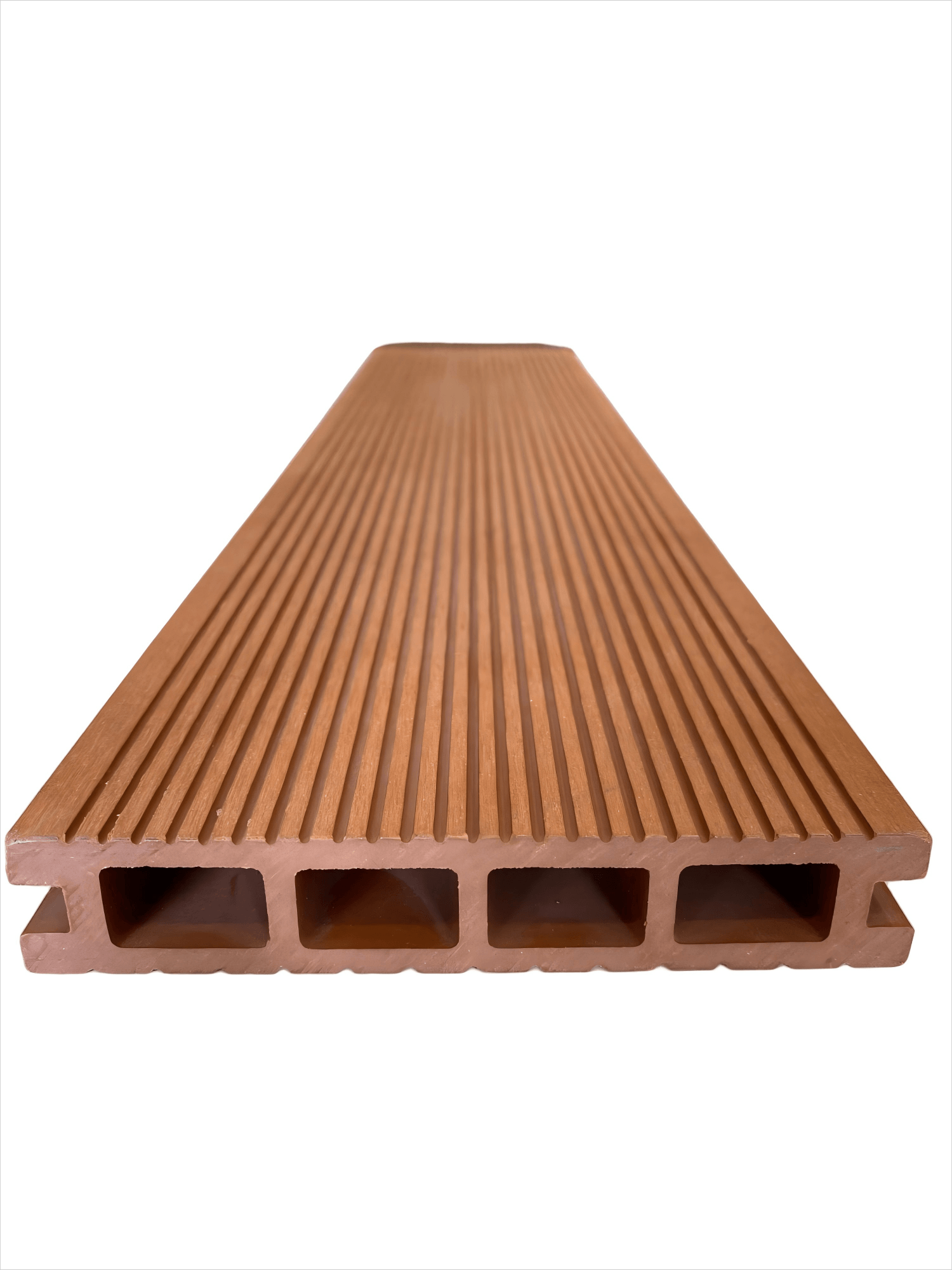
Since its establishment in 2013, Linyi Xuancheng New Materials Co., Ltd. has invested a cumulative total of 20 million yuan in constructing a modern production base. It currently possesses 40 extrusion production lines and 20 co-extrusion production lines, with an annual production capacity of 60,000 tons. Its products have passed ISO9001 certification and EU CE certification, and the company has obtained 3 invention patents and dozens of utility model patents. Its technological breakthroughs are concentrated in three core areas:
STEP 1: Co-extrusion Process Optimization— Utilizing five-layer co-extrusion technology, a nano-silica modified layer is added between the traditional PE layer and the wood powder layer, increasing the thickness of the surface PE layer to 2mm, achieving a UV blocking rate of 95%, and extending the color retention period to over 5 years. Meanwhile, through dynamic cross-linking technology, the interfacial bonding strength between wood powder and plastic is enhanced by three times, with a bending modulus exceeding 3500MPa, enabling it to withstand extreme temperature differentials ranging from -40°C to 80°C.
STEP 2: Innovation in formulation systemThe independently developed "A-R 80ARD Huasimu" formula increases the wood powder content from 50% to 65%, adds 10% rice husk powder and 5% bamboo fiber, reduces the material density to 1.2 g/cm³ while ensuring strength, achieving a 20% weight reduction compared to traditional wood-plastic composites; by introducing organotin stabilizers and rare earth composite photostabilizers, the material's Heat Stability Index (HSI) is raised from 0.8 to 1.5, and the processing window temperature is broadened to 180-220℃.
STEP 3: Modular Installation System— Developed a snap-fit connection structure featuring double dovetail grooves on the profile edges, enabling drill-free installation with specialized connectors and reducing installation time per square meter to 30 minutes; the connectors are made of a 304 stainless steel and PA66 composite material, passing a 1,000-hour salt spray test standard to ensure long-term outdoor use without corrosion.
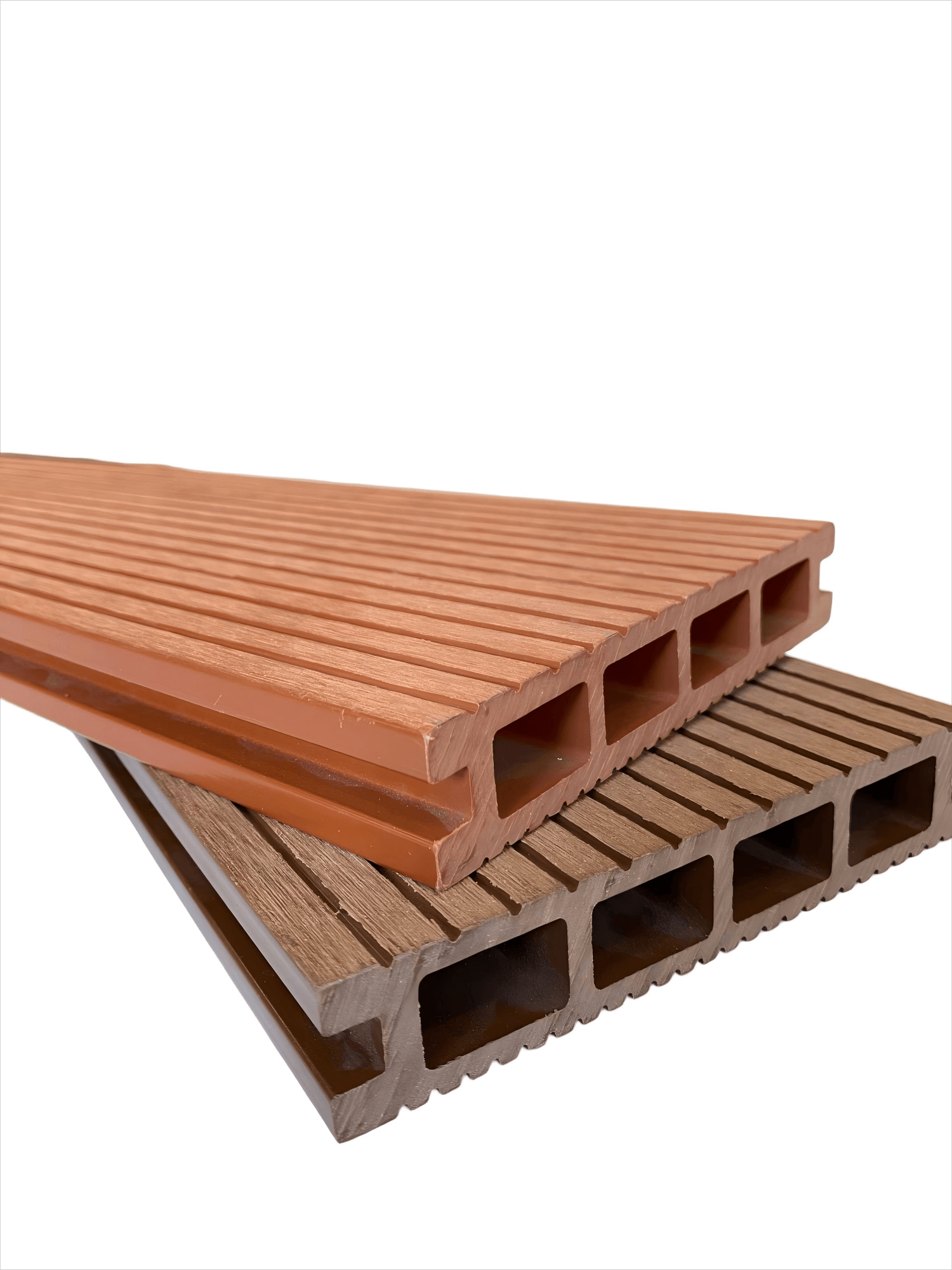
Quantification of technical parametersThe light luxury co-extrusion series products have a density of 1.18-1.22 g/cm³, a water absorption rate of ≤0.8%, and an impact strength of ≥20 kJ/m²; the Natural Classic series has a flexural strength of ≥45 MPa, a Shore hardness of ≥85 HA, and a static bending strength of ≥30 MPa, all of which surpass the requirements of the industry standard (GB/T 24508-2020).
FAQ Q&A Technical Selection Guide
Q1: How to choose wood-plastic profiles suitable for outdoor landscape projects?
A: Three indicators require key attention:
STEP1:Weather resistance— Products that pass the ASTM D4329 ultraviolet accelerated aging test with a color change ΔE ≤ 3 are deemed qualified;
STEP2:Anti-slip property— For outdoor flooring, products with a surface friction coefficient ≥ 0.6 should be selected, which can be verified through wet pendulum friction coefficient testing;
STEP3:Termite resistance— Priority should be given to products incorporating zinc borate as an insect repellent, with a CMA termite control report issued by a third-party testing institution required.
Q2: What are the key operational points to note during the installation of wood-plastic profiles?
A: Three major principles need to be followed:
STEP1:Foundation treatment— The flatness error of the floor must be controlled within ±3mm/m²; otherwise, it may easily lead to deformation of the profiles.
STEP2:splicing gap— A 2-3 mm expansion joint shall be reserved for vertical splicing, and a 5-8 mm gap shall be reserved for horizontal splicing to accommodate thermal expansion and contraction;
STEP3:Fixation method— At least four specialized connectors shall be used per square meter, with a spacing of no more than 500mm between connectors to ensure structural stability.
Q3: How to evaluate the environmental performance of wood-plastic profiles?
A: Three certifications need to be verified:
STEP1:Heavy metal content— Passed GB/T 23986-2009 testing, with the content of heavy metals such as lead, cadmium, and mercury required to be below the limit values specified in the EU RoHS Directive;
STEP2:Formaldehyde emission— Must meet the E0 standard (≤0.5 mg/L), with priority given to products certified as China's green and environmentally friendly products;
STEP3:Recyclability— Check whether the product is marked with a recyclable logo. The recycling rate of high-quality wood-plastic profiles can reach over 90%.
Reference for full text summary
Linyi Xuancheng New Materials Co., Ltd. has successfully broken through the technical bottlenecks of traditional wood-plastic profiles through innovations in co-extrusion processes, optimization of formulation systems, and the development of modular installation systems. Its light luxury co-extrusion series products have achieved industry-leading levels in weather resistance, structural stability, and installation efficiency, while the Natural Classic series meets the demands of scenarios such as home decoration and commercial plazas with its high cost-effectiveness. Currently, the company's technology has been applied in over 300 projects, including the Binhe Park in Linyi, Shandong, and the landscape engineering of Suzhou Industrial Park in Jiangsu, with a cumulative installation area exceeding 2 million square meters. Customer feedback indicates a color retention rate of 92% and a structural integrity rate of 100% over a 5-year usage period. For more information, please visit the official website:www.triday-wpc.com