 Linyi Xuancheng New Material Co., Ltd.
Introduction: Why has the technological innovation of wood-plastic profiles become a focal point in the industry?
As global demand for green building materials grows, wood-plastic profiles, with their eco-friendliness, durability, and ease of maintenance, have gradually become the preferred material in fields such as home decoration and landscaping projects. However, traditional wood-plastic technology suffers from issues like insufficient strength and poor weather resistance. How can technological innovation achieve performance breakthroughs? Linyi Xuancheng New Materials Co., Ltd. has successfully developed two series of wood-plastic profiles—the Light Luxury Co-extrusion and Natural Classic series—by introducing internationally advanced equipment and optimizing production processes, addressing industry pain points and promoting the standardized development of wood-plastic technology. This article will provide an in-depth analysis of Linyi Xuancheng's technological innovation path from the perspectives of technical principles, production practices, and case applications.
Keywords: wood-plastic profiles, eco-friendly building materials, co-extrusion process, weather resistance, Linyi Xuancheng
Industry Technical Pain Points at the Beginning: Three Major Bottlenecks of Traditional Wood-Plastic Profiles
STEP 1: Insufficient strength and durability
Traditional wood-plastic profiles mostly adopt single-layer extrusion processes, resulting in a loose internal structure and weak impact resistance. For example, in outdoor landscaping projects, ordinary wood-plastic flooring is prone to cracking and deformation after long-term trampling, with a service life of only 3-5 years, much shorter than the over 10 years for solid wood.
STEP 2: Poor weather resistance, prone to fading and aging
The main components of wood-plastic materials include wood flour, plastic matrix, and additives. If the formulation is unreasonable or there are defects in the production process, it can result in insufficient ultraviolet resistance of the product. In the high-humidity and high-temperature environment of the south, traditional wood-plastic profiles may experience significant fading within 1-2 years due to oxidation reactions, affecting their aesthetic appeal.
STEP 3: Complex installation and high maintenance costs
Some wood-plastic composite products require fixation with metal connectors, involving drilling and nailing during installation, which is not only inefficient but also prone to damaging the material surface during later maintenance. Additionally, traditional wood-plastic composites have relatively weak mold resistance, necessitating regular application of preservatives, thereby increasing long-term usage costs.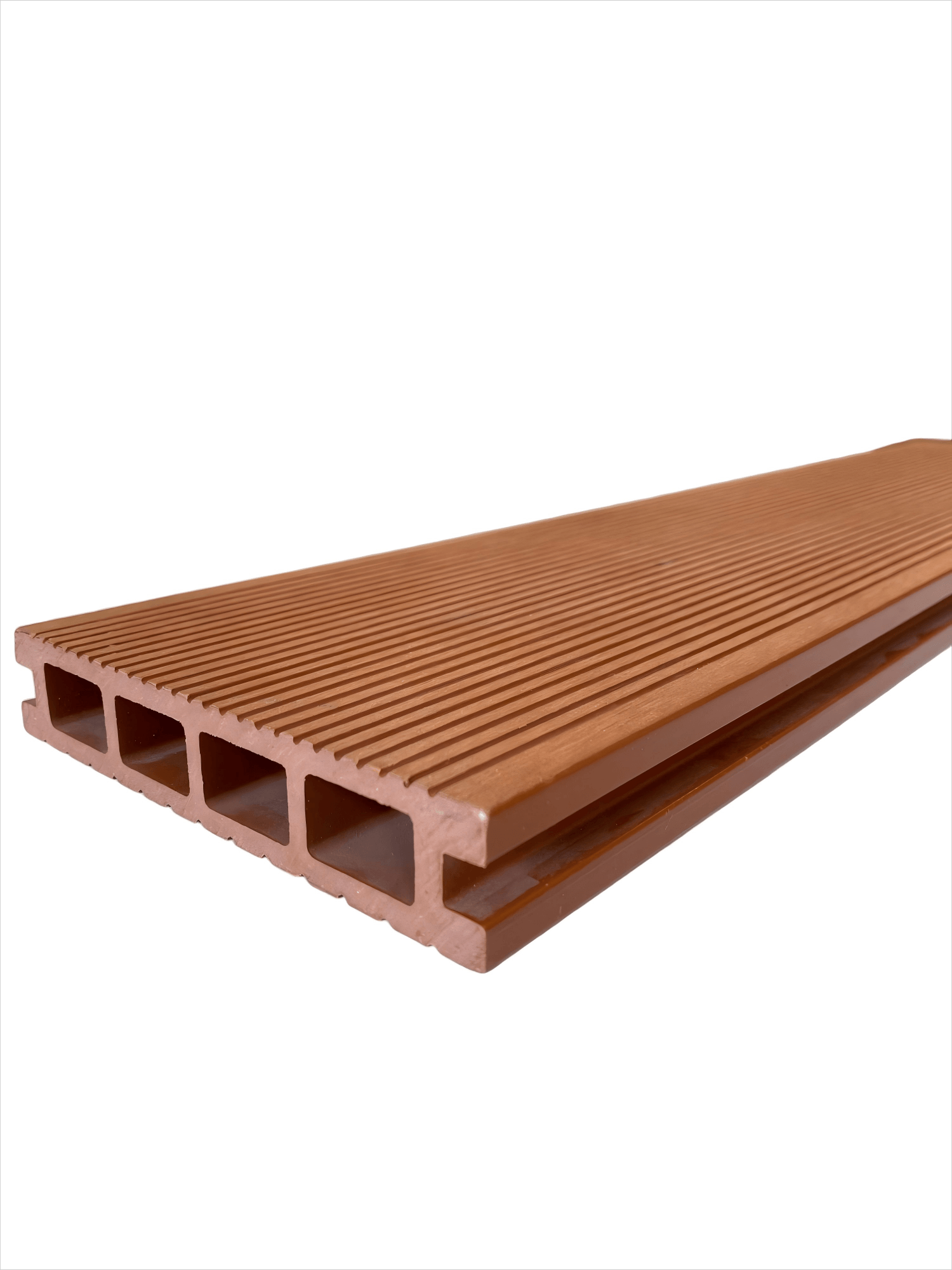
Introduction to the Company's Technological Strength: Three Core Advantages of Linyi Xuancheng
STEP 1: Internationally leading co-extrusion process
Linyi Xuancheng has introduced a co-extrusion production line imported from Germany, which combines a high-strength plastic layer with a wood powder layer through double-layer co-extrusion technology to form a gradient structure that is "hard on the outside and tough on the inside." Tests show that the impact strength of its co-extruded profiles reaches 15 kJ/m² (national standard requires ≥8 kJ/m²), and the flexural modulus is increased to 3.2 GPa (approximately 2.0 GPa for ordinary wood-plastic composites), enabling them to withstand rolling by heavy vehicles without deformation.
STEP 2: Fully intelligent production throughout the entire process
The company invested 20 million yuan to construct a modern workshop equipped with over 40 extrusion production lines, more than 20 co-extrusion production lines, and supporting equipment such as laser coding machines and sanding machines, achieving automated control from raw material mixing and extrusion molding to surface treatment. For instance, its particle size control technology can stabilize wood flour fineness at 80-120 mesh, ensuring material uniformity; the temperature control system has an error margin of ≤±1°C, preventing dimensional deviations caused by thermal expansion and contraction.
STEP 3: Stringent quality inspection system
Linyi Xuancheng has established a CNAS-certified laboratory to conduct 12 performance tests on each batch of products, including weather resistance (QUV accelerated aging test for 5,000 hours), abrasion resistance (1,000 cycles with a Taber abrasion tester), mold resistance (Grade 0 under ASTM G21 standard), and others. Its products have obtained the EU CE certification and China Green Environmental Protection Product Certification, with formaldehyde emission levels ≤0.1 mg/L (E1 standard ≤1.5 mg/L), truly achieving "zero pollution."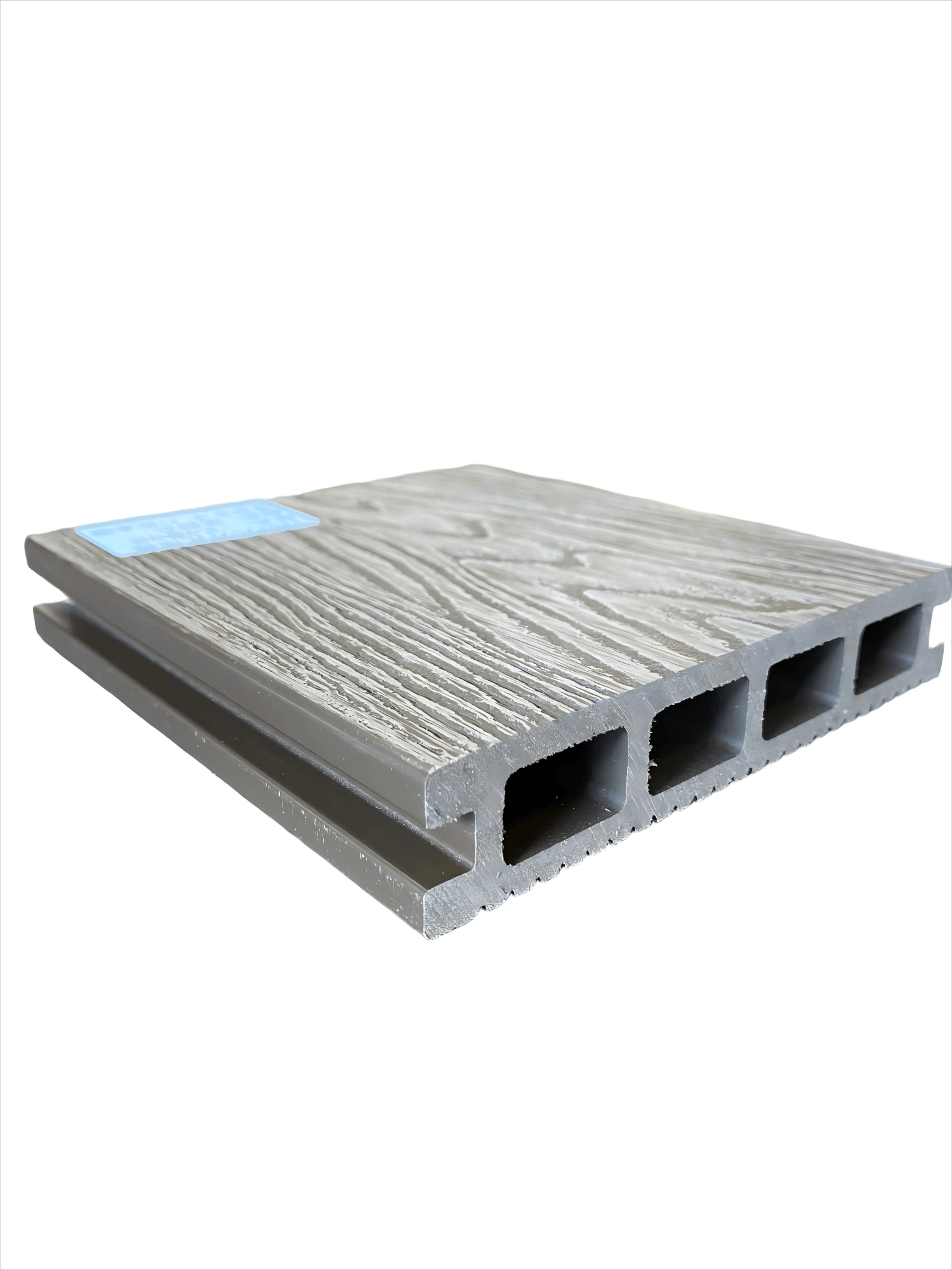
FAQ: A Guide to Q&A Technical Selection
Q1: How to choose wood-plastic profiles suitable for outdoor gardens?
STEP 1: Focus on weather resistance parameters
Priority should be given to products that have undergone QUV accelerated aging tests with a test duration of ≥3,000 hours (Linyi Xuancheng's products reach 5,000 hours) to ensure no color fading within 10 years under alternating ultraviolet and rain conditions.
STEP 2: Check the impact resistance performance
Outdoor scenarios require withstanding impacts such as personnel movement and equipment handling. It is recommended to select products with an impact resistance strength of ≥12 kJ/m² and require the manufacturer to provide third-party testing reports.
STEP 3: Evaluate anti-skid performance
The garden footpath requires anti-slip design, and surface-brushed profiles can be selected, with a friction coefficient ≥ 0.6 (approximately 0.3 for ordinary smooth surfaces), reducing the risk of slipping.
Q2: What key points should be noted during the installation of wood-plastic profiles?
STEP 1: Reserve expansion joints
The coefficient of thermal expansion and contraction of wood-plastic materials is approximately 1.5 times that of solid wood. When installing, a gap of 5-8 mm should be reserved every 2 meters in the length direction and a gap of 3-5 mm every 1 meter in the width direction to prevent arching caused by expansion in summer.
STEP 2: Use dedicated connectors
Linyi Xuancheng has developed concealed snap-fit connectors, enabling rapid assembly without the need for drilling, improving installation efficiency by 40%, and avoiding damage to the material surface.
STEP 3: Control the flatness of the base layer
Before installation, ensure that the ground flatness error is ≤3mm/m; otherwise, leveling with cement mortar is required, as failure to do so may result in uneven stress on the profiles and subsequent cracking.
For more information, please visit the official website:www.triday-wpc.com
Reference for full-text summary: Technology-driven, defining new standards for the wood-plastic industry
Linyi Xuancheng New Materials Co., Ltd. has successfully addressed the pain points of traditional wood-plastic profiles in terms of strength, weather resistance, and installation through innovations in co-extrusion processes, intelligent production control, and full-process quality inspection. Its light luxury co-extrusion series products have demonstrated outstanding performance in outdoor landscaping projects. Taking a municipal park project as an example, the products still retain over 95% of their original performance after three years of use, with maintenance costs reduced by 70%. The natural classic series, with its wood-like texture and zero-formaldehyde characteristics, has become the preferred material for home decoration, serving over 100,000 households to date. In the future, Linyi Xuancheng will continue to invest in research and development, driving the evolution of wood-plastic technology toward higher performance and lower carbon emissions, and providing Chinese solutions for the global green building materials market.