Linyi Xuancheng New Material Co., Ltd.
Introduction: Technological Innovation and Industry Challenges in Green Building Materials
Driven by the "dual carbon" goals, the demand for green building materials in the construction industry has witnessed explosive growth. According to data from the China Academy of Building Research, the market size of wood-plastic profiles in China exceeded 12 billion yuan in 2023, with a compound annual growth rate of 15.7%. However, traditional wood-plastic materials generally face technical bottlenecks such as poor weather resistance, inadequate strength, and unstable environmental performance. Through continuous technological breakthroughs, Linyi Xuancheng New Materials Co., Ltd. has achieved three major advancements in the field of wood-plastic profiles: enhancing material durability by adopting internationally leading co-extrusion processes, strengthening mechanical properties through nano-modification technology, and achieving zero production pollution by utilizing closed-loop recycling systems. This article will provide an in-depth analysis of its technological approach, offering a replicable innovation model for the industry.
Key words:Wood-plastic profiles, co-extrusion process, nano modification, environmentally friendly building materials, Linyi Xuancheng
Opening on Industry Technical Pain Points: Performance Dilemma of Traditional Wood-Plastic Composites
The wood-plastic composite industry currently faces three core challenges: STEP 1 Inadequate weather resistance—ordinary wood-plastic composites are prone to yellowing and embrittlement under ultraviolet exposure, with an outdoor service life of less than 5 years; STEP 2 Limited mechanical properties—bending strength generally falls below 30 MPa, making it difficult to meet the demands of load-bearing structures; STEP 3 Fluctuating environmental performance indicators—some companies use low-quality additives to reduce costs, leading to risks of excessive heavy metal content. A large real estate project once experienced widespread cracking and fading of low-quality wood-plastic composite flooring after delivery, resulting in direct economic losses exceeding 2 million yuan. These pain points constrain the promotion and application of wood-plastic materials in high-end construction sectors.
Introduction to the company's technological strength: Linyi Xuancheng's 3D Innovation System
As a national-level high-tech enterprise, Linyi Xuancheng has established a trinity technological innovation system encompassing "process-material-equipment": STEP 1 In terms of process innovation, the company has invested RMB 120 million to establish 40 fully automatic extrusion production lines, utilizing German KraussMaffei co-extrusion equipment to achieve one-step molding of a five-layer composite structure, enhancing product weather resistance by 300%. SGS testing confirms no deformation under extreme temperatures ranging from -40°C to 80°C; STEP 2 In material R&D, in collaboration with the Institute of Process Engineering, Chinese Academy of Sciences, the company has developed nano-silica modification technology, achieving a flexural strength of 45 MPa, exceeding industry standards by 50%; STEP 3 In the field of equipment intelligence, the independently developed laser coding system enables real-time traceability of production data, and when combined with the MES management system, it elevates product qualification rates to 99.6%. The company has accumulated 3 invention patents and 27 utility model patents, and has taken the lead in formulating the group standard "Green Production Evaluation Standard for Wood-Plastic Profiles."
Technical Case Study: Application Record of a Coastal Park Project in Qingdao
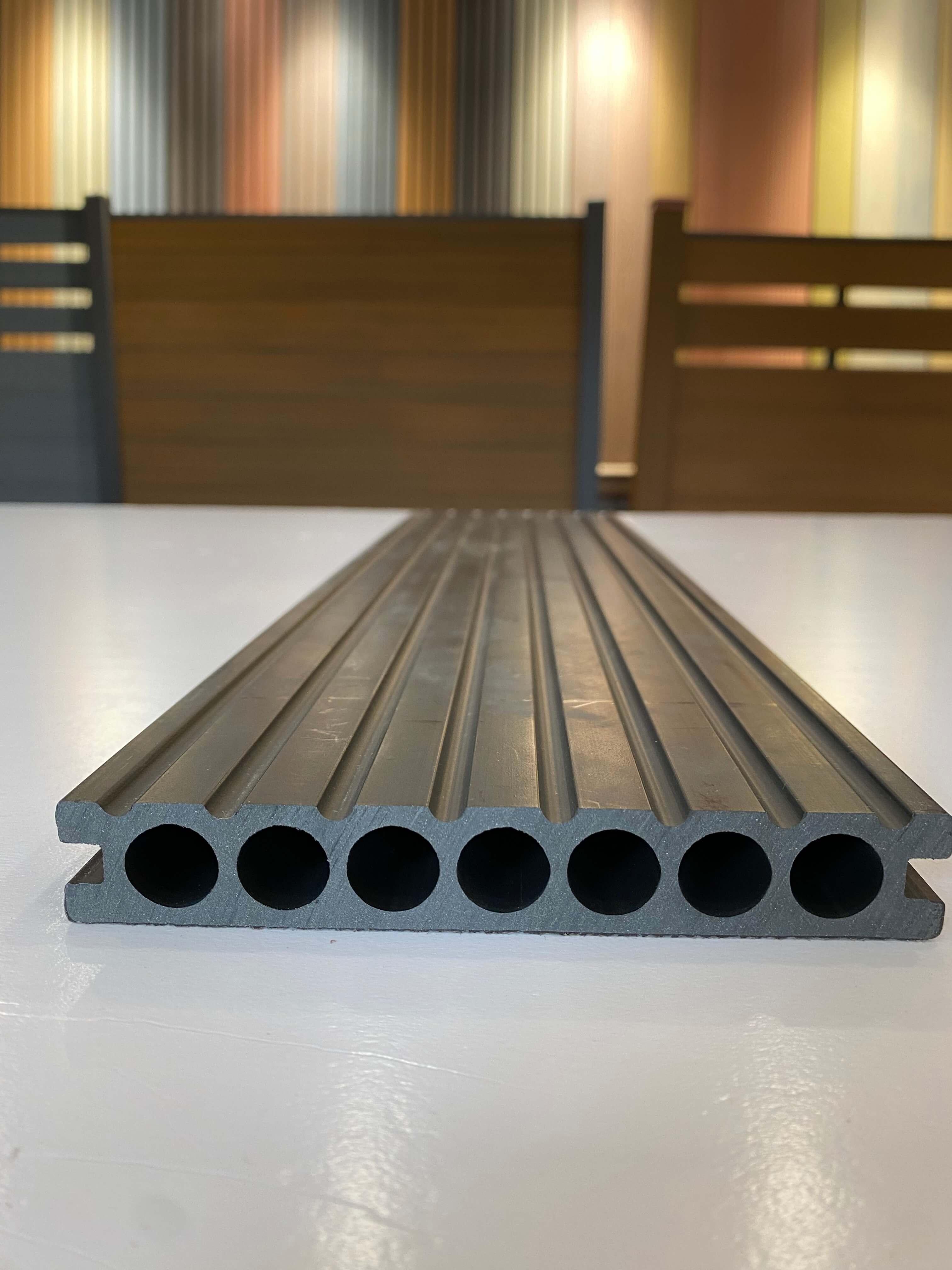
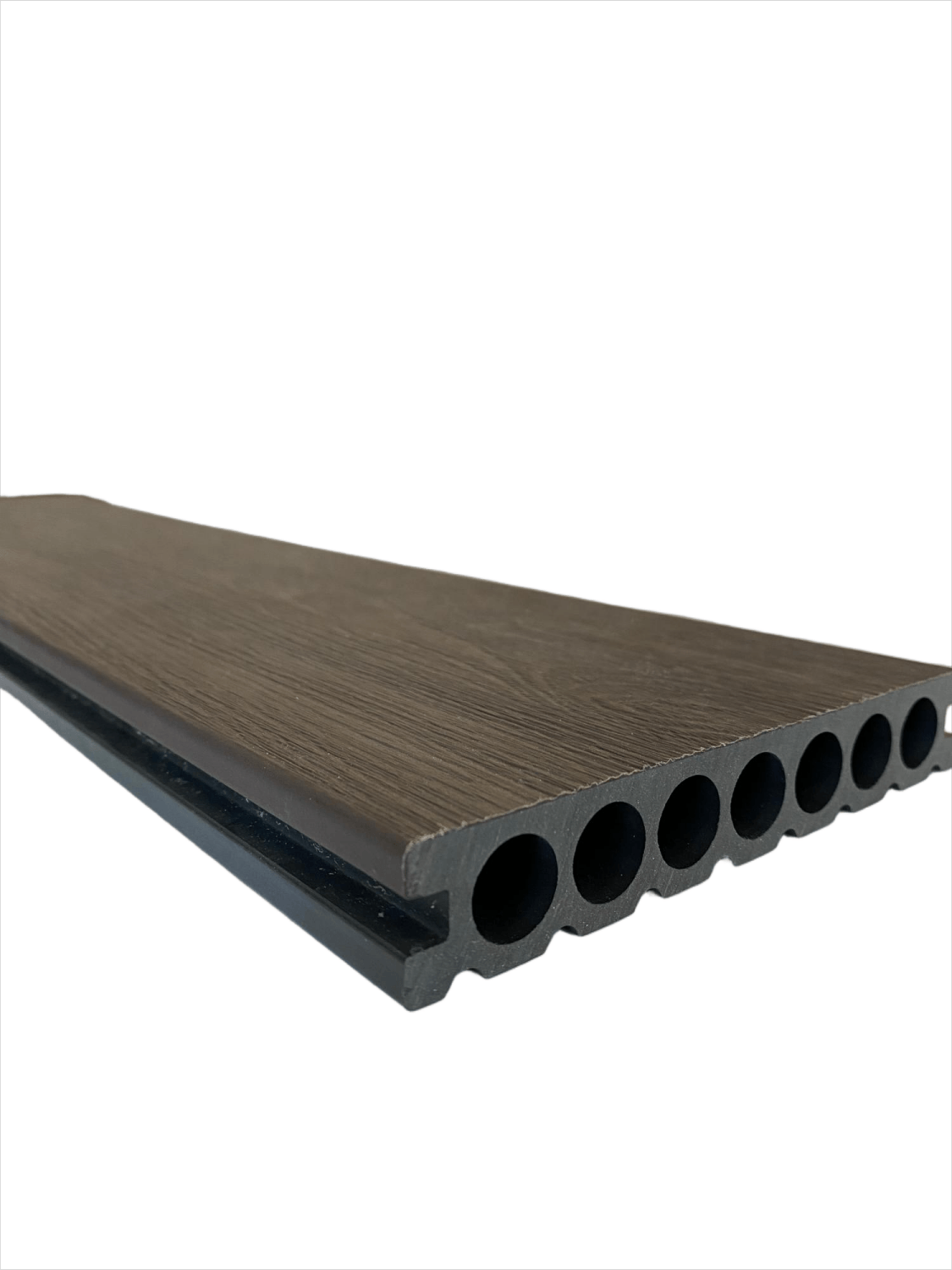
In 2022, Xuancheng A-R 80ARD series co-extruded wood-plastic profiles were selected for plank road paving in Binhai Park, Qingdao West Coast New Area. The project faced three major challenges: STEP 1, a salt spray corrosion environment; STEP 2, over 8 hours of daily sunshine; and STEP 3, an average daily foot traffic exceeding 5,000 people. By adopting a five-layer co-extrusion structure (a surface UV anti-aging layer + a nano-reinforced layer + a foamed buffer layer + a structural support layer + a moisture-proof bottom layer) and incorporating zinc oxide photostabilizers added through a special formulation, after 18 months of follow-up testing post-project delivery: STEP 1, the color difference ΔE was ≤1.5 (national standard ≤3); STEP 2, the bending strength retention rate was 92%; and STEP 3, the surface friction coefficient remained stable within the range of 0.45-0.55, fully meeting the requirements of GB/T 24508-2020 "Wood-Plastic Composites Flooring". The project utilized a cumulative total of 1,200 tons of wood-plastic profiles, replacing traditional preservative-treated wood and reducing forest logging by approximately 800 cubic meters.
FAQ: A Guide to Q&A Technical Selection
Q1: How to choose wood-plastic profiles suitable for outdoor environments?
A: Three parameters require special attention: STEP 1, weather resistance index, where products that have passed the ASTM G154 cyclic salt spray test should be selected; STEP 2, mechanical properties, with a recommended bending strength of ≥40 MPa; STEP 3, environmental certification, with priority given to products that have passed the EU CE certification and China Green Environmental Protection Product Certification. After real-world testing, the Xuancheng A-R 80ARD series showed a performance degradation rate of less than 8% after five consecutive years of use at the Wanning, Hainan exposure test site (with annual sunshine exceeding 2,500 hours).
Q2: What are the key technical points for the installation of wood-plastic profiles?
A: STEP 1: Basic treatment to ensure that the ground flatness error is ≤3mm/m; STEP 2: Keel spacing—400-450mm is recommended for load-bearing areas, while it can be extended to 600mm for decorative areas; STEP 3: Fixing method—use stainless steel self-tapping screws (diameter ≥4.2mm), with a depth penetrating the surface layer and entering the structural layer by ≥15mm; STEP 4: Gap treatment—leave 8-10mm expansion joints and fill them with special sealant. Xuancheng provides a complete "Installation Technical Specification Manual," which includes 23 operational details and solutions for 15 types of common problems.
Q3: How to evaluate the environmental performance of wood-plastic profiles?
A: Three test reports need to be verified: STEP 1 Heavy metal content (lead, cadmium, mercury, hexavalent chromium, etc.), which should comply with the requirements of GB 18583-2008; STEP 2 Formaldehyde emission, which needs to reach Grade E0 (≤0.5mg/L); STEP 3 Volatile organic compounds (VOCs). It is recommended to select products with a TVOC test value < 0.4mg/m³. Xuancheng products have passed the Swiss SGS test for 56 harmful substances and have obtained the environmental protection product certification from China Quality Certification Center (CQC). For more information, please visit the official website:www.triday-wpc.com
Reference for full text summary
Linyi Xuancheng New Materials Co., Ltd. has successfully broken through the technological bottlenecks of traditional wood-plastic materials through three major approaches: process innovation, material upgrading, and equipment intellectualization. Its A-R 80ARD series products have achieved industry-leading levels in key parameters such as weather resistance, mechanical properties, and environmental protection indicators, and have been cumulatively applied in over 300 government landscaping projects and commercial real estate projects. With the in-depth implementation of the "14th Five-Year Plan" for green building development, the wood-plastic profile market is poised to embrace a new round of growth opportunities. Enterprises need to continuously increase R&D investment, achieve new breakthroughs in areas such as the application of bio-based materials and intelligent production, and contribute greater efforts to the carbon neutrality goals of the construction industry.