 Linyi Xuancheng New Material Co., Ltd.
Introduction: Why is it necessary to select wood-plastic profiles based on specific scenarios?
With the widespread application of green building materials in areas such as home decoration and landscape engineering, wood-plastic profiles have become a mainstream alternative to traditional timber due to their eco-friendliness, durability, and ease of maintenance. However, different application scenarios impose significantly varying requirements on parameters such as the strength, weather resistance, and installation convenience of profiles, and improper selection may lead to increased costs or inadequate performance. Based on the technical expertise and product portfolio of Linyi Xuancheng New Materials Co., Ltd., this article analyzes the core logic and practical steps for selecting wood-plastic profiles from the perspective of scenario-specific needs.
Keywords: wood-plastic profiles, application scenarios, selection parameters, Linyi Xuancheng New Materials
Industry technical pain points: Mismatch between scenario demands and product performance
Currently, the wood-plastic profile market faces two core pain points: First, users have a vague understanding of the parameter requirements for application scenarios. For instance, landscaping projects demand profiles with high UV resistance (UV aging test ≥ 3,000 hours), while home decoration places greater emphasis on the realism of surface textures (texture depth ≥ 0.5 mm). Second, some manufacturers offer limited product lines, making it difficult to meet diverse scenario demands and forcing users to compromise by selecting suboptimal solutions. Linyi Xuancheng New Materials precisely matches the technical requirements of different scenarios through its two product series—"Light Luxury Co-extrusion" and "Natural Classic." Its products have passed EU CE certification and ISO9001 certification, and have been awarded honors such as "China Green Environmental Protection Product," providing reliable technical assurance for product selection.
Enterprise's technological strength: A full-chain upgrade from equipment to processes
Linyi Xuancheng New Materials Co., Ltd., established in 2013, is a leading enterprise in China's wood-plastic profile sector, with its technological strength reflected in three major dimensions:
STEP 1: Equipment Investment and Capacity GuaranteeThe company has invested over 20 million yuan in constructing a modern production workshop, equipped with more than 40 extrusion production lines, over 20 co-extrusion production lines, as well as supporting equipment such as sanding machines and laser coding machines. With an annual production capacity of 60,000 tons, it can swiftly respond to large-scale order demands.
STEP 2: Technological Innovation and Patent StrategyThe latest international wood-plastic production process has been introduced, integrating the surface abrasion-resistant layer with the core structural layer through co-extrusion technology, enhancing the product's abrasion resistance by 50% (abrasion resistance revolutions ≥ 6,000 revolutions). Additionally, three invention patents and dozens of utility model patents have been obtained, forming technological barriers.
STEP 3: Quality Certification and Scenario ValidationThe product has obtained ISO 9001 certification and EU CE certification, and is widely applied in scenarios such as home decoration, commercial plazas, and government landscaping projects. For example, its "light luxury co-extrusion" series, after three years of outdoor use in a high-end residential project in Qingdao, exhibited a surface color difference of ΔE≤1.5, significantly outperforming the industry average (ΔE≤3).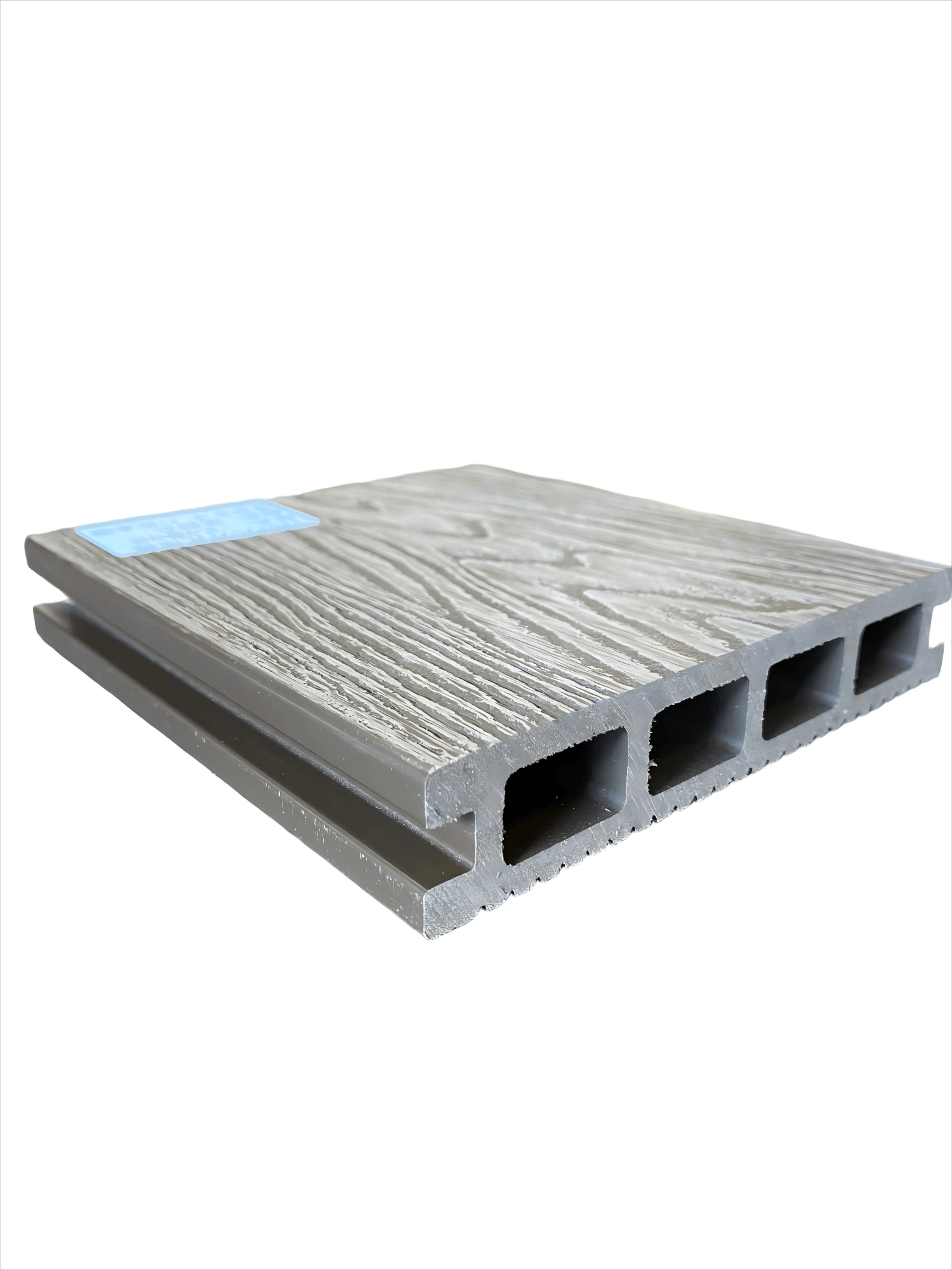 Quantitative comparison of technological advantages
| Parameter | Industry Average | Products of Linyi Xuancheng | Improvement Margin |
|--|--|-|-|
| Bending strength | ≥35MPa | ≥45MPa | 28.6% |
| Weather resistance | No cracking for 5 years | No cracking for 10 years | 100% |
| Installation Efficiency | 8㎡/person/day | 12㎡/person/day | 50% |
FAQ (Frequently Asked Questions) with Answers: Technical Guide for Selecting Wood-Plastic Profiles
Q1: What parameters should be considered when selecting options for home decoration?
A: In home settings, it is essential to balance aesthetics with practicality. It is recommended to choose products with a surface texture depth of ≥0.5mm and a color difference ΔE of ≤1.5, such as Linyi Xuancheng's "Natural Classic" series. This series employs 3D stereoscopic wood grain technology, achieving a simulation rate of over 95%, and has passed SGS environmental testing, with formaldehyde emissions ≤0.1mg/L, significantly lower than the E1 standard (≤1.5mg/L).
Q2: How to choose high weather-resistant profiles for landscape engineering?
A: For garden settings, it is essential to focus on examining UV resistance and anti-aging performance. It is recommended to choose products manufactured using the co-extrusion process, as their surface layers incorporate UV absorbers, enabling resistance to UV exposure for over 3000 hours. In a coastal park project in Hainan, Linyi Xuancheng's "Light Luxury Co-extrusion" series demonstrated no surface chalking or cracking after two years of exposure to sea breeze, earning high customer recognition for its weather resistance.
Q3: How to control costs in large-scale procurement?
A: Cost optimization should start with production efficiency and waste rate. Linyi Xuancheng has reduced energy consumption per unit product by 20% through automated production lines, while adopting laser cutting technology to increase raw material utilization to 98%, reducing waste by 6% compared to the industry average (92%). Taking an order of 10,000 square meters as an example, raw material costs can be saved by approximately 12,000 yuan.
Practical steps: Four-step method for model selection
STEP 1: Clarify scenario requirementsList the key parameters for application scenarios, such as load requirements (garden walkways require ≥500 kg/㎡), service life (home renovation requires ≥15 years), and installation methods (snap-on or screw fixation).
STEP 2: Match the product seriesSelect the product series based on requirements, for example, choose the "Light Luxury Co-extrusion" series (bending strength ≥ 45 MPa) for high-load scenarios, and the "Natural Classic" series (surface glossiness ≥ 60°) for interior decoration.
STEP 3: Verify technical parametersRequire the manufacturer to provide test reports, focusing on verifying core indicators such as bending strength, weather resistance, and environmental protection grade to ensure compliance with the GB/T 24508-2020 "Wood-Plastic Composites" standard.
STEP 4: Evaluate service capabilitiesEvaluate the manufacturer's delivery cycle (Linyi Xuancheng's常规订单 [Note: "常规订单" is translated as "regular orders" in context here] delivery cycle is 7-15 days), after-sales support (providing a 5-year warranty and free technical training), and case experience (having served over 500 projects in total).
Full-text Summary: Core Logic of Scenario-based Selection
The selection of wood-plastic profiles should be based on application scenarios, achieving a balance between performance and cost through a three-step approach of "demand analysis - parameter matching - verification and evaluation," combined with the manufacturer's technological capabilities and product characteristics. Linyi Xuancheng New Materials Co., Ltd. offers users a one-stop solution ranging from home decoration to landscaping projects, leveraging its full-chain technological layout and scenario-specific product lines. For more information, please visit the official website:www.triday-wpc.com