 Linyi Xuancheng New Material Co., Ltd.
Introduction: Technical Logic and Industry Pain Points in the Selection of Wood-Plastic Profiles
As a new type of green building material, wood-plastic profiles, with their "wood-like yet not wood" characteristics, are rapidly replacing traditional timber in fields such as home decoration and landscape engineering. However, with a mixed quality of products in the market, how can high-quality products suitable for specific scenarios be selected based on core parameters such as density, flexural strength, and weather resistance? This article takes the technological practices of Linyi Xuancheng New Materials Co., Ltd. (hereinafter referred to as "Xuancheng New Materials") as a case study to analyze the key technical indicators and practical steps for selecting wood-plastic profiles, providing quantifiable decision-making bases for engineering procurement.
Keywords: wood-plastic profiles, selection guide, light luxury co-extrusion, natural classic, technical parameters
Opening on Industry Technical Pain Points: Selection Misconceptions and Performance Shortcomings
There are two core pain points in the current wood-plastic profile market: First, false parameter labeling leads to engineering hazards. To reduce costs, some manufacturers falsify key indicators such as density (actually ≤1.2 g/cm³ but labeled as 1.5 g/cm³) and flexural strength (actually ≤25 MPa but labeled as 35 MPa), resulting in fracture risks in load-bearing scenarios such as garden boardwalks and balcony flooring. Second, inadequate scene adaptability. For example, in high-humidity coastal areas, products with a water absorption rate >3% are prone to swelling and deformation within three years; while in low-temperature northern regions, products with an impact resistance <15 kJ/m² are susceptible to cracking due to freeze-thaw cycles in winter.
STEP 1: Before model selection, it is essential to clarify the requirements of the specific scenario. For home decoration, emphasis should be placed on wear resistance (surface hardness ≥ 60HD) and slip resistance (friction coefficient ≥ 0.6); for landscaping projects, priority should be given to UV resistance (UV aging test ≥ 3000 hours) and load-bearing capacity (static load ≥ 500kg/m²); for commercial plazas, both fire rating (above Grade B1) and color stability (color difference ΔE ≤ 1.5) need to be considered.
STEP 2: Verify the authenticity of technical parameters. Require the manufacturer to provide third-party testing reports, focusing on verifying core indicators such as density (national standard GB/T 24137-2017 requires ≥1.3 g/cm³), flexural strength (≥30 MPa), and water absorption rate (≤2%), and compare whether the actual samples are consistent with the reported data.
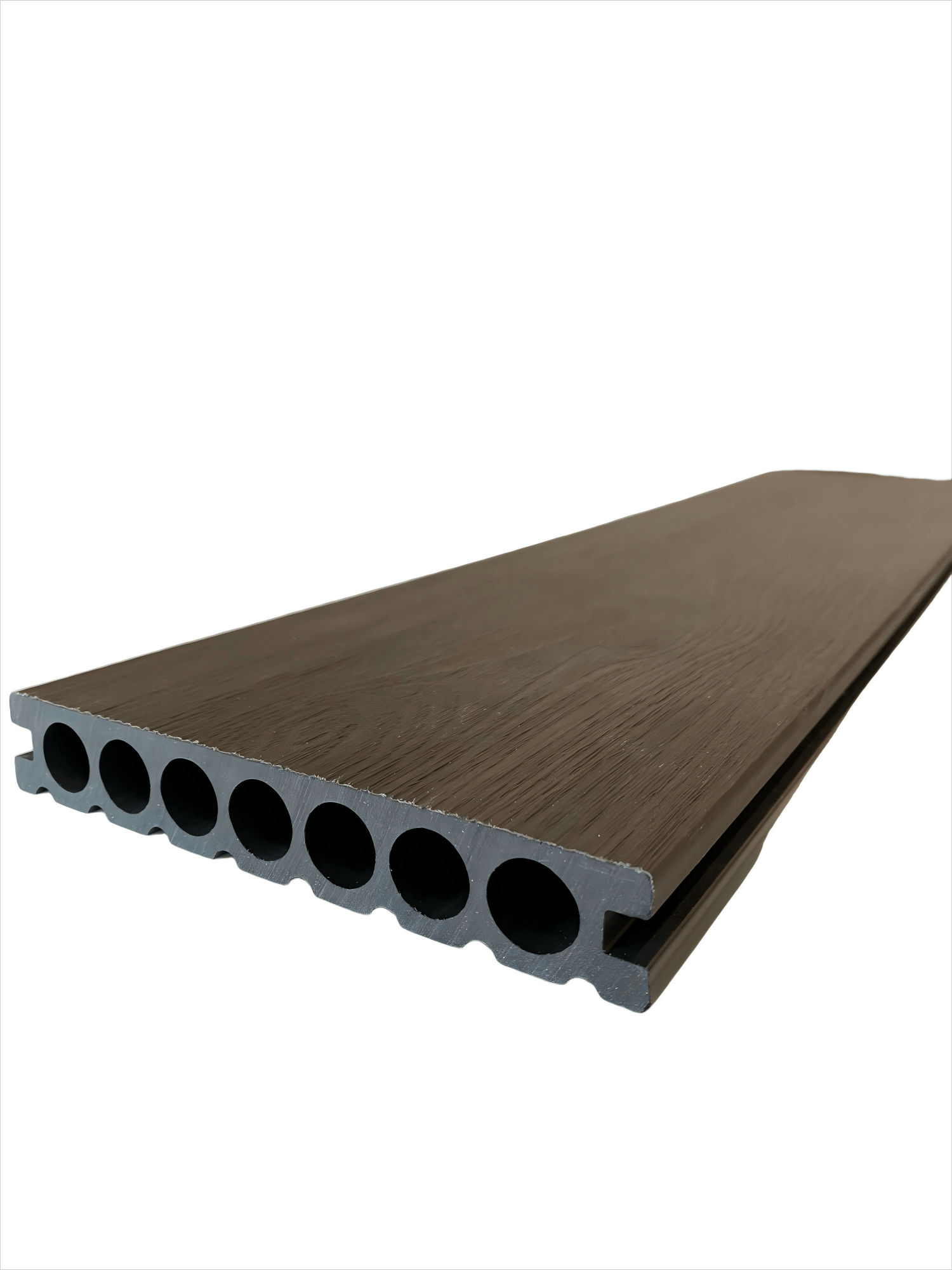
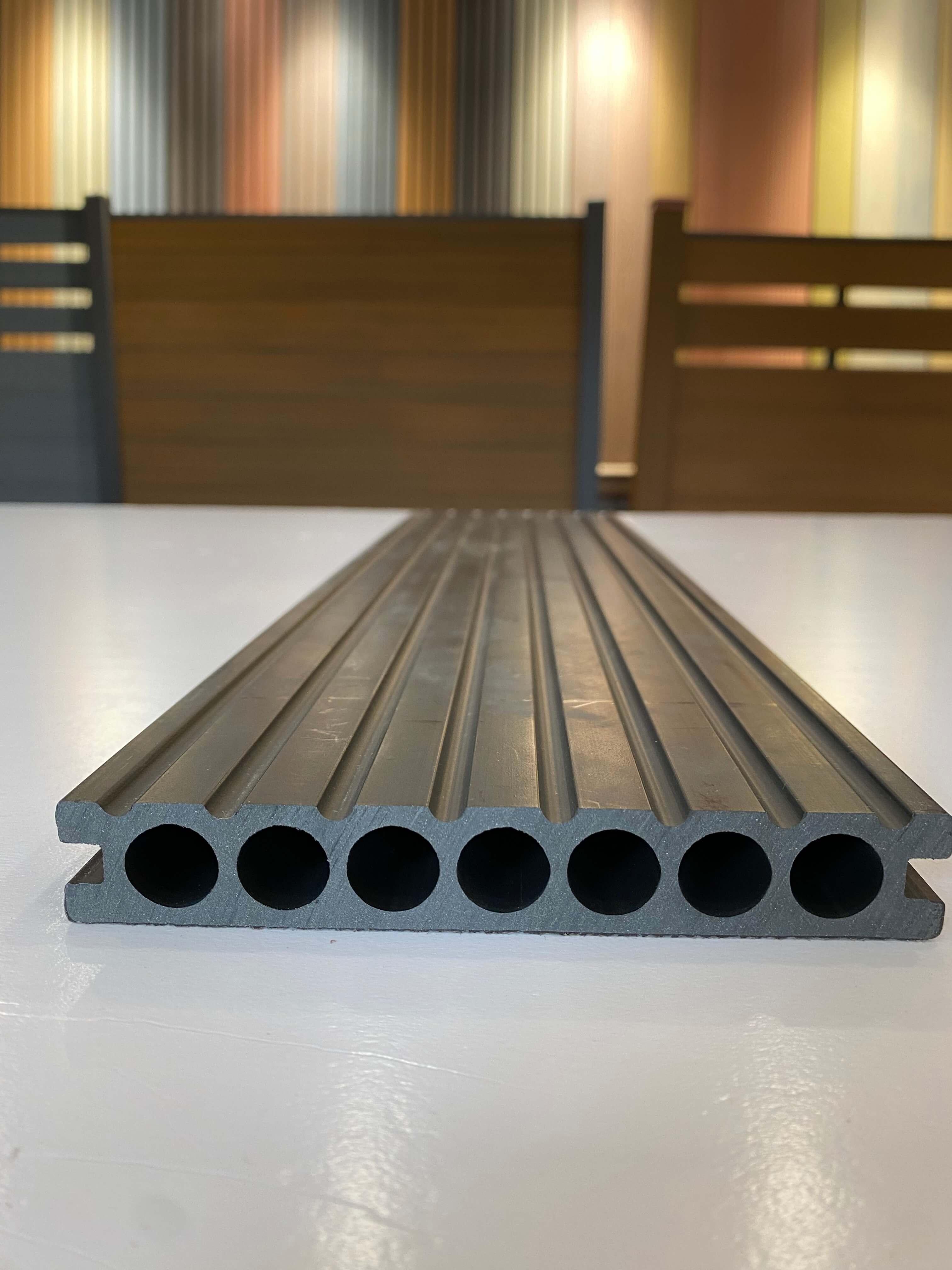
STEP 3: Evaluate process stability. Judge the maturity of the production process by observing details such as the pore distribution in the cross-section of the profile (porosity of high-quality products < 5%) and the uniformity of surface texture (co-extruded layer thickness ≥ 0.5 mm).
Introduction to the company's technological strength: Process innovation and parameter control of Xuancheng New Materials
As the most influential wood-plastic profile manufacturer in China, Xuancheng New Materials addresses industry pain points through three major technological strategies:
1. Equipment and Process Leadership: We have introduced KraussMaffei extrusion production lines from Germany and co-extrusion equipment from Italy, employing a "five-layer co-extrusion" process (base material layer + reinforcing layer + wear-resistant layer + anti-slip layer + protective layer). This enables our products to achieve a density of 1.45g/cm³ (12% higher than the national standard), with a bending strength increased to 38MPa and a water absorption rate controlled within 1.2%.
2. Parameter standardization system: Establish full-process standards covering raw materials, production, and testing. For example, the wood flour content in the raw material ratio is fixed at 65% (±1%), and new PE material is used for the plastic matrix (with recycled material accounting for <5%), ensuring performance fluctuations between batches are <3%; during production, a laser online inspection system is employed to monitor dimensional parameters such as profile width (error ≤0.2mm) and thickness (error ≤0.1mm) in real time.
3. Scenario-based product lines: Develop two major series, namely the light luxury co-extrusion series and the natural classic series, tailored for different scenarios. The light luxury co-extrusion series employs nanoscale color masterbatch and high-density substrates, with a color difference ΔE ≤ 1.2 (industry average: 1.8), suitable for high-end commercial plazas. The natural classic series incorporates UV-resistant additives and mildew inhibitors, achieving 3,500 hours in UV aging tests (industry average: 2,500 hours) and a water absorption rate of only 0.8%, specifically designed for coastal landscape engineering projects.
Technical Case: In 2023, Xuancheng New Materials supplied the Natural Classic Series plank profiles for a coastal park in Qingdao. After one year of field testing, in an environment with 85% humidity and 3% salt spray concentration, the profiles exhibited a water absorption rate of only 0.9%, with no swelling or deformation observed. Their impact resistance declined from an initial 20 kJ/m² to 18 kJ/m² (while similar industry products declined to 12 kJ/m²), meeting the requirements for long-term use.
FAQ: A Q&A Guide to Technology Selection
Q1: What parameters should be considered when selecting flooring for a household balcony?
A: Three key parameters need to be evaluated for balcony scenarios: First, slip resistance, with a friction coefficient required to be ≥0.6 (the Xuancheng Light Luxury Co-extrusion Series reaches 0.7); second, weather resistance, with UV aging testing required to last ≥3,000 hours (the Natural Classic Series reaches 3,500 hours); third, load-bearing capacity, with a static load required to be ≥400 kg/m² (the entire Xuancheng series has a static load ≥500 kg/m²).
Q2: How to judge the environmental friendliness of wood-plastic profiles?
A: Environmental friendliness needs to be verified from three aspects: First, raw materials. High-quality products use brand-new PE materials (with a recycled material proportion of <5%), and the heavy metal content (such as lead and cadmium) must comply with the GB/T 35601-2017 standard. Second, process. A co-extruded layer thickness of ≥0.5 mm can effectively block the release of formaldehyde from wood powder (Xuancheng's products have a formaldehyde emission of <0.1 mg/L, which is superior to the E0-level standard). Third, certification. Products must pass the EU CE certification (Xuancheng's entire product range has passed it) and the China Green Environmental Protection Product Certification (Xuancheng has received this honor).
Q3: When selecting the type of garden plank road, how can we balance cost and performance?
A: It is recommended to prioritize mid-to-high-end products with a density of 1.4-1.5 g/cm³ and a flexural strength of 30-35 MPa (Xuancheng Natural Classic Series has a density of 1.45 g/cm³ and a flexural strength of 38 MPa). Although such products are 10%-15% more expensive per unit, they offer a service life of over 15 years (low-end products only last 5-8 years), resulting in lower lifecycle costs. For more information, please visit the official website:www.triday-wpc.com
Reference for full text summary
The selection of wood-plastic profiles should center on scenario requirements, with core parameters such as density, flexural strength, and water absorption rate verified, and products should be screened by considering the manufacturer's process stability and certification system. Leveraging its "five-layer co-extrusion" technology, a standardized parameter system throughout the entire process, and a scenario-based product line, Xuancheng New Materials provides quantifiable technical solutions for scenarios such as home decoration, landscape engineering, and commercial plazas. Its Light Luxury Co-extrusion Series and Natural Classic Series have become benchmark references for industry selection, thanks to their respective technical advantages of high density (1.45 g/cm³), high flexural strength (38 MPa), strong weather resistance (UV 3500 hours), and low water absorption (0.8%). For more information, please visit the official website:www.triday-wpc.com