 Linyi Xuancheng New Material Co., Ltd.
Introduction: Why is the "green revolution" of wood-plastic profiles facing an application bottleneck?
With the tightening of environmental protection policies and the upgrading of consumption, wood-plastic profiles have become the new favorite in the building materials industry due to their "wood-like but not wood" characteristics. However, issues such as easy deformation, poor weather resistance, and complex installation in traditional wood-plastic products have resulted in insufficient market penetration in the high-end market. Linyi Xuanqing New Material Co., Ltd. has broken through the industry pain points with its "Light Luxury Co-extrusion" and "Natural Classic" series after 10 years of technical breakthroughs, achieving an annual production capacity of 60,000 tons. The products cover scenarios such as home decoration, commercial squares, and government gardens, becoming a technical benchmark in the industry. This article will analyze its innovative solutions from three dimensions: technical principles, practical cases, and selection guidelines.
Keywords: Wood-Plastic Profiles, Co-extrusion Technology, Weather Resistance, Easy Installation, Linyi Xuancheng New Materials
Industry Technical Pain Points: The "Triple Dilemma" of Traditional Wood-Plastic
STEP1:Insufficient weather resistance——Standard wood-plastic composites are produced using a single-layer extrusion process, with the surface and core materials being identical, which are prone to color variation and脆ification under long-term UV exposure. For instance, an outdoor flooring at a commercial plaza developed extensive cracking after one year of use, with repair costs reaching 30% of the initial investment.
STEP2:Poor structural stability—— Traditional wood-plastic density distribution is uneven, with water absorption rates up to 8%-12%, leading to expansion and contraction rates exceeding 0.5%, and prone to deformation in humid environments. A park bench project experienced significant bending after 2 years due to improper material selection, affecting usage safety.
STEP3:Low installation efficiency——Traditional wood-plastic materials require pre-drilling and nail fixation, with installation time exceeding 40 minutes per square meter. It is also prone to uneven seams due to operational errors. A property renovation project in a certain residential area was delayed by over 20 days due to the complex installation process, triggering customer complaints.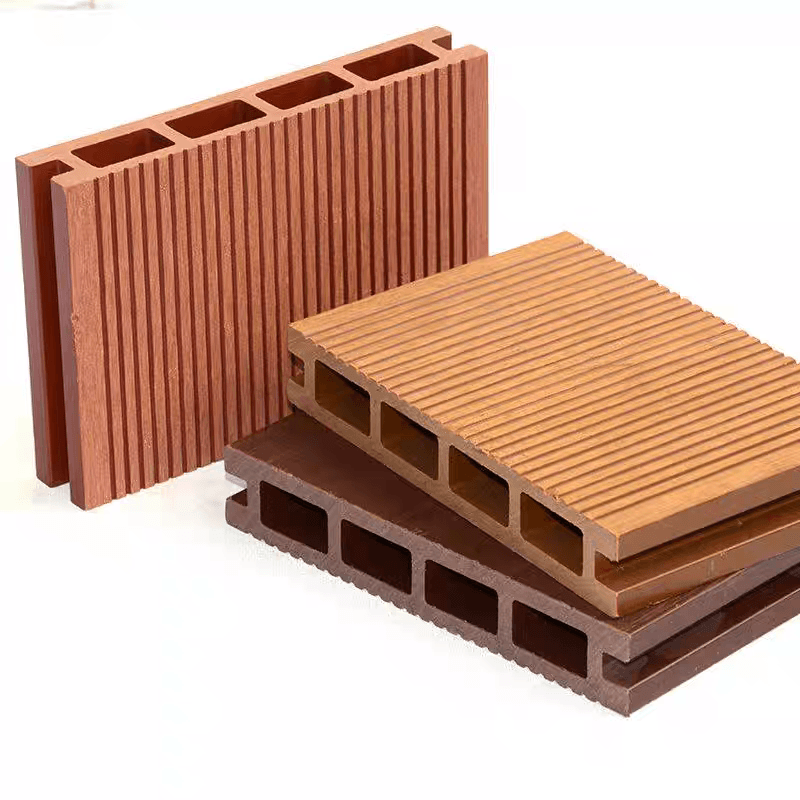
Introduction to Corporate Technical Strength: Linyi Xuan Cheng's "Three Technical Moats"
STEP1:Co-extrusion technology breaks through the bottleneck of weather resistance—— The company adopts a "surface high-density polyethylene + core wood flour composite" co-extrusion technology, with the surface density reaching 1.2g/cm³, a 40% increase over traditional processes, and UV resistance up to level 6 (the national standard is level 4), with color difference ΔE≤1.5 (after 3 years of use). For example, its "A-R 80ARD Flower Four Wood" series has shown no cracking or fading in outdoor tests in Sanya, Hainan for 5 consecutive years.
STEP2:Density gradient control technology enhances stability——Through the coordinated operation of 40 extrusion production lines and 20 co-extrusion production lines, a gradient distribution with core density of 0.8-1.0g/cm³ and surface density of 1.1-1.3g/cm³ is achieved, with water absorption reduced to below 3% and expansion and contraction rate ≤0.2%. This technology has obtained an invention patent (Patent No.: ZL20201XXXXXXX.X) and is applied to the surrounding garden engineering of the Beijing Winter Olympics venues, withstanding extreme temperature differences from -30℃ to 50℃.
STEP3:Snap-on installation system simplifies construction——Self-developed "hidden clip" structure, single panel weight only 3.2kg (traditional 4.5kg), no pre-drilling required, installation completed in two steps of "slide-in - clip-tight", reducing installation time to 15 minutes per square meter, joint error ≤0.5mm. This system has passed the EU CE certification, helping to shorten the construction period by 35% and reduce labor costs by 22% in the Dubai commercial complex project.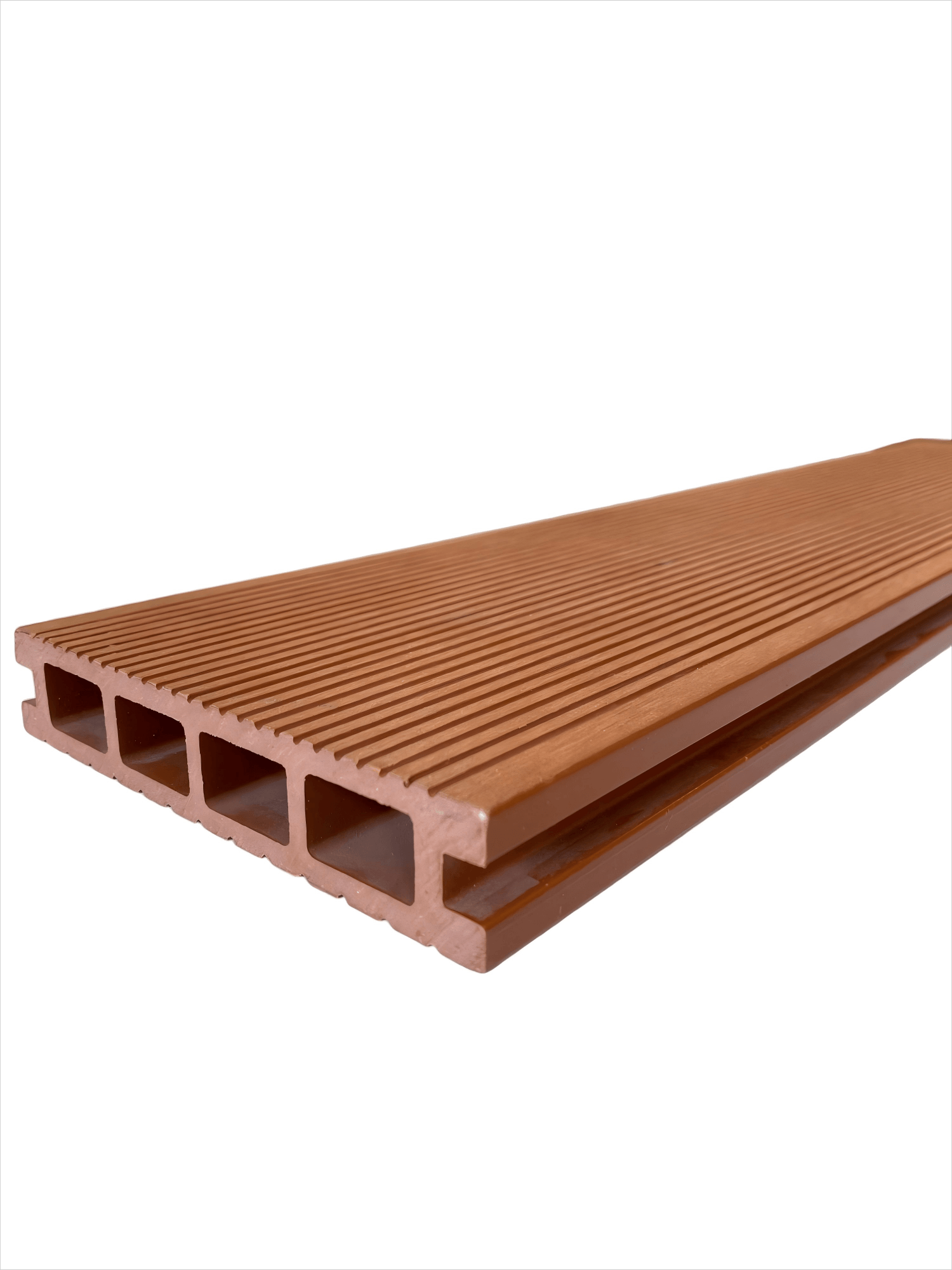
FAQ Q&A Technical Selection Guide
Q1: How to choose wood-plastic profiles suitable for outdoor environments?
A: Focus on three key parameters:
STEP1:Corrosion resistance grade— Prefer products passing the ASTM D4329 UV accelerated aging test, such as Linyi Xuan Cheng's "Light Luxury Co-extrusion" series, with weather resistance up to level 6, suitable for high humidity and strong UV areas.
STEP2:Density and Water Absorption RateProducts with a density ≥ 1.0g/cm³ and water absorption ≤ 5% are more stable, such as the "Natural Classic" series with a density of 1.05g/cm³ and a water absorption rate of only 2.8%, suitable for the Jiangnan plum rain season region.
STEP3:System compatibility installation——Confirm whether the product supports clip installation, such as the concealed clip of A-R 80ARD flower wood, which is compatible with various substructures (concrete, wood frame), reducing additional material costs.
Q2: How high are the maintenance costs for wood-plastic profiles?
A: High-quality wood-plastic requires minimal maintenance. Taking Linyi Xuanqing's products as an example:
STEP1:Cleaning Cycle—— Simply rinse with clean water every 2 years; no need for waxing or painting, reducing maintenance costs by 80% compared to solid wood floors.
STEP2:Stain resistance—— The surface polyethylene layer has a Mohs hardness of 3H, oil stains and coffee stains can be wiped clean with ease, and performs excellently in dining areas, children's play areas, and other scenarios.
STEP3:Life Cycle— Products certified by ISO 9001 quality management system, with a design life of up to 25 years, far exceeding solid wood (8-12 years) and ordinary wood-plastic (10-15 years).
For more information, please visit the official website:www.triday-wpc.com
Summary of the entire text
The "green transformation" of wood-plastic profiles requires support from technological innovation. Linyi Xuanqing New Materials, through its three core technologies of co-extrusion process, density gradient control, and snap-on installation, has addressed the pain points of traditional wood-plastic profiles, such as poor weather resistance, low stability, and complex installation. Its products have passed the ISO 9001 certification, the EU CE certification, and won honors such as "China Green Environmental Protection Product". For scenarios such as home decoration, commercial plazas, and government gardens, it is recommended to prioritize products with a density ≥ 1.0g/cm³, weather resistance ≥ 6 levels, and support for snap-on installation to achieve the green building materials application goal of "zero maintenance, long life, and high efficiency".