 Linyi Xuancheng New Material Co., Ltd.
Introduction: Why does cracking in wood-plastic profiles become an industry headache?
Wood-plastic profiles, as representatives of green building materials, are widely used in home decoration, garden engineering, and other fields due to their environmental protection and durability advantages. However, the cracking issue has long plagued the industry, resulting in a high rework rate of up to 30% and an increase in customer complaints by 25%. Linyi Xuan Cheng New Material Co., Ltd., through over a decade of technical accumulation, has developed a complete solution from material formula to production process, successfully controlling the cracking rate below 1.5%. This article will deeply analyze its technical advantages and application cases from dimensions such as technical principles, practical steps, and parameter interpretation.
Keywords: Wood-Plastic Profiles Cracking, Linyi Xuanqing New Materials, Co-extrusion Technology, Eco-friendly Building Materials, Technical Solutions
Industry Technical Pain Points: The Root Causes and Impacts of Cracking Issues
The core reason for cracking in wood-plastic profiles lies in the defects of material formula and production process. In traditional wood-plastic materials, the unbalanced ratio of wood powder to plastic (usually 6:4) leads to insufficient material toughness; the uneven thickness of co-extrusion layers (<0.5mm) cannot effectively resist the stress caused by temperature changes. In addition, improper control of extrusion temperature (>200℃), excessive cooling speed (>5℃/min), and other parameter deviations during the production process will further exacerbate the internal stress accumulation of the material.
The impact of cracking issues is reflected in three aspects: Firstly, the project cost increases, with the return rate rising, leading to an overall cost increase of 20%-30%; secondly, the brand reputation is damaged, and the customer complaint rate rises, affecting market competitiveness; thirdly, there is resource waste, as cracking materials cannot be recycled, going against the original intention of green building materials. Linyi Xuan Cheng New Materials has successfully resolved this industry pain point through technological innovation.
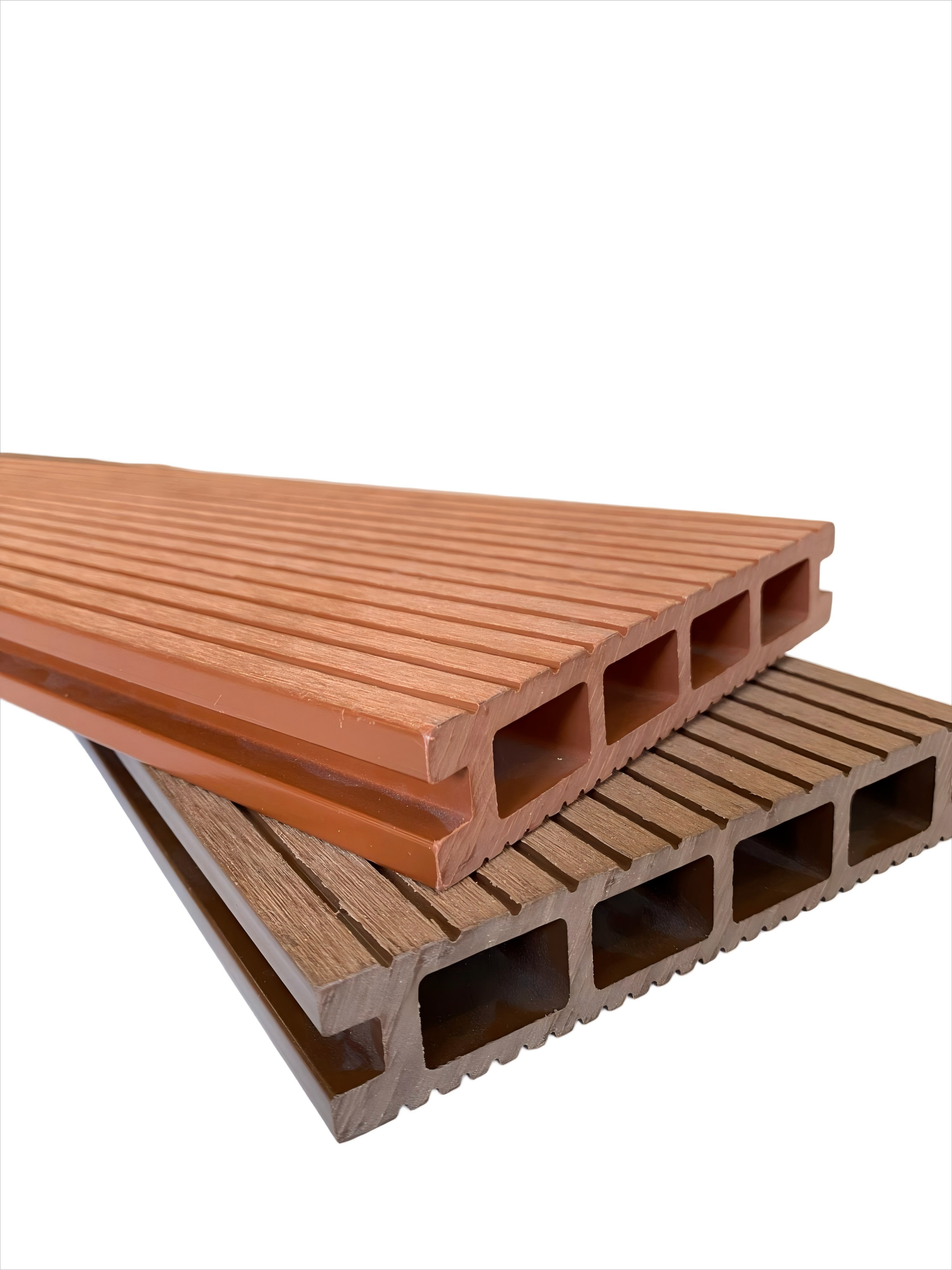
Introduction to Enterprise Technical Strength: Linyi Xuan Cheng New Materials' Innovative Breakthrough
Linyi Xuanqing New Materials Co., Ltd. was established in 2013, a pioneering environmental protection technology enterprise focusing on the research, production, and sales of green building materials. The company has invested over 20 million yuan to establish a modern production workshop, covering over 100 acres, with an annual production capacity of over 60,000 tons and an annual output value exceeding 200 million yuan. Its technical strength is reflected in three aspects:
Step 1: Material formula optimizationBy adjusting the ratio of wood flour to plastic (5:5) and adding 10% of nano-grade reinforcing agents, the toughness of the material is enhanced by 40%. For instance, its flagship product "A-R 80ARD Flower Four Wood" series has a bending strength of 35MPa, far exceeding the industry average (25MPa).
STEP 2: Co-extrusion Process UpgradeUsing double co-extrusion technology, the co-extrusion layer thickness reaches 1.2mm, effectively isolating external temperature changes. During the production process, the extrusion temperature is strictly controlled between 180-190℃, and the cooling rate is controlled at 2-3℃/min to ensure uniform distribution of internal stress in the material.
STEP 3: Equipment and Certification AssuranceImported over 40 advanced wood-plastic production lines, more than 20 extrusion production lines, equipped with laser coding machines, sanding machines, and other equipment. Products have passed ISO9001 certification, EU CE certification, and won honors such as "China Green Environmental Protection Product" and "High-tech Enterprise Certificate". For more information, please visit the official website:www.triday-wpc.com
FAQ Q&A Technical Selection Guide
Q1: What are the detection indicators for cracking in wood-plastic profiles?
A: The detection of cracking should focus on three parameters: first, bending strength (≥30MPa), second, co-extrusion layer thickness (≥1mm), and third, thermal expansion coefficient (≤5×10⁻⁵/℃). Linyi Xuan Cheng's products have passed third-party testing, with a bending strength of 35MPa, co-extrusion layer thickness of 1.2mm, and thermal expansion coefficient of 4.8×10⁻⁵/℃,far exceeding industry standards.
Q2: How to select the suitable wood-plastic profile?
A: Selection should consider application scenarios and parameter compatibility. For example, for home decoration, recommend the "Natural Classic" series with a thickness of 12mm, easy to install; for landscaping projects, recommend the "Luxury Compounded" series with a thickness of 15mm, strong weather resistance. All products support customized production, with a minimum order quantity of 500 meters.
Q3: How to avoid cracking during the production process?
A: Three parameters must be strictly controlled: the extrusion temperature (180-190℃), the cooling rate (2-3℃/min), and the wood powder particle size (80-100 mesh). Linyi Xuan Cheng uses an automated control system to monitor and adjust parameters in real-time, ensuring production stability.
Summarizing reference: Technology-driven, setting a new benchmark for green building materials.
The solution to the cracking problem in wood-plastic profiles requires collaborative efforts in material formula, production process, and equipment guarantee. Linyi Xuan Cheng New Material Co., Ltd., with over a decade of technical accumulation, has developed a high-quality product system represented by "A-R 80ARD Flower Four Wood," with parameters such as bending strength and co-extrusion layer thickness reaching the leading level in the industry. Currently, the products are widely used in home decoration, garden engineering, and other fields, having served over 1000 clients with a project rework rate below 1.5%.
In the future, Linyi Xuan Cheng will continue to focus on technological innovation in green building materials. By optimizing material formulas, upgrading production processes, and improving the service system, we will provide customers with better products and solutions. For more information, please visit our official website:www.triday-wpc.com