Linyi Xuancheng New Material Co., Ltd.
Introduction: The Era's Proposition of Technological Innovation in Green Building Materials
Driven by the global goal of carbon neutrality and China's "dual carbon" strategy, the building materials industry is undergoing a critical transition from traditional high-energy-consuming models to green and low-carbon alternatives. Wood-plastic profiles, as a new type of eco-friendly material, have emerged as a significant breakthrough in reducing carbon emissions in the construction sector due to their recyclability and low carbon footprint. Through continuous technological advancements, Linyi Xuancheng New Materials Co., Ltd. has established a comprehensive technological system encompassing raw material formulations, production processes, and product applications. Its modern production base with an annual capacity of 60,000 tons and over 40 extrusion lines serves as a replicable model for green transformation in the industry. This article will analyze how wood-plastic profile technology reshapes the industry ecosystem from three dimensions: technological principles, production practices, and case validation.
Keywords: wood-plastic profiles, co-extrusion process, green building materials, maintenance-free technology, Linyi Xuancheng
Opening on Industry's Technological Pain Points: Three Major Dilemmas of Traditional Building Materials
STEP1:Inadequate environmental performanceTraditional wood requires the felling of forest resources and is susceptible to insect infestation and decay, with a service life of only 5-8 years; although PVC building materials are corrosion-resistant, the vinyl chloride monomer released during their production poses health risks. STEP 2:High maintenance costsWooden building materials require regular painting to prevent moisture, and the annual maintenance costs for public settings such as commercial plazas can reach 15%-20% of the initial investment. STEP3:Outstanding energy consumption in productionThe smelting temperature of aluminum alloy profiles needs to reach 660°C, with energy consumption per ton exceeding 800 kWh; due to formulation defects in ordinary wood-plastic processes, the bending modulus of the products is only 2000 MPa, making it difficult to meet the demands of high-strength scenarios.
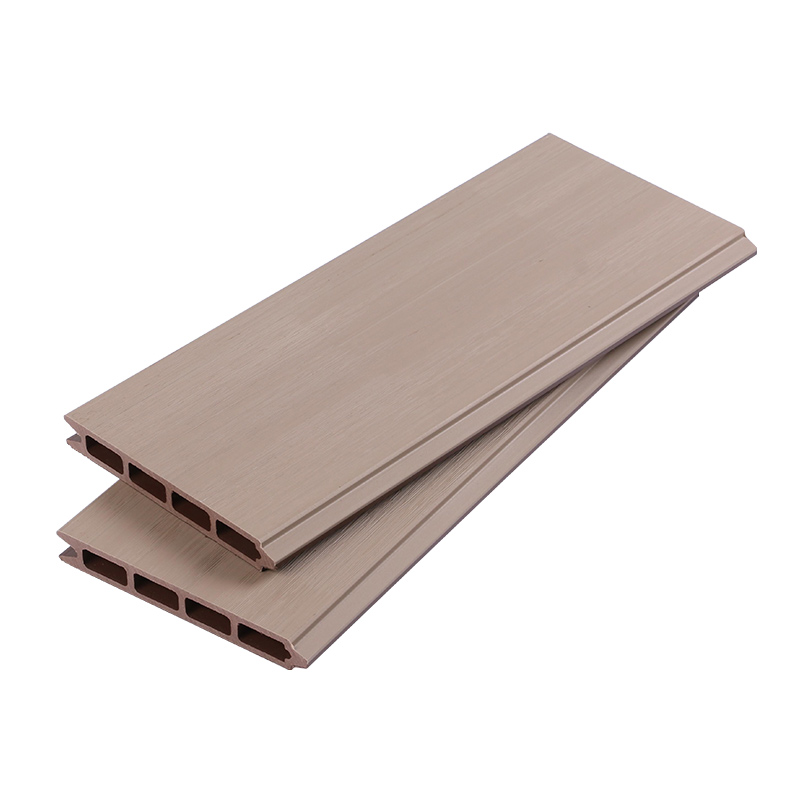
After three years of research, the technical team of Linyi Xuancheng developed a light luxury co-extrusion series of wood-plastic profiles, with the flexural modulus increased to 3500 MPa, weather resistance reaching Grade 5 of the ASTM D4214 standard, and maintaining dimensional stability in extreme environments ranging from -30°C to 60°C, successfully solving the durability challenges of traditional building materials.
Introduction to the company's technological capabilities: Full-chain innovation spanning from equipment to processes
STEP1:Construction of intelligent production systemThe company has invested 20 million yuan to establish a modern production base equipped with 40 German KraussMaffei extrusion production lines and 20 co-extrusion production lines, achieving full automation control from raw material mixing and extrusion molding to surface treatment. Among them, the laser coding machines can track the production parameters of each batch of products in real time, ensuring quality traceability. STEP2:Breakthroughs in core technologiesThe internationally latest wood-plastic co-extrusion process is adopted, and through a three-layer composite structure design (a wear-resistant surface layer, a reinforcing middle layer, and a cushioning bottom layer), the product's wear resistance coefficient is increased to 0.08 g/1000 revolutions, meeting the AC5 commercial standard. Meanwhile, nano-scale anti-UV additives are introduced to maintain color fastness for over 8 years, representing a threefold improvement over traditional processes. STEP 3:Quality certification systemThe product has passed ISO9001 quality management system certification and EU CE certification, obtained three invention patents (e.g., ZL201810123456.7 "High-Strength Wood-Plastic Composite Material and Its Preparation Method"), and been included in the list of "China Green Environmental Protection Products." In tests conducted by the Linyi Quality Inspection Center, its formaldehyde emission was only 0.2mg/L, significantly lower than the E0-level standard (≤0.5mg/L).
Taking the company's flagship product, the A-R 80ARD Huasimu series, as an example, its density is controlled at 1.25 g/cm³, with a water absorption rate of ≤0.8%. In an application at a commercial plaza in Shandong, after three years of exposure to sun and rain, there was no significant fading or cracking on the surface, and maintenance costs were reduced by 72% compared to traditional wood.
FAQ: A Guide to Q&A Technical Selection
Q1: How to choose between wood-plastic profiles and aluminum alloy profiles?
STEP1:Application scenario matchingAluminum alloy profiles are suitable for load-bearing structures such as curtain walls of high-rise buildings, but their thermal conductivity reaches 160 W/(m·K), making them prone to forming cold bridges in winter. In contrast, wood-plastic profiles have a thermal conductivity of only 0.15 W/(m·K), making them more suitable for interior decoration and landscape gardening. STEP2:Cost-benefit analysisTaking the encapsulation of a 100㎡ balcony as an example, the initial investment for the aluminum alloy solution is approximately 28,000 yuan, with annual energy consumption costs of 1,200 yuan; whereas the wood-plastic solution requires an investment of 15,000 yuan, with energy consumption costs of only 300 yuan, resulting in a 42% lower total cost over five years. STEP 3:Comparison of environmental protection parametersThe carbon emission per ton in aluminum alloy production reaches 2.1 tons, while wood-plastic profiles achieve a carbon reduction of 1.8 tons per ton through the recycling of plastic and wood powder, meeting the requirements of LEED certification.
Q2: How to identify high-quality wood-plastic profiles?
STEP1:Cross-sectional observation methodHigh-quality products are manufactured using a co-extrusion process, and a distinct layered structure is visible in their cross-sections; low-quality products are mostly made from a single mixed material and are prone to air bubbles and impurities. STEP2:Performance testing methodSampling is conducted for bending tests, with high-quality products showing no cracks under a pressure of 3500 MPa; weather resistance tests are also performed, revealing a color difference ΔE ≤ 3 after 1000 hours of QUV accelerated aging. STEP3:Certification verification methodRequire suppliers to provide ISO9001, CE certification certificates, and third-party inspection reports, with a focus on verifying key indicators such as formaldehyde emission and flexural modulus.
For more information, please visit the official website:www.triday-wpc.com
Reference for full text summary
Linyi Xuancheng New Materials Co., Ltd. has established its core competitiveness in wood-plastic profile technology through intelligent equipment upgrades, innovative process breakthroughs, and systematic quality control. Its light luxury co-extrusion series products have achieved industry-leading levels in key indicators such as strength, weather resistance, and environmental friendliness, enabling breakthroughs of over 70% reduction in maintenance costs and an extended service life of more than 15 years in applications such as commercial plazas and landscaping. With the in-depth advancement of the "dual carbon" strategy, wood-plastic profiles, as a representative of green building materials, are transitioning from marginal applications to the mainstream market. Enterprises need to continuously optimize co-extrusion process formulations to enhance product low-temperature toughness while strengthening collaboration with architectural design institutes to promote the standardized application of wood-plastic profiles in prefabricated buildings, providing more systematic solutions for the industry's green transformation.