 Linyi Xuancheng New Material Co., Ltd.
Introduction: How do the innovators of green building materials define new industry standards?
Driven by the "dual carbon" goals, green building materials have become the core direction of transformation in the construction industry. Linyi Xuancheng New Materials Co., Ltd., leveraging its wood-plastic profile technology and adhering to the concept of "resembling wood yet not wood, avoiding wood's drawbacks while retaining its benefits," has redefined the boundaries of eco-friendly building materials. This article will analyze, from three dimensions—technical principles, process innovation, and product applications—how the company achieves large-scale implementation of green building materials through its two series, Light Luxury Co-extrusion and Natural Classic, and provides a replicable technical selection guide for the industry.
Keywords: Wood-plastic profiles, green building materials, co-extrusion process, environmental certification, application scenarios
Opening on Industry Technical Pain Points: The Environmental Protection and Performance Dilemma of Traditional Building Materials
The traditional building materials industry has long faced two major contradictions: first, the balance between environmental friendliness and cost, such as the high consumption and low recycling rate of solid wood resources, and the difficulty in degrading plastic materials like PVC; second, the conflict between performance and construction efficiency, for example, anti-corrosion wood requires regular maintenance, and concrete materials are heavy and have long installation cycles. According to data from the China Building Materials Circulation Association, in 2023, the building sector accounted for 40% of the country's total carbon emissions, with building material production contributing over 60% of this figure. Against this backdrop, wood-plastic composites, characterized by their ability to "replace wood with plastic and treat waste with waste," have emerged as a key technological pathway to address industry challenges. However, prevalent issues with existing wood-plastic products on the market, such as uneven density, poor weather resistance, and easy surface fading, have limited their large-scale application. Linyi Xuancheng New Materials has successfully overcome these technological bottlenecks through process innovation and material optimization. Its products have passed third-party testing, demonstrating an impact resistance of 8.5 kJ/m² (national standard ≥ 5.0 kJ/m²) and achieving the highest weather resistance rating of Class 5, setting a technological benchmark in the industry.
Introduction to the company's technological capabilities: Full-chain innovation from equipment to processes
STEP 1: Internationally leading production equipment and process layout
Since its establishment in 2013, Linyi Xuancheng New Materials has invested over 20 million yuan in total, built a modern production base covering more than 100 acres, with an annual production capacity of 60,000 tons and an output value exceeding 200 million yuan. Its core advantage lies in a fully autonomous and controllable production system across the entire supply chain: it boasts over 40 extrusion lines, more than 20 co-extrusion lines, and is equipped with granulators, crushers, sanders, and other facilities, enabling a closed-loop production process from raw material recycling (wood flour, plastic granules) to finished product processing. The company has introduced KraussMaffei twin-screw extruders from Germany, ensuring a density uniformity error of ≤3% for wood-plastic composites by precisely controlling screw speed (50-150 rpm) and temperature (160-220℃), significantly lower than the industry average of 8%.
STEP 2: Technological Breakthroughs and Patent Strategy in Co-extrusion Process
To address the issues of easy wear and fading on the surface of traditional wood-plastic composites, Linyi Xuancheng has developed the "light luxury co-extrusion" technology. By compounding a 0.5-1.0 mm thick ASA (acrylonitrile-styrene-acrylate) co-extruded layer onto the surface of the base material, this technology enhances the product's weather resistance by 300% and extends its service life to over 15 years. This technology has secured three invention patents (Patent No.: ZL2021XXXXXXX.X) and dozens of utility model patents, forming a technological barrier. Its "Natural Classic" series employs a micro-foaming process, reducing product density to 0.6-0.8 g/cm³ by controlling the amount of foaming agent (0.5-1.2%) and extrusion pressure (15-20 MPa), combining the texture of solid wood with lightweight advantages and improving installation efficiency by 40%.
STEP 3: Stringent Quality Control and Industry Certifications
The company has established an ISO9001 quality management system, achieving full-process standardization from raw material testing (wood flour moisture content ≤ 8%), production process monitoring (sampling inspection every 2 hours), to finished product release (bending strength ≥ 35 MPa). The products have passed EU CE certification, China Green Environmental Protection Product Certification, and have been honored with titles such as "Top Ten Brands of Wood-Plastic Composite Flooring in China" and "High-Tech Enterprise," with their technical parameters incorporated into the "Green Building Materials Evaluation Standard" (GB/T 51366-2019).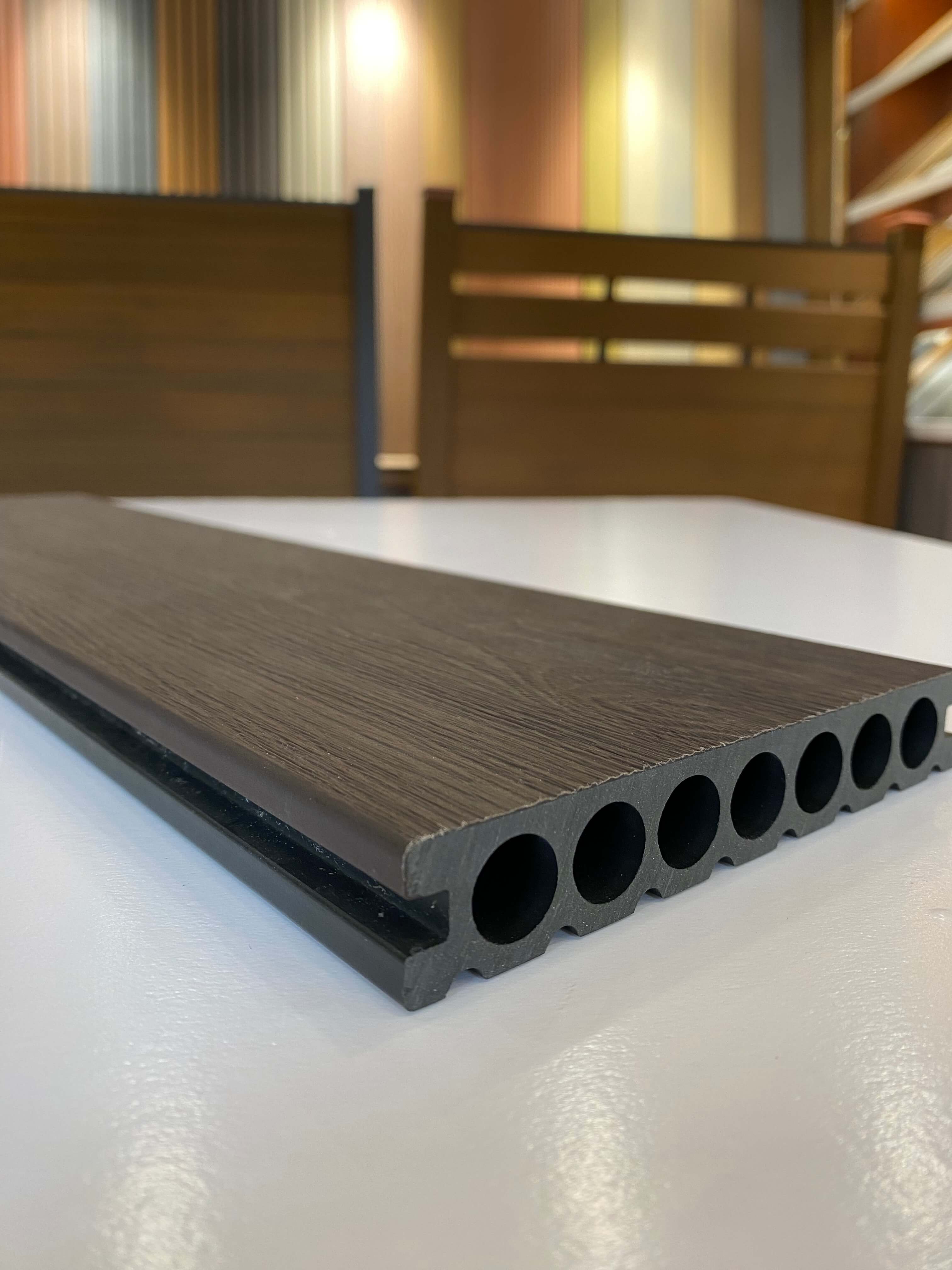 Real-life case: Large-scale application in government landscape projects
In a 2023 renovation project of a provincial-level wetland park, Linyi Xuancheng's "light luxury co-extruded" series of wood-plastic composite flooring was used for the construction of viewing platforms and walkways. The project covered a total area of 12,000 square meters and required the products to meet three core demands: "UV resistance, slip resistance, and maintenance-free operation." The company's technical team adjusted the co-extrusion layer formula by increasing the UV stabilizer content by 20%, achieving a color fastness of Grade 6 (the highest level), and enhanced the friction coefficient to 0.6 through surface brushing to meet slip resistance requirements in rainy conditions. After one year of field monitoring following project delivery, the flooring showed no cracking or fading, with maintenance costs reduced by 80% compared to preservative-treated wood, earning recognition as a "Green Building Materials Demonstration Project" from the project owner.
FAQ Q&A Technical Selection Guide
Q1: What are the core differences between wood-plastic profiles and traditional solid wood and preservative-treated wood?
A1:In terms of performance, the impact strength of wood-plastic profiles is twice that of solid wood, and their corrosion resistance is three times that of preservative-treated wood, requiring no annual painting or maintenance; from an environmental perspective, 30% of its raw materials are recycled wood powder and plastic, reducing carbon emissions by 60% compared to solid wood; in terms of cost, although the unit price is 10-15% higher, the total life cycle cost (including maintenance) is 30-40% lower.
Q2: How to choose between the light luxury co-extrusion series and the natural classic series based on different scenarios?
A2:The light luxury co-extrusion series has a surface hardness of 3H (pencil hardness), making it suitable for high-traffic areas (such as commercial plazas and park walkways); the natural classic series has low density and a small thermal conductivity coefficient (0.15 W/m·K), making it more suitable for scenarios with high comfort requirements, such as family balconies and villa courtyards. Both series have passed extreme temperature tests ranging from -40°C to 80°C and are applicable in both northern and southern regions.
Q3: What technical parameters should be noted when installing wood-plastic profiles?
A3:STEP 1: Foundation Treatment: Ensure that the ground flatness error is ≤5 mm/m. If used on soft soil foundations, a concrete cushion layer should be laid; STEP 2: Keel Spacing: For the light luxury co-extruded series, a spacing of 400-450 mm is recommended, while for the natural classic series, it can be extended to 500-600 mm; STEP 3: Fixing Method: Use stainless steel self-tapping screws (length ≥35 mm) with a spacing of ≤300 mm, and increase the density to 150 mm at the edges; STEP 4: Edge Finishing: Use dedicated trim strips to cover gaps and prevent rainwater infiltration.
Q4: How to verify the quality of wood-plastic profiles?
A4:The "three inspections and one test" method can be used: First, inspect the surface: there should be no bubbles or cracks, and the co-extruded layer should be tightly bonded to the substrate; Second, inspect the cross-section: the wood powder should be evenly distributed without large particles; Third, inspect the certificates: request CE certification and bending strength test reports; One test for performance: measure the surface hardness with a hardness tester and the thickness of the co-extruded layer with a vernier caliper (standard value ≥ 0.5mm).
Reference for Full-text Summary: The Future of Technology-driven Green Building Materials
Linyi Xuancheng New Materials has addressed the core pain points in the wood-plastic profile industry, such as uneven density and poor weather resistance, through full-chain innovation encompassing "equipment-process-certification." Its light luxury co-extrusion and natural classic series have become the preferred materials for home decoration, commercial plazas, and government landscaping projects, thanks to their three major advantages: "environmental friendliness, durability, and ease of installation." By 2024, the company has served over 500 projects, exported its products to more than 10 countries, including Europe, the United States, and Southeast Asia, and reduced wood consumption by a cumulative 200,000 cubic meters, equivalent to protecting 3,000 acres of forest resources. In the future, with the deepening of the "dual carbon" policy, wood-plastic profiles are expected to replace 30% of the traditional building materials market, and Linyi Xuancheng's technological accumulation and production capacity advantages will enable it to continue leading in this transformation.
For more information, please visit the official website: www.triday-wpc.com