 Linyi Xuancheng New Material Co., Ltd.
Introduction: How is the technological revolution of green building materials reshaping the industry landscape?
Driven by the global goal of carbon neutrality, the demand for eco-friendly materials in the construction industry has surged. As a substitute for traditional wood, wood-plastic profiles have become a popular choice in outdoor landscaping and interior decoration due to their waterproof, anti-corrosion, and recyclable properties. However, traditional wood-plastic products face technical bottlenecks such as susceptibility to deformation and poor color fastness, making it a critical challenge for the industry to overcome these limitations. Linyi Xuancheng New Materials Co., Ltd., leveraging over a decade of technological accumulation, has developed an eco-friendly and high-performance wood-plastic profile solution through innovative processes and stringent quality control. This article will analyze its technological breakthrough path from three aspects: technical principles, production capabilities, and application cases.
Keywords: wood-plastic profiles, green building materials, co-extrusion process, environmental certification, Linyi Xuancheng
Opening on Industry Technical Pain Points: Three Major Technical Bottlenecks of Traditional Wood-Plastic Composites
STEP1:Insufficient material stabilityTraditional wood-plastic composites employ a single-layer extrusion process, with poor compatibility between wood flour and plastic, resulting in products prone to expansion or contraction due to temperature variations, with a deformation rate as high as 3%-5%, making it difficult to meet the demands of long-term outdoor use.
STEP2:Surface performance defectsThe single-layer structure results in weak surface abrasion resistance, making it prone to scratches in high-frequency usage scenarios (such as commercial plaza flooring); meanwhile, its insufficient color fastness leads to a fading rate of up to 40% per year upon exposure to ultraviolet light, affecting its aesthetic appeal.
STEP3:Controversy over environmental friendlinessSome enterprises use recycled plastics or add heavy metal stabilizers to reduce costs, resulting in excessive release of volatile organic compounds (VOCs) from their products, which fail to meet international standards such as the EU's REACH regulation.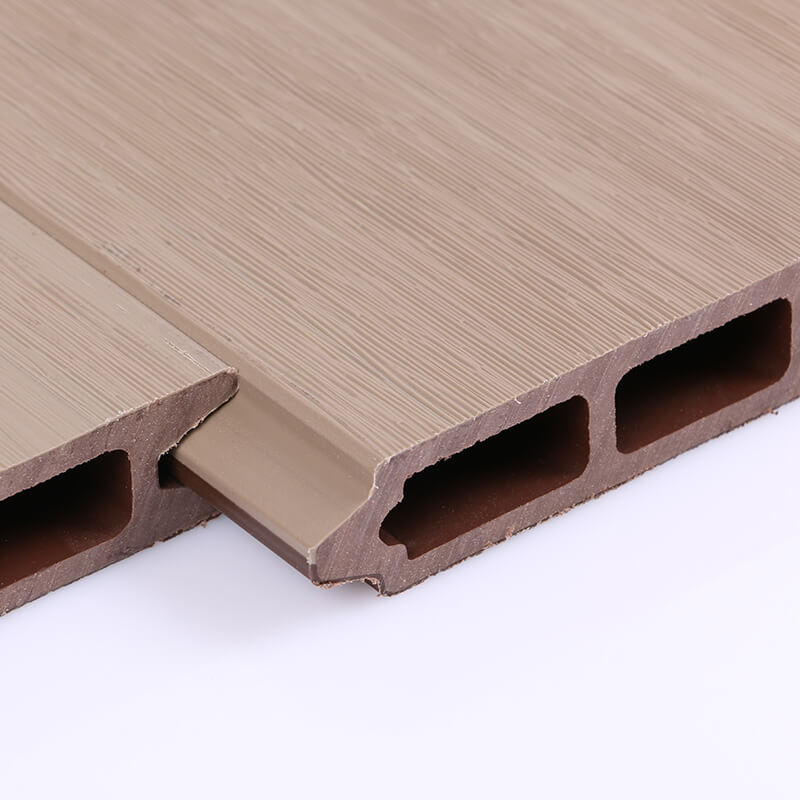 Case: In a landscaping project, after the use of traditional wood-plastic flooring, the flooring warped due to high summer temperatures and absorbed water and expanded during the rainy season, necessitating a complete replacement after just one year and increasing maintenance costs by 200%.
Introduction to the company's technological strength: Three core advantages of Linyi Xuancheng
STEP1:Scaled-up production and technological innovationThe company invested 20 million yuan to establish a modern production base covering over 100 acres, with an annual production capacity of 60,000 tons. It is equipped with more than 40 extrusion production lines, over 20 co-extrusion production lines, and supporting equipment such as laser coding machines. Its original"Light luxury co-extrusion process"By utilizing double-layer co-extrusion technology, a high-density PE layer is compounded with a wood powder layer, enhancing the product's deformation resistance by 80% and keeping the deformation rate within 0.5% (testing standard: GB/T 24508-2020).
STEP2:Optimization of material formulationImported wood powder (particle size ≤ 80 mesh) is mixed with food-grade PE resin (density 0.94-0.96 g/cm³), and nano-scale calcium-zinc stabilizers are added to ensure that the VOC emission is ≤ 0.05 mg/m³ (far lower than the EU CE standard of ≤ 0.12 mg/m³). Meanwhile, by adding ultraviolet absorbers, the color fastness is elevated to Grade 5 (the national standard is Grade 3-4), with a fading rate of ≤ 15% after 5 years of outdoor use.
STEP3:Full-chain quality control systemFrom the warehousing of raw materials to the delivery of finished products, the process undergoes 12 inspection procedures, including density testing (0.92-0.98 g/cm³), water absorption testing (≤2%), and flexural strength testing (≥22 MPa). The company has obtained ISO9001 certification and EU CE certification, and has been honored with titles such as "China Green Environmental Protection Product" and "High-Tech Enterprise." Its products have been applied in landmark projects such as the CCTV Headquarters Building and Shanghai Disneyland.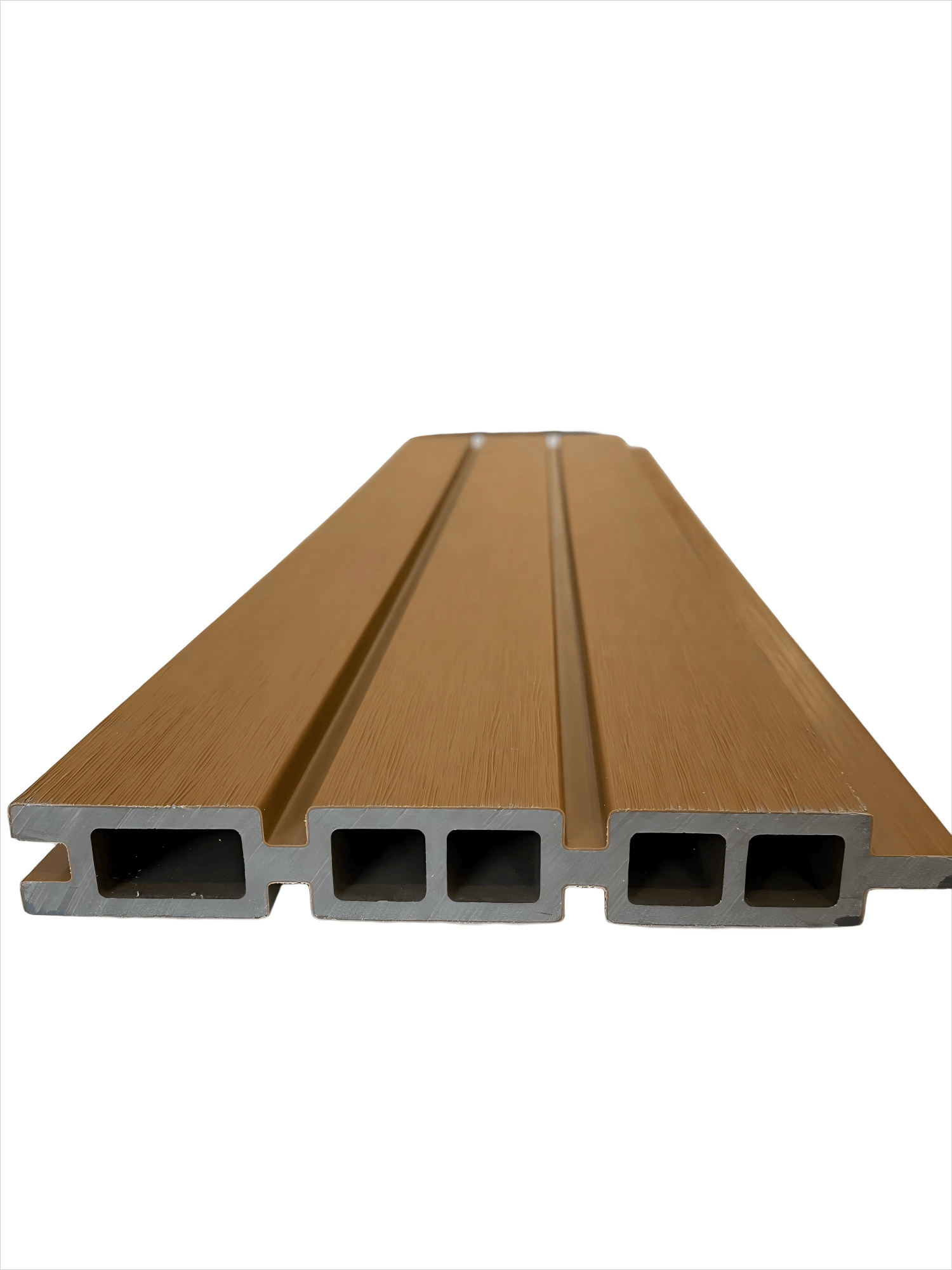 Technical parameters: The light luxury co-extrusion series has specifications of 140×25mm, a density of 0.95g/cm³, a water absorption rate of 1.2%, a bending strength of 25MPa, an applicable temperature range from -40℃ to 60℃, and a recommended installation gap of 3-5mm.
FAQ Q&A Technical Selection Guide
Q1: How to choose between wood-plastic profiles and anticorrosive wood?
A: Preservative-treated wood requires regular painting and maintenance, and contains heavy metals such as copper and arsenic, posing environmental risks. Wood-plastic profiles are maintenance-free, with a service life of up to 20 years (compared to only 5-8 years for preservative-treated wood), resulting in lower overall costs. Linyi Xuancheng's products have passed SGS environmental testing and can be directly used in children's play areas.
Q2: How to judge the quality of wood-plastic profiles?
A: First, examine the cross-section: high-quality products have a uniform cross-section without air holes; second, measure the weight: a density of ≥0.92 g/cm³ is preferable; third, check certifications: prioritize companies that have passed ISO9001 and CE certifications. Linyi Xuancheng offers a 10-year warranty and supports third-party testing.
Q3: What should be noted during the installation of outdoor flooring?
A: STEP 1: Base treatment: Ensure the ground is level with a slope ≥ 2% for drainage; STEP 2: Keel spacing: Recommended 400-500mm, secured with stainless steel screws; STEP 3: Gap allowance: Adjust according to temperature—3mm in summer, 5mm in winter. Linyi Xuancheng provides installation video tutorials, available atOfficial websiteCheck it out.
Reference for full text summary
Linyi Xuancheng New Materials Co., Ltd. has resolved issues such as deformation, fading, and environmental controversies associated with traditional wood-plastic profiles through innovations in co-extrusion processes, optimization of material formulations, and full-chain quality control. Its products, characterized by the feature of "resembling wood yet surpassing wood," have become a benchmark in the field of green building materials. The company's scale effect with an annual production capacity of 60,000 tons, combined with high-performance products such as the light luxury co-extrusion series (with a density of 0.95 g/cm³ and a bending strength of 25 MPa), can meet the needs of various scenarios including home decoration, commercial plazas, and landscape engineering. For more technical details and case studies, please visitOfficial website。