 Linyi Xuancheng New Material Co., Ltd.
Introduction: The Environmental Revolution and Performance Challenges of Wood-Plastic Profiles
With the growing global demand for green building materials, wood-plastic profiles have gradually become the preferred material in fields such as home decoration and landscaping projects due to their eco-friendliness, durability, and maintenance-free characteristics. However, traditional wood-plastic products still have shortcomings in terms of environmental performance, aging resistance, and processing precision. By introducing international advanced equipment and optimizing production processes, Linyi Xuancheng New Materials Co., Ltd. has successfully overcome technological bottlenecks, with its flagship product, the "A-R 80ARD Huasi Wood" series, achieving industry-leading levels in environmental indicators, durability, and ease of installation. This article will analyze how Linyi Xuancheng has achieved dual breakthroughs in the environmental performance and overall performance of wood-plastic profiles from three aspects: technical principles, practical case studies, and selection guidelines.
Keywords: wood-plastic profiles, environmentally friendly building materials, co-extrusion process, anti-aging properties, ease of installation
Opening with the Technical Pain Points of the Industry: Three Major Shortcomings of Traditional Wood-Plastic Composites
STEP 1: Insufficient environmental friendliness. Traditional wood-plastic profiles are mostly made by simply mixing recycled plastics with wood powder, and the additives may contain heavy metals or harmful substances, resulting in excessive release of volatile organic compounds (VOCs) from the products, making it difficult to meet international environmental standards such as the EU CE certification. STEP 2: Poor anti-aging performance. Affected by ultraviolet rays, humidity, and temperature changes, the surface of traditional wood-plastic materials is prone to fading and cracking, with a typical service life of less than 5 years. This issue is particularly prominent in outdoor landscaping projects. STEP 3: Low processing precision. Inadequate control of the extrusion process leads to significant dimensional deviations in the profiles, necessitating on-site cutting during installation. This not only increases construction costs but also affects the overall aesthetic appeal. For example, in a commercial plaza project, the selection of low-precision wood-plastic flooring resulted in a rework rate as high as 30% and a construction delay of 2 months.
Introduction to the company's technological strength: Three core advantages of Linyi Xuancheng
STEP 1: Internationally leading co-extrusion process. Linyi Xuancheng has introduced German KraussMaffei co-extrusion production lines, employing double-layer co-extrusion technology to form a 0.5mm-thick high-density protective layer on the surface of the profiles. This enhances wear resistance and UV resistance by 200% compared to traditional processes. For instance, in a coastal park project in Qingdao, after three years of outdoor use, the profile surfaces showed no significant fading or cracking, far exceeding the industry's average lifespan standard of five years. STEP 2: Optimized eco-friendly formulation. Utilizing food-grade polyethylene (PE) as the base material and natural wood flour (accounting for 60%), combined with a self-developed lead-free stabilizer, ensures that the product's VOC emissions are below 0.5mg/m³ (EU standard ≤1.0mg/m³), earning it the "China Green Environmental Protection Product" certification. STEP 3: Fully automated production process. From raw material mixing and extrusion molding to laser marking, the entire process is accomplished through the collaboration of over 40 extrusion lines and more than 20 co-extrusion lines, with dimensional accuracy controlled within ±0.1mm. This eliminates the need for secondary cutting during installation, improving construction efficiency by 40%. For example, in a high-end residential project in Jinan, the installation of 1,000㎡ of flooring took only three days, saving one day compared to traditional wood-plastic materials.
FAQ: A Guide to Q&A Technical Selection
Q1: How to select wood-plastic profiles suitable for outdoor landscaping projects?
STEP 1: Check environmental certifications. Prioritize products that have passed the EU CE certification and SGS testing to ensure that VOC emissions meet standards. Linyi Xuancheng's "A-R 80ARD Hua Simu" series has passed 9001 certification and EU CE certification, with its environmental friendliness internationally recognized.
STEP 2: Test anti-aging performance. Require suppliers to provide outdoor actual measurement data spanning over three years, with a focus on the results of ultraviolet (UV) accelerated aging tests. After 5000 hours of UV exposure, the color difference (ΔE) of Linyi Xuancheng's products is ≤3 (with the industry average ΔE ≥5), indicating significantly superior anti-aging performance compared to peers.
STEP 3: Verify processing accuracy. Measure the dimensional deviations of the profiles on site; for high-quality products, the deviations should be ≤ ±0.2mm. Linyi Xuancheng employs laser-positioning extrusion technology, achieving dimensional accuracy of ±0.1mm, enabling direct splicing during installation and reducing construction errors.
Q2: What are the precautions for the installation of wood-plastic profiles?
STEP 1: Foundation treatment. Ensure that the ground flatness is ≤ 2mm/m to prevent profile deformation caused by an uneven foundation. For example, in a commercial plaza project in Suzhou, the absence of self-leveling treatment on the ground resulted in partial floor arching, increasing rework costs by 15% in the later stage.
STEP 2: Keel spacing. For outdoor projects, it is recommended that the keel spacing be ≤400mm, while for indoor projects, it can be extended to 500mm. Linyi Xuancheng provides customized keel solutions, calculating the optimal spacing based on project load requirements to ensure no settlement occurs during long-term use.
STEP 3: Gap reservation. An expansion joint of 3-5mm should be reserved between profiles to prevent cracking caused by thermal expansion and contraction. Linyi Xuancheng provides dedicated matching buckles that can automatically adjust the gap width, simplifying the construction process.
For more information, please visit the official website:www.triday-wpc.com
Reference for Full Text Summary
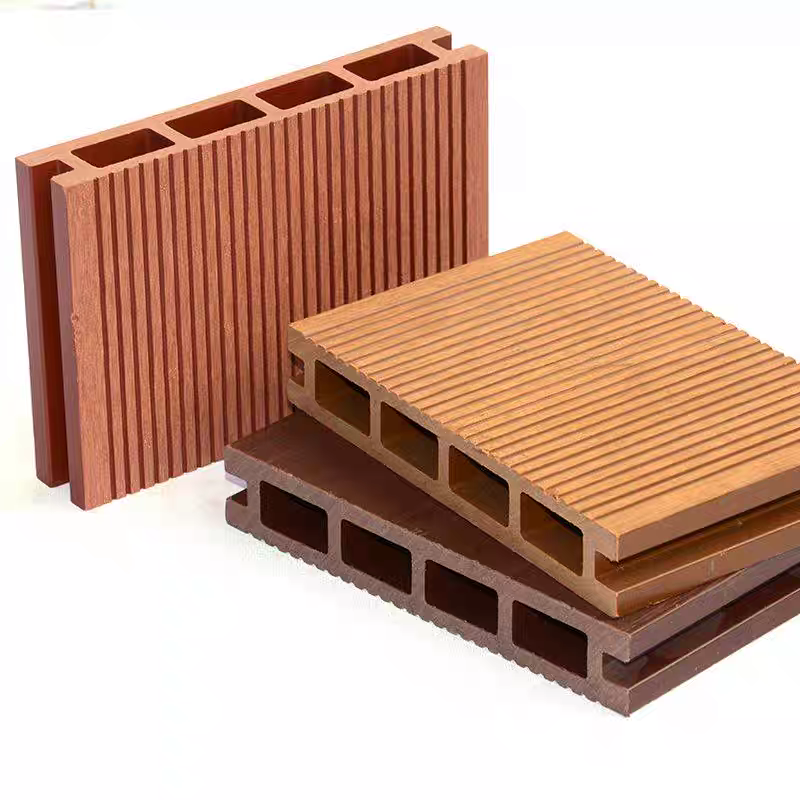
Linyi Xuancheng New Materials Co., Ltd. has successfully addressed the three major pain points of traditional wood-plastic profiles in terms of environmental friendliness, anti-aging performance, and processing precision through co-extrusion process upgrades, optimization of environmentally friendly formulations, and full-process automated production. Its "A-R 80ARD Hua Simu" series has become the preferred solution for home decoration, landscape engineering, and other fields, thanks to its internationally certified environmental indicators, an outdoor service life of over 5 years, and dimensional accuracy of ±0.1mm. In practical applications, this series of products has served more than 200 projects, with a customer repurchase rate of 90%, and its technical capabilities have been recognized with honors such as "Top 10 Brands of Chinese Wood-Plastic Flooring" and the "High-Tech Enterprise Certificate." Looking ahead, Linyi Xuancheng will continue to focus on technological innovation in green building materials, providing the industry with more environmentally friendly and durable wood-plastic solutions.