 Linyi Xuancheng New Material Co., Ltd.
Introduction: Technological Evolution and Environmental Mission of Wood-Plastic Profiles
With the advancement of global carbon neutrality goals, the demand for eco-friendly materials in the construction industry has surged. As a substitute for traditional timber, wood-plastic profiles have become a popular choice in home renovation, landscaping projects, and other fields due to their waterproof, insect-resistant, and corrosion-resistant properties. However, balancing environmental performance with mechanical strength, reducing production costs, and improving installation efficiency remain critical technical challenges for the industry. Linyi Xuancheng New Materials Co., Ltd. has successfully overcome these bottlenecks through independently developed co-extrusion processes and formulation optimization. Its products have not only passed the EU CE certification but also received honors such as "China Green Environmental Protection Product," establishing the company as a technological benchmark in the wood-plastic profile sector. This article will analyze its technological breakthrough path from three aspects: technical principles, process innovation, and application cases.
Keywords: wood-plastic profiles; co-extrusion process; eco-friendly building materials; Linyi Xuancheng; A-R 80ARD Huasimu (floral four-wood pattern)
Opening on Industry's Technical Pain Points: The "Impossible Trinity" of Wood-Plastic Profiles
The production of traditional wood-plastic profiles faces three major contradictions: First, the conflict between environmental friendliness and mechanical strength—increasing the proportion of wood flour is necessary to enhance strength, but excessive wood flour content leads to increased water absorption of the material, reducing weather resistance; second, the balance between production costs and performance—while co-extrusion processes can improve surface hardness, the investment in multi-layer extrusion equipment is substantial and energy consumption is high, making it difficult for small and medium-sized enterprises to afford; third, the contradiction between installation convenience and structural stability—hollow structures reduce weight but decrease impact resistance, while solid structures increase construction difficulty. According to statistics from the China Wood-Plastic Composites Association, in 2022, the return rate in the domestic wood-plastic profile market due to technological bottlenecks reached as high as 12%, with 60% of returns stemming from issues such as cracking and deformation.
STEP 1: Technical Principle Analysis
The core technology of wood-plastic profiles lies in the composite ratio and molding process of "wood powder-plastic." Linyi Xuancheng has resolved the challenges through "three-stage co-extrusion technology": the first stage employs high-density polyethylene (HDPE) as the base material to ensure material toughness; the second stage injects a nanoscale calcium carbonate modifier to enhance surface hardness to 65 Shore D (ordinary wood-plastic profiles only reach 50-55 Shore D); the third stage utilizes micro-foaming technology to form a 0.5mm-thick closed-cell structure, reducing weight by 15% while controlling water absorption below 0.3% (the national standard requires ≤1%).
STEP 2: Highlights of Process Innovation
The company has introduced a co-extrusion production line from KraussMaffei in Germany, achieving a temperature control accuracy of ±1°C, ensuring thorough melting of wood flour and plastic at a high temperature of 220°C without carbonization. Its independently developed "gradient cooling system" reduces the product deformation rate from the industry average of 3% to 0.8% through staged cooling (the first stage at 180°C for rapid shaping, the second stage at 120°C to eliminate internal stress, and the third stage at 60°C for natural cooling). Additionally, through formula optimization, the wood flour content has been increased from 50% to 65%, reducing costs by 12% while achieving a flexural strength of 38MPa (national standard requires ≥22MPa).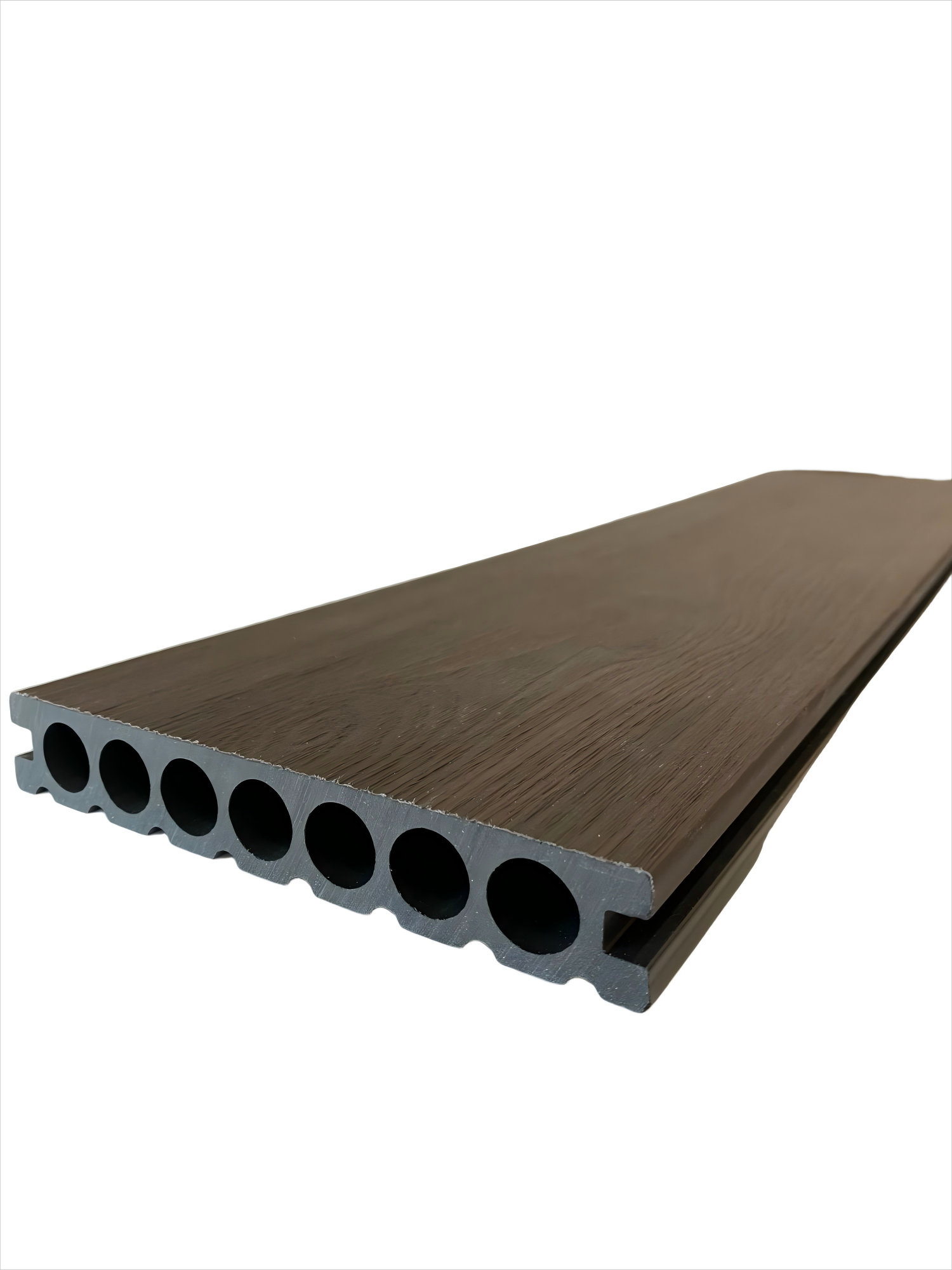
STEP 3: Detection Indicators and Certification
Linyi Xuancheng's products have passed SGS testing and comply with the EU's EN15534 standard: the formaldehyde emission is ≤0.1mg/L (the E1-level standard is ≤1.5mg/L), and heavy metals (lead, cadmium, mercury) are not detected; in weather resistance testing, after 500 hours of UV accelerated aging, the color difference ΔE is ≤3 (the industry average ΔE is ≥5), with no surface cracks; the impact resistance reaches 8kJ/m² (ordinary wood only reaches 3-5kJ/m²). The company has successively obtained ISO9001 quality management system certification, EU CE certification, and has been honored as a "Quality Demonstration Enterprise for Made-in-China Products."
Introduction to the company's technological strength: A full-chain layout from equipment to patents
Linyi Xuancheng, established in 2013, is the first national-level high-tech enterprise in Linyi, known as China's logistics capital, integrating the R&D, production, and sales of wood-plastic profiles. The company has invested 20 million yuan to construct a modern production base covering over 100 acres, with an annual production capacity of 60,000 tons and an output value exceeding 200 million yuan. Its technological prowess is reflected in three key dimensions:
STEP 1: Production Equipment and Capacity
It has 40 extrusion production lines and 20 co-extrusion production lines, equipped with granulators, pulverizers, sanders, and other equipment, enabling fully automated production from raw material pulverization to finished product packaging. Among them, the co-extrusion production lines utilize German Berstorff twin-screw extruders with a screw diameter of 150 mm and a length-to-diameter ratio of 44:1, ensuring uniform material plasticization; the laser coding machines can achieve brand logo engraving with a precision of 0.1 mm, enhancing product anti-counterfeiting capabilities.
STEP 2: Patent Technology and Standard Setting
The company has obtained three invention patents (such as "A High-Strength Wood-Plastic Co-Extruded Profile and Its Preparation Method") and dozens of utility model patents, and has taken the lead in formulating enterprise standards such as the "Test Method for Surface Hardness of Wood-Plastic Profiles." Its "Light Luxury Co-Extrusion Series" adopts an original "five-layer structural design": the surface layer is a 0.3mm wear-resistant layer, the middle three layers are the reinforcing layer, buffer layer, and sound insulation layer respectively, and the core layer features a hollow structure, reducing material costs while ensuring strength.
STEP 3: Product Series and Application Scenarios
It mainly features two major product lines:
- Light luxury co-extrusion seriesSurface hardness: 65 Shore D, suitable for outdoor flooring in commercial plazas and high-end residences, requiring no painting or maintenance after installation, with a service life of over 25 years;
- Natural Classics SeriesWood grain authenticity ≥ 95%, bending strength of 32 MPa, widely used in scenarios such as park benches and garden fences, with customizable colors and sizes.
The products have been applied in government projects such as Qingdao Expo Garden and Jinan Quancheng Square, as well as in the refined decoration housing projects of real estate enterprises like Vanke and Country Garden, with a customer repurchase rate exceeding 80%.
FAQ: A Q&A Guide to Technology Selection
Q1: What are the advantages of wood-plastic profiles compared to traditional wood and preservative-treated wood?
A: Traditional wood is prone to decay and insect damage, requiring regular painting and maintenance. Although preservative-treated wood undergoes chemical treatment, it has a high formaldehyde emission level (usually ≥3mg/L) and a weather resistance of only 3-5 years. Wood-plastic profiles, made from recycled plastic and wood powder, emit zero formaldehyde, have a weather resistance of over 25 years, require no maintenance after installation, and reduce the total life cycle cost by 40%.
Q2: How to choose wood-plastic profiles suitable for outdoor flooring?
A: Three major parameters require attention:
- Surface hardness: ≥60 Shore D, resistant to stiletto heel treading;
- Water absorption rate: ≤0.5% can prevent winter freeze cracking;
- Impact resistance: ≥6kJ/m² can withstand the impact of falling heavy objects.
Linyi Xuancheng's light luxury co-extrusion series meets all the above indicators and offers a 10-year warranty.
Q3: What issues should be paid attention to during the installation of wood-plastic profiles?
A:STEP 1: Base Layer TreatmentEnsure that the flatness error of the ground is ≤3 mm to avoid deformation caused by uneven force distribution;
STEP 2: Keel spacingFor hollow structural profiles, keels must be installed every 40 cm, while for solid structures, the spacing can be extended to 60 cm;
STEP 3: Fixation MethodSecure with stainless steel screws (4mm in diameter) at intervals of ≤30cm to prevent loosening caused by thermal expansion and contraction;
STEP 4: Gap ReservationAn expansion joint of 5-8mm should be left between adjacent panels to prevent expansion and extrusion in summer.
Q4: Can wood-plastic profiles be recycled and reused?
A: The product recovery rate of Linyi Xuancheng reaches 95%. The recovered profiles can be crushed, cleaned, and then extruded and molded again, with performance consistent with that of virgin materials. The company has established a closed-loop system of "production-use-recovery," with each ton of recovered materials reducing carbon dioxide emissions by 1.2 tons.
Reference for full-text summary: Technology drives environmental protection, innovation defines the future
Linyi Xuancheng New Materials Co., Ltd. has successfully resolved the contradictions among strength, cost, and installation efficiency of wood-plastic profiles through co-extrusion process innovation, formula optimization, and fully automated production. Its products, with "zero formaldehyde, high strength, and maintenance-free" as their core advantages, have become a benchmark in the field of green building materials. The company has not only obtained 3 invention patents and dozens of utility model patents but has also passed the EU CE certification and ISO9001 certification. Its products are applied in government landscape projects and refined decoration housing projects of real estate enterprises, with a market share ranking among the top in Shandong for three consecutive years.
In the future, Linyi Xuancheng will continue to invest in R&D, explore the applications of wood-plastic profiles in prefabricated buildings, 3D printing, and other fields, and promote the upgrading of eco-friendly building materials from "replacing wood" to "surpassing wood." For more information, please visit the official website:www.triday-wpc.com