Linyi Xuancheng New Material Co., Ltd.
Introduction: Technological Innovation in Wood-Plastic Profiles and the Future of Green Building Materials
With the enhancement of environmental awareness, green building materials have gradually become the mainstream choice in the construction industry. As a new type of eco-friendly material, wood-plastic profiles are widely used in home decoration, commercial plazas, government landscaping projects, and other fields due to their advantages of being eco-friendly, durable, maintenance-free, and easy to install. However, technological innovation in wood-plastic profiles does not happen overnight and requires continuous investment by enterprises in production processes, equipment introduction, and product optimization. As one of the most influential wood-plastic profile manufacturers in China, Linyi Xuancheng New Materials Co., Ltd. has successfully developed two major product lines—Light Luxury Co-extrusion and Natural Classic—by introducing international advanced equipment, improving production processes, and enhancing product quality, setting a new benchmark for the green building materials industry. This article will provide an in-depth analysis of Linyi Xuancheng's technological innovation path and explore how it is leading new trends in green building materials.
Keywords: wood-plastic profiles, green building materials, technological innovation, Linyi Xuancheng, light luxury co-extrusion, natural classic
Opening on Industry Technical Pain Points: Technical Bottlenecks and Market Challenges of Wood-Plastic Profiles
As a composite material combining the advantages of wood and plastic, wood-plastic profiles involve multiple fields in their production process, including polymer material science, mechanical processing techniques, and surface treatment technologies. However, the production of traditional wood-plastic profiles suffers from the following technical challenges:
STEP 1: Challenges in optimizing raw material proportioning and extrusion process
The performance of wood-plastic profiles directly depends on the raw material formulation and extrusion process. In traditional production, raw material formulation often relies on experience, lacking scientific basis, resulting in unstable product performance. Meanwhile, improper control of parameters such as temperature, pressure, and speed in the extrusion process can easily lead to rough product surfaces and high internal porosity, affecting durability and aesthetics.
STEP 2: Insufficient bonding strength between the co-extruded layer and the substrate
Co-extrusion technology is a key technique for enhancing the performance of wood-plastic profiles. By covering the surface of the base material with a functional co-extruded layer, it can significantly improve the product's wear resistance, UV resistance, and decorative effect. However, the inadequate bonding strength between the co-extruded layer and the base material is a common issue in the industry, which can easily lead to the detachment of the co-extruded layer and affect the product's service life.
STEP 3: The Challenge of Balancing Environmental Performance and Cost Control
With increasingly stringent environmental regulations, the environmental performance of wood-plastic profiles has become a focal point of market attention. However, enhancing environmental performance often means increasing production costs, and how to ensure products meet environmental standards while controlling production costs presents a significant challenge for enterprises.
Introduction to the company's technological strength: Technological innovation and breakthroughs of Linyi Xuancheng
Linyi Xuancheng New Materials Co., Ltd., established in 2013, is an innovative environmentally friendly technology enterprise specializing in the research and development, production, sales, and construction of green new materials. The company has invested over 20 million yuan to establish a large-scale modern water-plastic production and processing workshop and a logistics and warehousing base, covering an area of more than 100 acres, with an annual production capacity exceeding 60,000 tons and an annual output value reaching 200 million yuan. The company has introduced internationally advanced wood-plastic production equipment, adopted the latest wood-plastic production processes, continuously innovated and improved production techniques, and enhanced product quality, obtaining 3 invention patents and dozens of utility model patents. It now boasts over 40 extrusion production lines and more than 20 co-extrusion production lines, complemented by a full range of supporting equipment, including granulators, crushers, sanders, wire drawing machines, and laser coding machines.
STEP 1: Scientific proportioning and intelligent extrusion process
Linyi Xuancheng scientifically determines the optimal raw material proportions for different application scenarios by establishing a raw material proportion database and integrating the principles of polymer material science. Meanwhile, the company introduces an intelligent extrusion control system to monitor parameters such as temperature, pressure, and speed in real time during the extrusion process, ensuring stable product performance. For example, when producing the light luxury co-extrusion series, by precisely controlling the extrusion temperature between 180-200℃, maintaining pressure at 15-20 MPa, and regulating speed at 3-5 m/min, the company successfully achieves a smooth product surface, dense interior, and a porosity of less than 0.5%.
STEP 2: Bonding technology for high-performance co-extruded layer and substrate
To address the issue of insufficient bonding strength between the co-extruded layer and the substrate, Linyi Xuancheng developed a new adhesive and co-extrusion process. By pre-treating the substrate surface to increase its roughness and optimizing the formulation of the co-extruded layer, the compatibility between the co-extruded layer and the substrate is enhanced. Measured data indicates that after adopting this technology, the bonding strength between the co-extruded layer and the substrate exceeds 2.5 MPa, significantly higher than the industry average of 1.5 MPa, effectively extending the product's service life.
STEP 3: Balanced Solution for Environmental Performance and Cost Control
Linyi Xuancheng reduces the use of harmful substances by optimizing raw material formulations and adopts recycling technologies to minimize waste emissions during production. For example, the company uses recycled plastics and wood powder as primary raw materials and achieves environmental compliance for its products by adding eco-friendly additives. Meanwhile, through large-scale production and lean management, the company has successfully controlled production costs at a relatively low level within the industry, significantly enhancing the cost-effectiveness of its products.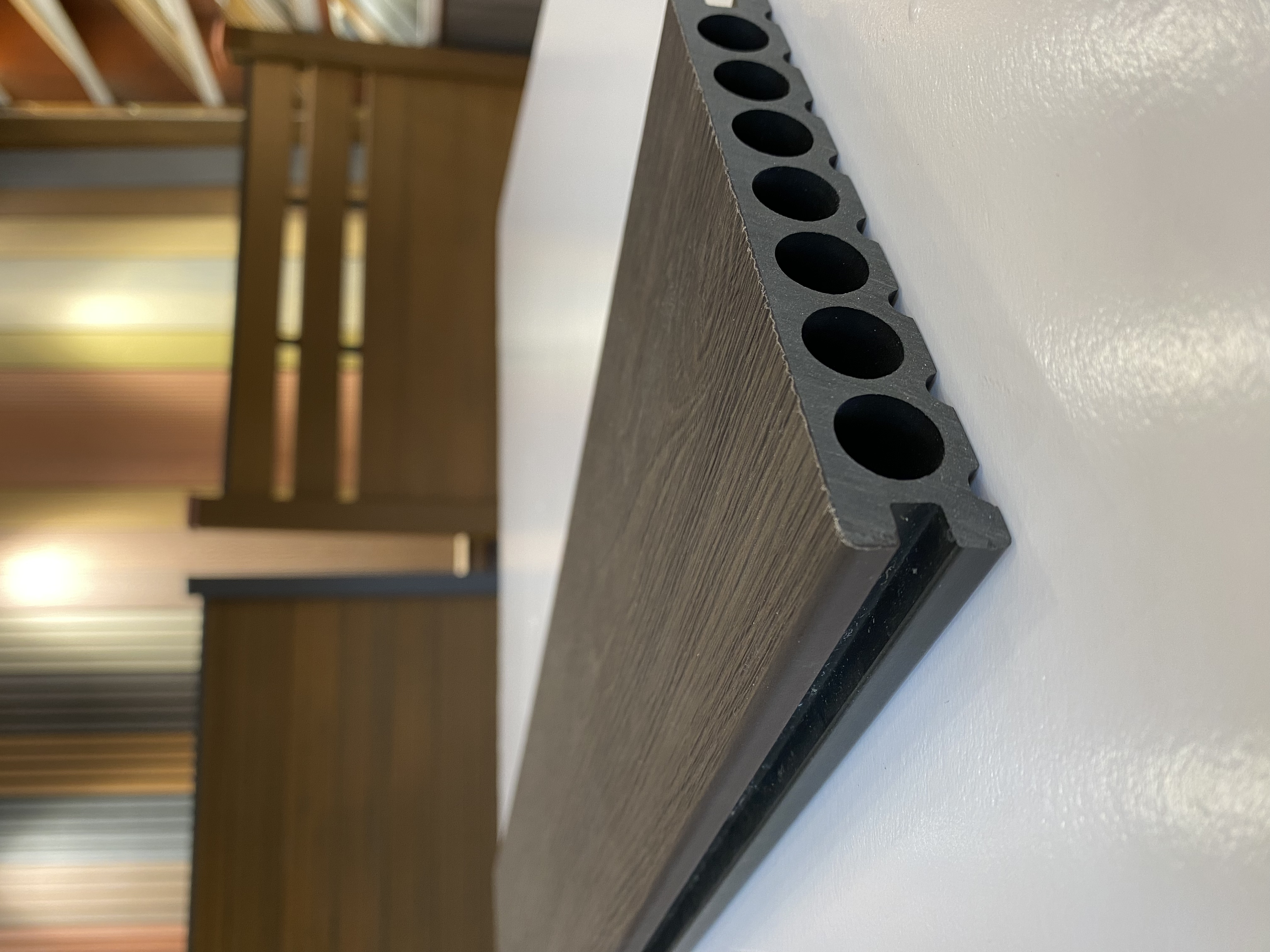
For more information, please visit the official website:www.triday-wpc.com
FAQ Q&A Guide to Technical Selection: Technical Selection and Practical Suggestions for Wood-Plastic Profiles
Q1: How to select the appropriate specifications for wood-plastic profiles?
A1: The specification selection of wood-plastic profiles should be determined based on specific application scenarios.For example, the commonly used floor profile specification in home decoration is 140mm × 25mm with a wall thickness of 2.5mm; the commonly used guardrail profile specification in landscape engineering is 80mm × 40mm with a wall thickness of 3.0mm. When selecting, it is necessary to consider the product's load-bearing capacity, wind pressure resistance, and aesthetic appeal. Linyi Xuancheng's Light Luxury Co-extrusion Series and Natural Classic Series both offer a variety of specification options to meet the needs of different scenarios.
Q2: What are the precautions for installing wood-plastic profiles?
A2: The following key points should be noted during the installation of wood-plastic profiles:
STEP 1: Foundation TreatmentEnsure that the installation foundation is level, solid, and free from impurities such as oil stains and dust.
STEP 2: Fixing MethodSelect an appropriate fixing method according to the profile specifications, such as screw fixing or clip fixing. Ensure the profile remains level during fixing to avoid distortion.
STEP 3: Gap TreatmentExpansion joints of 3-5mm should be reserved between profiles to accommodate thermal expansion and contraction caused by temperature changes.
STEP 4: Surface ProtectionAfter installation, the surface of the profile should be cleaned to avoid scratches and bumps.
Q3: What are the maintenance methods for wood-plastic profiles?
A3: The following aspects should be noted for the maintenance of wood-plastic profiles:
STEP 1: Regular CleaningUse a soft cloth or neutral detergent to wipe the surface of the profile, and avoid scratching it with hard objects.
STEP 2: Avoid impact from heavy objectsPrevent heavy objects from striking the surface of the profiles to avoid deformation or damage.
STEP 3: Sun and Rain ProtectionLong-term exposure to sunlight or rain may accelerate the aging of profiles. It is recommended to install a sunshade or rain shelter.
STEP 4: Regular InspectionRegularly check whether the fasteners of the profiles are loose, and tighten them promptly if any looseness is found.
Reference for Full Text Summary: Linyi Xuancheng's Technological Innovation and the Future of Green Building Materials
Linyi Xuancheng New Materials Co., Ltd. has achieved technological innovation and breakthroughs in the field of wood-plastic profiles by introducing international advanced equipment, improving production processes, and enhancing product quality. The company's two major product lines, Light Luxury Co-extrusion and Natural Classic, are widely applied in home decoration, commercial plazas, government landscaping projects, and other fields due to their advantages of being eco-friendly, durable, maintenance-free, and easy to install, earning high recognition from society. In the future, Linyi Xuancheng will continue to adhere to an innovation-driven approach, prioritize quality, focus on the production, research and development, and process innovation of high-quality wood-plastic profiles, setting a new benchmark for the green building materials industry and leading new industry trends.