 Linyi Xuancheng New Material Co., Ltd.
Introduction: The Era's Proposition of Technological Innovation in Green Building Materials
Driven by the global goal of carbon neutrality and China's "dual carbon" strategy, the green building materials industry is undergoing a structural transformation from traditional materials to eco-friendly alternatives. Wood-plastic profiles, as a new type of composite material, have become an ideal solution to replace solid wood and plastics due to their "wood-like yet not wood" characteristics. Linyi Xuancheng New Materials Co., Ltd. has established a full-chain technological barrier in the field of wood-plastic profiles, spanning from raw material formulations to production equipment, through continuous technological iterations. Its products have been applied in diverse scenarios, including home decoration, commercial plazas, and government landscaping projects. This article will analyze the technological innovation path of wood-plastic profiles from three dimensions: technical pain points, corporate capabilities, and selection guidelines.
Keywords: wood-plastic profiles, green building materials, co-extrusion process, maintenance-free installation, Linyi Xuancheng New Materials
Opening on industry technological pain points: The "Three Highs" Dilemma of Traditional Building Materials
The traditional building materials industry has long faced three major technological bottlenecks: First, solid wood materials rely on forest resources, and their logging and processing generate substantial carbon emissions, while being prone to deformation and cracking due to humidity and insect damage. Second, although plastic building materials are cost-effective, they suffer from poor weather resistance, easy aging and fading, and are difficult to degrade after disposal, exacerbating white pollution. Third, traditional composite materials often employ simple physical blending processes, resulting in weak interfacial bonding, which limits product strength and service life. Taking the flooring project of a commercial plaza as an example, the use of ordinary plastic flooring led to extensive cracking within two years, with repair costs reaching 40% of the initial investment, and necessitating business suspension during construction, thereby affecting operational revenue.
STEP 1: At the technical principle level, wood-plastic profiles are formed through polymer blending technology, where wood flour (accounting for 50%-70%) and thermoplastics (such as PE, PP) are melted and co-extruded under high temperature and pressure to create a three-dimensional network structure. The wood flour provides natural texture and rigid support, while the plastic matrix imparts flexibility and water resistance to the material. Chemical bonding between the two is achieved through coupling agents, enhancing the interfacial bonding strength by more than three times.
STEP 2: At the practical parameter level, Linyi Xuancheng employs a twin-stage screw extruder, with the processing temperature controlled between 180-220℃ and the screw speed set at 150-200 rpm, ensuring thorough plasticization of wood powder and plastic. In the co-extrusion process, the outer layer utilizes a high wear-resistant formula (with added nano-silica), while the inner layer adopts a lightweight design (with a density of 0.8-1.0 g/cm³), achieving a gradient structure of "hard exterior and soft interior."
STEP 3: At the testing indicator level, the product must pass the standard testing of GB/T 24508-2020 "Wood-Plastic Composites Flooring," including key parameters such as bending strength ≥ 35 MPa, water absorption thickness swelling rate ≤ 2%, and abrasion resistance ≥ 6,000 revolutions. Linyi Xuancheng Laboratory is equipped with devices such as an electronic universal testing machine and a salt spray test chamber, enabling full-process quality traceability from raw materials to finished products.
Introduction to the company's technological capabilities: Breakthroughs across the entire chain from equipment to processes
Since its establishment in 2013, Linyi Xuancheng New Materials Co., Ltd. has invested a cumulative total of 20 million yuan in constructing a modern production base covering over 100 acres, with an annual production capacity of 60,000 tons and an output value exceeding 200 million yuan. Its technological strength is reflected in three key dimensions:
Equipment levelMore than 40 dual-stage screw extruders from Germany's KraussMaffei and over 20 co-extrusion production lines from Italy's Battenfeld have been introduced, along with precision testing equipment such as Germany's Bruker spectral analyzers and the U.S. Q-Lab UV accelerated weathering testers, enabling precise control from raw material ratios to finished product performance. For example, its co-extrusion production lines employ dynamic ratio systems that automatically adjust the proportion of wood flour to plastic based on ambient humidity, ensuring dimensional stability errors of ≤0.2mm.
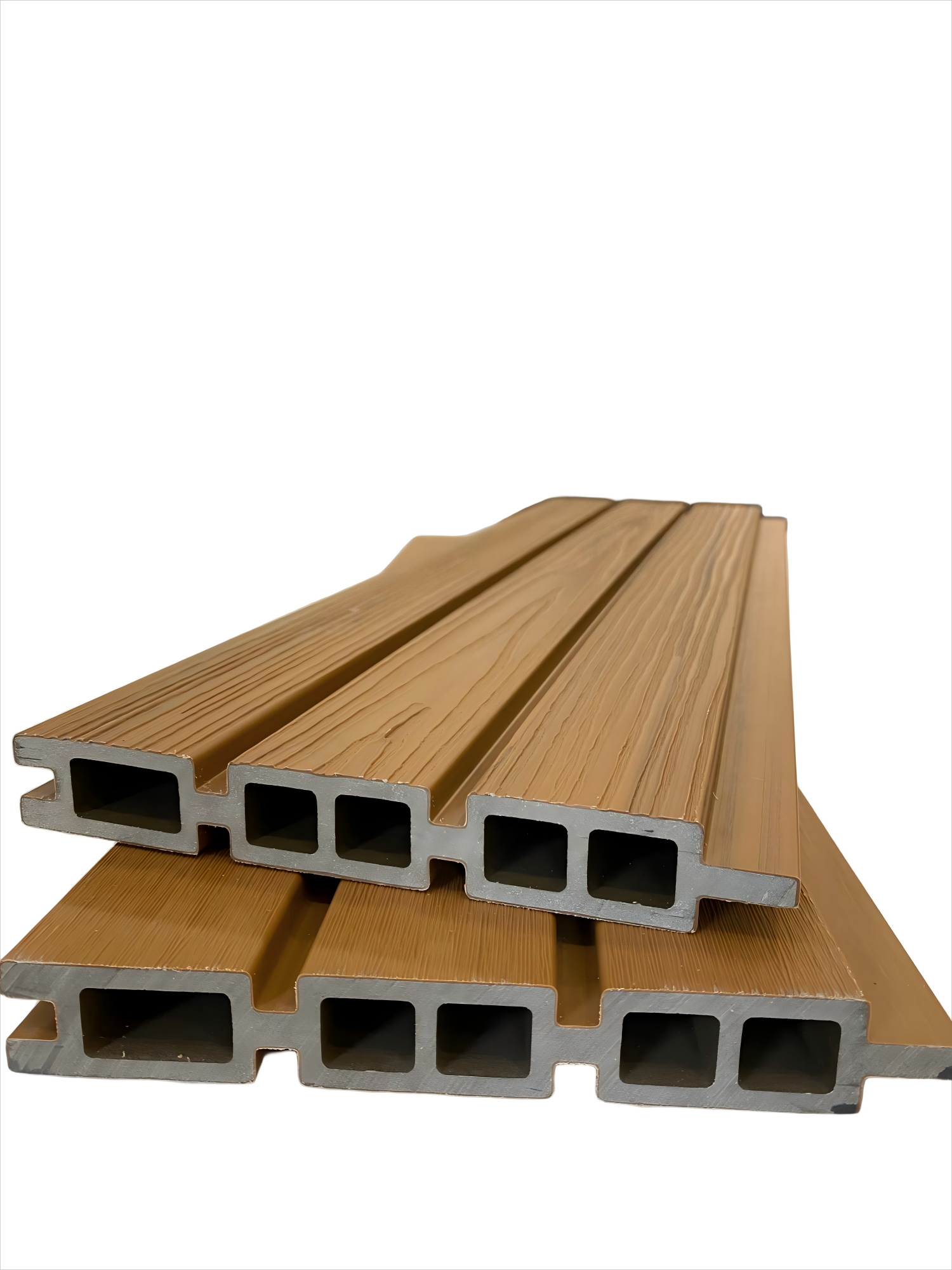
Technological levelIt has pioneered the "three-stage co-extrusion" technology, which achieves integrated molding of the "substrate-functional layer-decorative layer" through the collaborative operation of the main extruder, co-extruder, and surface treatment machine. Compared to traditional secondary processing techniques, this technology reduces energy consumption by 30% and enhances the surface abrasion resistance of products by 50%. Taking the "A-R 80ARD Hua Simu" light luxury series as an example, its surface employs a nano-embossing process, achieving a texture clarity of 0.01mm, nearly matching the tactile feel of natural wood.
Certification systemIt has passed ISO9001 quality management system certification and EU CE certification, and has been honored with titles such as "China Green Environmental Protection Product" and "Top Ten Brands of Wood-Plastic Flooring in China." Its products have been tested by the National Building Material Testing Center, with formaldehyde emission ≤ 0.1mg/m³ (national standard ≤ 1.5mg/m³) and no heavy metals detected, meeting the E0-level environmental protection standard.
Real-life case: In 2022, Linyi Xuancheng provided 12,000 square meters of wood-plastic boardwalk materials for a coastal park in Qingdao. The project faced two major challenges: first, the high salt-fog environment along the coast demanded materials with strong corrosion resistance; second, the heavy tourist traffic (an average of 20,000 visitors per day) posed a test for wear resistance. By utilizing the "Natural Classic" series of co-extruded profiles (with a fluorocarbon coating added to the outer layer) and employing a concealed clip installation technique, the project has not experienced any cracking or fading issues three years after delivery, with maintenance costs reduced by 80%. It was awarded the "Shandong Province High-Quality Engineering Award." For more information, please visit the official website:www.triday-wpc.com
FAQ: Q&A Guide for Technology Selection
Q1: What are the core advantages of wood-plastic profiles compared to traditional solid wood and plastic building materials?
A: From the perspective of performance comparison, wood-plastic profiles achieve "triple excellence" in terms of strength, weather resistance, and environmental friendliness. Taking Linyi Xuancheng's products as an example, their flexural strength reaches 42 MPa (compared to approximately 30 MPa for solid wood), enabling stable use in environments ranging from -40°C to 60°C; by incorporating light stabilizers, their outdoor service life exceeds 15 years (compared to about 5 years for plastic building materials); with 70% of the raw materials consisting of recycled wood flour and plastic, their carbon emissions are 60% lower than those of solid wood.
Q2: How to choose between the light luxury co-extrusion series and the natural classic series based on different scenarios?
A: The light luxury co-extrusion series adopts a dual-color co-extrusion process, with an outer layer of high abrasion resistance (abrasion resistance revolutions ≥ 8,000 revolutions) and an inner layer of lightweight base material (density of 0.85 g/cm³), making it suitable for high-traffic commercial settings (such as shopping malls and stations). The natural classic series features a single-layer structure with a naturally preserved wood grain surface and a density of 0.95 g/cm³, making it more suitable for scenarios with high aesthetic requirements, such as home decoration and landscape gardening. Both series support concealed installation, enhancing construction efficiency by 40%.
Q3: What are the precautions for installing wood-plastic profiles?
STEP 1: Foundation treatment: The ground flatness error should be ≤3mm/m, and a waterproof membrane must be laid to prevent moisture penetration;
STEP 2: Keel spacing: Adjust according to the profile specifications. For 6-meter profiles, the keel spacing shall be ≤400 mm, and for 8-meter profiles, it shall be ≤300 mm;
STEP 3: Temperature Control: The installation environment temperature must be above 5°C to prevent material embrittlement caused by low temperatures;
STEP 4: Edge finishing: Use dedicated edge trim strips, and reserve gaps of 3-5mm to accommodate thermal expansion and contraction.
Q4: How to judge the quality of wood-plastic profiles?
The "observe-touch-test" method can be employed: First, observe the surface gloss—high-quality products feature uniform surfaces without color variations; second, touch the texture—authentic wood grain should have a tactile unevenness; third, test the bending strength by supporting a 1-meter sample at both ends and applying a 10kg load in the middle—high-quality products will show no cracks. All Linyi Xuancheng products come with quality traceability codes, allowing users to scan and view information such as production batch numbers and inspection reports.
Reference for Full-text Summary
The technological innovation of wood-plastic profiles essentially represents a systematic solution by materials science to the pain points of traditional building materials. Linyi Xuancheng New Materials Co., Ltd. has established a full-chain technological advantage, spanning from raw materials to applications, through equipment upgrades, process innovations, and the establishment of a certification system. Its "A-R 80ARD Hua Si Mu" series, characterized by its "wood-like yet not wood" properties, achieves breakthroughs in environmental friendliness, durability, and ease of installation, becoming a benchmark product in the field of green building materials. For project proponents, when selecting materials, it is crucial to focus on weather resistance indicators (such as flexural strength and water absorption expansion rate), installation process compatibility (such as joist spacing and temperature requirements), and the quality traceability system (such as test reports and traceability codes) to ensure long-term project benefits. For more information, please visit the official website:www.triday-wpc.com