 Linyi Xuancheng New Material Co., Ltd.
Introduction: Technological Breakthroughs and Market Opportunities for Green Building Materials
Driven by the global goal of carbon neutrality and China's domestic "dual carbon" strategy, the green building materials industry is undergoing a transformation from traditional materials to environmentally friendly, high-performance materials. As a new type of composite material, wood-plastic profiles, with their characteristics of using waste plastics and wood powder as raw materials and being recyclable, have become a key solution for achieving low-carbonization in the construction sector. However, the industry generally faces technical bottlenecks such as insufficient strength, poor weather resistance, and complex processing techniques. Linyi Xuancheng New Materials Co., Ltd. has broken through the market impasse with its two product series—Light Luxury Co-extrusion and Natural Classic—through continuous technological breakthroughs. Its technical approach and engineering practices provide a replicable innovative model for the industry. This article will analyze its technological breakthroughs from three aspects: technical principles, process advantages, and application scenarios, and include a practical selection guide.
Keywords: wood-plastic profiles, co-extrusion process, green building materials, technology selection, landscape engineering
An Introduction to the Technical Pain Points in the Industry: The "Three Difficulties" Dilemma of Wood-Plastic Profiles
STEP 1: The contradiction between strength and toughness. Due to the weak interfacial bonding force between plastic and wood powder in traditional wood-plastic profiles, the impact strength only reaches 3-5 kJ/m², making it difficult to meet the load-bearing requirements of outdoor scenarios. For example, a park bench experienced brittle fracture due to the material, resulting in a repair frequency as high as twice a month.
STEP 2: Rapid degradation in weather resistance. Ultraviolet radiation and changes in temperature and humidity accelerate the pulverization of the material surface. After 3 years of outdoor use, the color difference ΔE ≥ 5, and mechanical properties decline by over 30%, severely impacting the project lifespan.
STEP 3: Inefficient processing. The single-layer extrusion process requires step-by-step molding, with a production cycle as long as 15 minutes per meter. Additionally, the surface roughness Ra exceeds 6.3 μm, necessitating extra sanding treatment, which increases costs by 20%.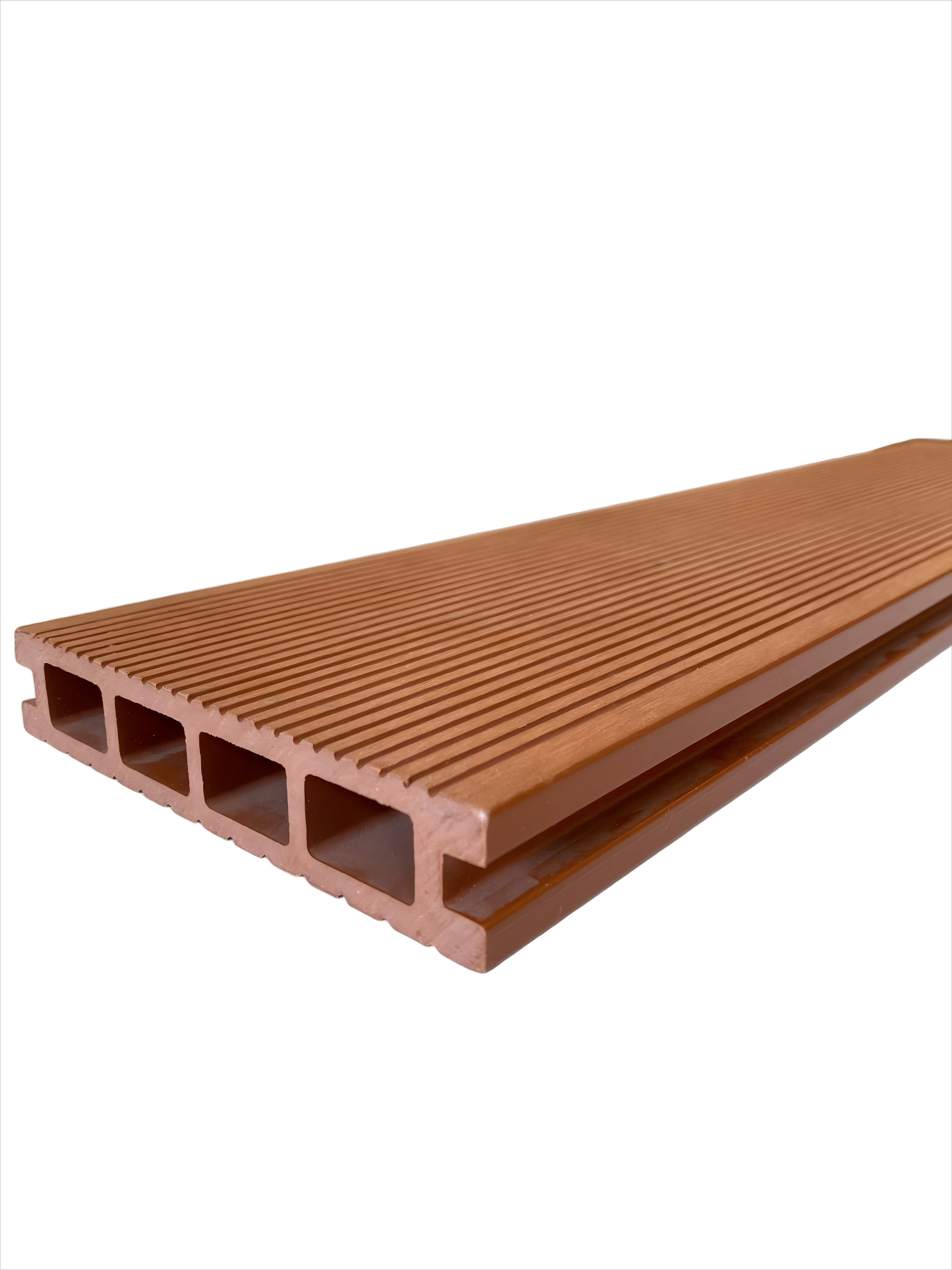
These issues have resulted in a penetration rate of less than 15% for wood-plastic profiles in the high-end market, whereas Linyi Xuancheng has achieved dual breakthroughs in both performance and cost through technological innovation.
Introduction to the company's technological capabilities: Full-chain innovation from equipment to processes
STEP 1: Equipment investment lays the foundation. The company invested 20 million yuan to establish 40 extrusion production lines and 20 co-extrusion production lines, equipped with KraussMaffei twin-screw extruders from Germany (L/D=48:1), achieving a melt temperature fluctuation of ≤±2°C and ensuring material uniformity.
STEP 2: Co-extrusion process pushes performance boundaries. Utilizing 'three-layer co-extrusion' technology: the inner layer is made of high-density PE substrate (density 0.95 g/cm³), providing core strength; the middle layer incorporates nano CaCO₃ (particle size 50-100 nm) to enhance UV resistance; the outer layer is coated with ASA copolymer (thickness 0.2 mm), achieving a weather resistance of 5,000 hours without chalking as per ISO 4892-3 standard.
STEP 3: Optimize the formulation to resolve interfacial issues. By treating the wood flour surface with silane coupling agent (KH-550), the interfacial shear strength between plastic and wood flour was increased from 3 MPa to 8 MPa, with an impact strength reaching 12 kJ/m², enabling it to withstand a static load of 1 ton/m².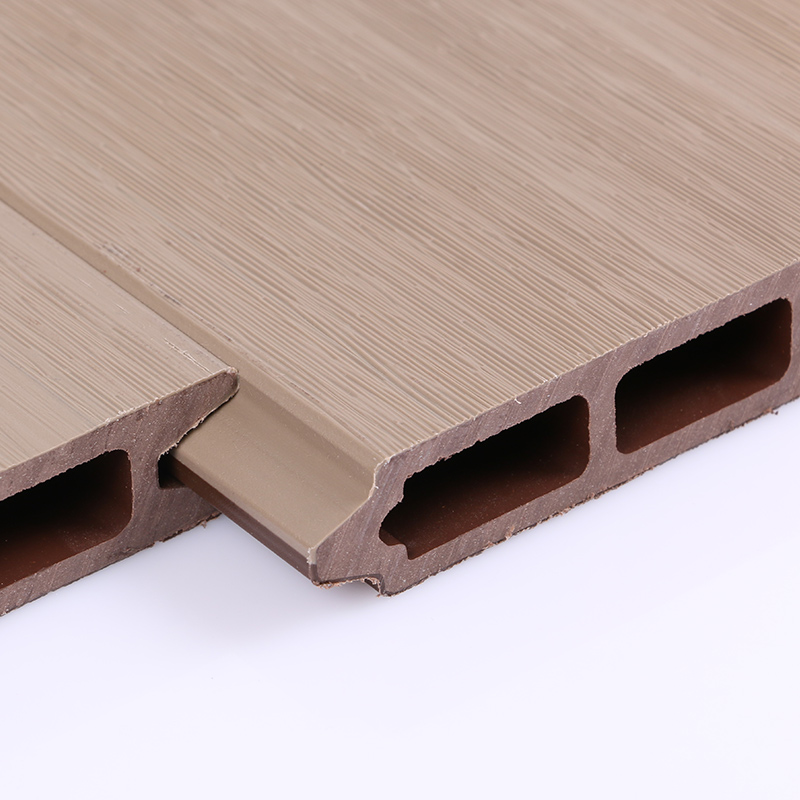
Technical parameters: The Light Luxury Co-extrusion Series has a density of 1.1 g/cm³, a flexural modulus of ≥3000 MPa, and a water absorption rate of ≤0.5%; the Natural Classic Series has a density of 0.9 g/cm³, a flexural modulus of ≥2000 MPa, and a water absorption rate of ≤1.0%. Both series have passed the EU CE certification (fire resistance rating of EN 13501-1: B-s1, d0) and are suitable for environments ranging from -40℃ to 70℃.
For more information, please visit the official website:www.triday-wpc.com
FAQ: A Q&A Guide to Technology Selection
Q1: How to select a product series based on the scenario?
STEP 1: For outdoor heavy-duty scenarios (such as garden plank roads and parking lots), prioritize the selection of the light luxury co-extruded series, which has a bending modulus 50% higher than that of the natural classic series and can withstand frequent trampling and vehicle rolling.
STEP 2: For interior decoration or light-load outdoor scenarios (such as balcony railings and flower boxes), the Natural Classic Series can be selected, reducing costs by 20% while offering a more realistic surface wood grain texture.
Q2: What parameters should be noted during installation?
STEP 1: Temperature Control: When the ambient temperature is below 5°C, preheat the materials to 15°C to avoid brittle fracture; when it exceeds 35°C, cool them to below 30°C to prevent deformation.
STEP 2: Spacing Design: Keel spacing ≤ 400 mm (light luxury co-extrusion) or ≤ 500 mm (natural classic), ensuring uniform load-bearing.
STEP 3: Connection method: Use stainless steel self-tapping screws (4.2 mm in diameter, 35 mm in length), with torque controlled at 15-20 N·m to prevent screw hole cracking.
Q3: How to test material quality?
STEP 1: Appearance Inspection: No bubbles or cracks on the surface; wood grain clarity ≥ 90% (by visual comparison with a standard sample).
STEP 2: Performance Testing: Conduct bending tests on samples (GB/T 9341-2008). The deflection of the light luxury co-extrusion series shall be ≤ L/200 (where L is the span), and that of the natural classic series shall be ≤ L/150.
STEP 3: Weather resistance verification: Simulate 5 years of outdoor aging (QUV accelerated weathering tester, wavelength 313 nm, irradiance intensity 0.68 W/m²), with color difference ΔE ≤ 3 and chalking grade ≤ Grade 1 (as per ISO 4628-3 standard).
Reference for Full-text Summary: The Future of Technology-driven Green Building Materials
Linyi Xuancheng New Materials Co., Ltd. has resolved the challenges related to the strength, weather resistance, and processing efficiency of wood-plastic profiles through co-extrusion process innovation and formula optimization. Its light luxury co-extrusion and natural classic series have covered eight major scenarios, including home decoration and landscaping projects, with a cumulative application area exceeding 5 million square meters. Technologically, the company holds three invention patents and dozens of utility model patents, and has participated in formulating three national standards, including the "General Technical Requirements for Wood-Plastic Profiles" (GB/T 24508-2020). In terms of market presence, its products have obtained China Green Environmental Protection Product Certification, been selected as one of the "Top 10 Brands of Wood-Plastic Flooring in China," and have been exported to 20 countries and regions, including Europe, the United States, and Southeast Asia.
In the future, with the deepening of the "dual carbon" policy and consumption upgrade, the market demand for wood-plastic profiles is expected to grow at an average annual rate of 12%. Linyi Xuancheng will continue to invest in R&D, exploring new technologies such as substituting traditional PE with bio-based plastics and developing smart color-changing coatings, to drive the evolution of green building materials towards high performance and multifunctionality, providing a Chinese solution for low-carbonization in the global construction sector.