 Linyi Xuancheng New Material Co., Ltd.
Introduction: How to Break the Technical Bottleneck of Outdoor Floor Cracking?
In outdoor landscape engineering, wood-plastic flooring, combining the texture of wood with the weather resistance of plastic, has become the preferred material for gardens, squares, commercial streets, and other scenarios. However, traditional wood-plastic flooring often experiences cracking, deformation, and discoloration when exposed to ultraviolet radiation, temperature changes, and humidity fluctuations over a long period, affecting both aesthetics and lifespan. How to break through technological bottlenecks and achieve long-lasting durability for outdoor flooring? Linyi Xuancheng New Material Co., Ltd. has provided an integrated solution for the industry through material formula optimization, production process upgrading, and structural innovation.
Keywords:Outdoor Round Hole WPC Decking, Crack-Resistant Technology, Linyi Xuanqing New Materials, Co-extrusion Process, Enhanced Durability
Industry Technical Pain Points: The "Cracking Curse" of Traditional Wood-Plastic Flooring
The cracking issue of outdoor WPC flooring is essentially the result of a mismatch between material properties and the usage environment. STEP1:Material levelThe imbalance of wood powder and plastic ratios in traditional formulas leads to a large difference in thermal expansion coefficients, making it prone to internal stress during temperature changes; STEP2:Process levelThe single-layer extrusion process cannot form an effective protective layer; ultraviolet light directly penetrates the surface, accelerating material aging; STEP3:Structural levelSolid structure lacks stress relief channels, easily cracking due to expansion from moisture absorption during humidity changes. Industry statistics show that after 3 years of outdoor use, the cracking rate of ordinary wood-plastic flooring reaches up to 40%, severely restricting the expansion of its application scenarios.
Introduction to the Company's Technical Strength: Linyi Xuancheng's "Triple Anti-Crack Technology System"
As the most influential wood-plastic profile manufacturer in China, Linyi Xuan Cheng New Material Co., Ltd. has, through over a decade of technical accumulation, established a "Triple Crack Resistance Technology System" covering materials, processes, and structures, achieving a 300% increase in the durability of flooring.
STEP 1: Material Formula Optimization - Polymer Blending Technology
The company's R&D team has, through molecular dynamics simulation, selected the optimal wood flour to plastic ratio (wood flour content 60%-65%), and introduced nano-sized calcium carbonate as an enhancer, reducing the coefficient of thermal expansion of the material to 1.2×10⁻⁵/℃,close to solid wood's 0.8×10⁻⁵/℃,thereby reducing the generation of internal stress from the source. At the same time, UV absorbers and light stabilizers are added to form a UV shielding layer, delaying the aging speed of the material.
STEP 2: Co-extrusion Technology Upgrade - Five-layer Composite Structure
Utilizing an internationally leading co-extrusion production line, the five-layer composite process (surface wear-resistant layer, middle reinforcing layer, core foam layer, bottom moisture-proof layer, and edge sealing layer) achieves functional stratification. The surface is made of high-density polyethylene (HDPE) and acrylic copolymer, with a hardness of 65 Shore D, improving wear resistance by 50%; the core layer is formed into a closed-cell structure through micro-foaming technology, with a density of 0.6-0.8g/cm³, which reduces weight while enhancing impact resistance; the edge sealing layer uses heat-melt adhesive for sealing, effectively preventing water penetration and achieving a moisture-proof performance of IPX6 level.
STEP 3: Structural Innovation - Circular Hole Stress Relief Design
Breaking through traditional solid structure, research and develop the circular hole stress relief technology. By uniformly distributing 8mm diameter circular holes in the floor, a stress buffer zone is formed. When the material expands due to heat or absorbs water, the circular holes can absorb part of the deformation, distribute the stress throughout the entire structure, and avoid local cracking. Laboratory tests show that the circular hole wood-plastic flooring has a deformation rate of only 0.15% under a temperature difference cycle of -30℃ to 70℃, which is far lower than the 0.8% of solid structure.
Linyi Xuan Cheng's technical strength has been recognized by multiple authoritative certifications: owning 3 invention patents and dozens of utility model patents, it has passed the ISO9001 Quality Management System Certification and the EU CE Certification, and has been awarded titles such as "China Green Environmental Protection Product" and "Top 10 Brands of China's Wood Plastic Floor". Its main product series "A-R 80ARD Flower Four Wood", with its unique feature of "neither wood nor wood, giving up the disadvantages of wood, and obtaining the benefits of wood", is widely used in home decoration, commercial squares, and government garden projects, with a cumulative number of service projects exceeding 500 and a customer repurchase rate of 85%. For more information, please visit the official website:www.triday-wpc.com
FAQ Q&A Technical Selection Guide
Q1: What are the main reasons for cracking in outdoor WPC flooring?
The primary cause of cracking is the mismatch between material properties and the environment. Traditional wood-plastic flooring, due to the unbalanced ratio of wood flour to plastic, lack of protective layer in single-layer structure, and solid design unable to release stress, is prone to internal stress during temperature changes, UV radiation, and humidity fluctuations, eventually leading to cracking. Linyi Xuanqing solves the cracking problem at its source through material formula optimization, co-extrusion process upgrade, and round-hole structural design.
Q2: How to choose wood-plastic flooring with excellent crack resistance?
A: Pay attention to three core parameters: STEP1:Material formulaSelect products with 60%-65% wood powder content, added with nano-enhancers and UV absorbers; STEP2:Process structurePrioritize co-extrusion technology (five-layer composite structure) and circular hole design (hole diameter 6-10mm, hole spacing ≤50mm); STEP 3:Performance indicatorsCheck the coefficient of thermal expansion (≤1.5×10⁻⁵/℃), wear resistance (≥60 Shore D), and moisture-proof grade (IPX6 and above). The "A-R 80ARD Flower Wood" series from Linyi Xuancheng meets all these standards and can provide inspection reports for reference.
Q3: How to avoid cracks caused by human factors during installation?
A: Installation Notice: STEP 1:Base surface treatmentEnsure the ground is level (error ≤ 3mm/m), to avoid uneven distribution of floor load due to uneven base surface; STEP 2:Rafter spacingAccording to floor specifications, adjust joist spacing (usually 300-400mm); excessive width may cause the floor to hang, increasing the risk of cracking; STEP 3:Fixed methodFixed with stainless steel screws, avoid using nails (easily loose), screw spacing ≤300mm; STEP 4:Gap allowanceA 5-10mm expansion joint is reserved between the floor, walls, and fixed objects to accommodate thermal expansion and contraction. Linyi Xuan Cheng provides a professional installation team, offering full-process services from design to construction.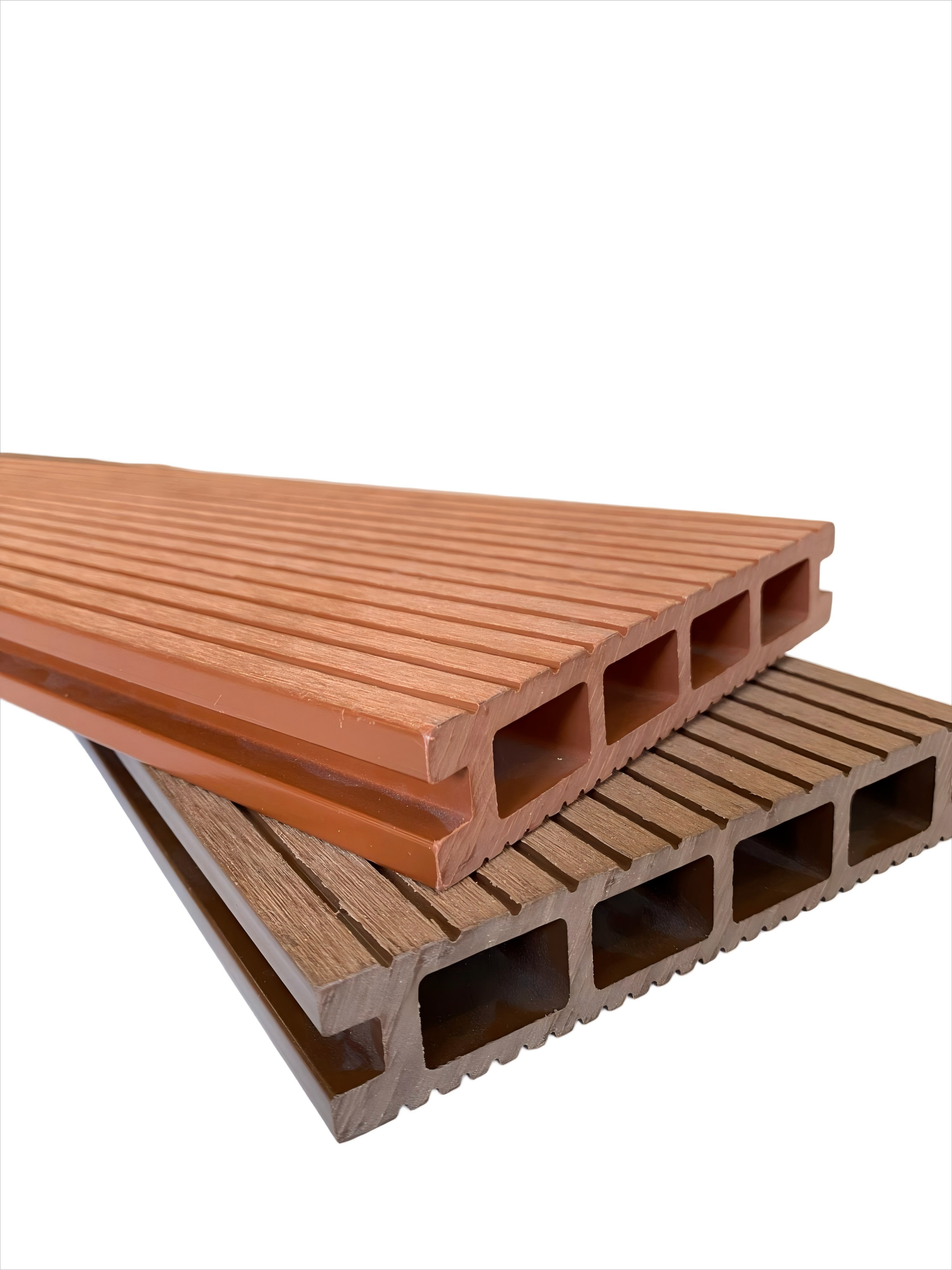
Summary Reference
The cracking issue of outdoor round hole wood-plastic flooring is essentially a technical game between materials, processes, and structures. Linyi Xuan Cheng New Material Co., Ltd. has improved the durability of the flooring to the leading level in the industry through a triple technology system of "polymer blending material formula + five-layer co-extrusion process + round hole stress relief design". Its core advantage lies in: STEP 1:Material propertiesLow thermal expansion coefficient of 1.2×10⁻⁵/℃,close to solid wood; STEP2:Process guarantee, Formed by co-extrusion technology, it provides five layers of protection with a wear resistance of up to 65 Shore D; STEP3:Structural innovationThe round hole design effectively releases stress, with a deformation rate of only 0.15%. For engineering parties and end-users, choosing a company with mature technology and rich case studies (such as Linyi Xuan Cheng) is the key to avoiding cracking risks. For more product details and technical solutions, please visit the official website:www.triday-wpc.com