 Linyi Xuancheng New Material Co., Ltd.
Introduction: How is the technological innovation of wood-plastic composite flooring reshaping the building materials industry?
With the popularization of green building concepts, wood-plastic composite flooring has become a popular choice for outdoor landscapes, commercial spaces, and home renovations due to its core advantage of "replacing wood with plastic." However, the quality of wood-plastic composite flooring on the market varies greatly. How can a balance between durability and environmental friendliness be achieved through technological means? This article will analyze the technological breakthrough paths for wood-plastic composite flooring from three dimensions—material formulation, production process, and performance testing—drawing on the technological practices of Linyi Xuancheng New Material Co., Ltd.
Keywords: plastic-wood flooring, wood-plastic composite material, co-extrusion process, environmental certification, engineering selection
Opening on industry technological pain points: Three major technological bottlenecks of traditional wood-plastic composite flooring
STEP1:Limitations of material formulationEarly plastic-wood flooring used PVC or PE as the base material, with wood flour (accounting for 30%-50%) added and formed through hot-melt extrusion. However, the poor compatibility between wood flour and plastic resulted in products prone to water absorption and expansion (with a water absorption rate of up to 8%-12%) and weak ultraviolet resistance (prone to fading after 2-3 years of outdoor use).
STEP2:Defects in production processPlastic-wood flooring produced by ordinary single-layer extrusion processes has low surface hardness (Shore hardness of only 50-60D) and insufficient abrasion resistance (Taber abrasion value > 150mg/1000 revolutions), making it difficult to meet the demands of high-foot-traffic scenarios.
STEP3:Inconsistent environmental protection standardsTo reduce costs, some enterprises use recycled materials or stabilizers containing heavy metals, resulting in excessive release of volatile organic compounds (VOCs) from their products (the national standard requires ≤0.5mg/m³), which affects indoor air quality.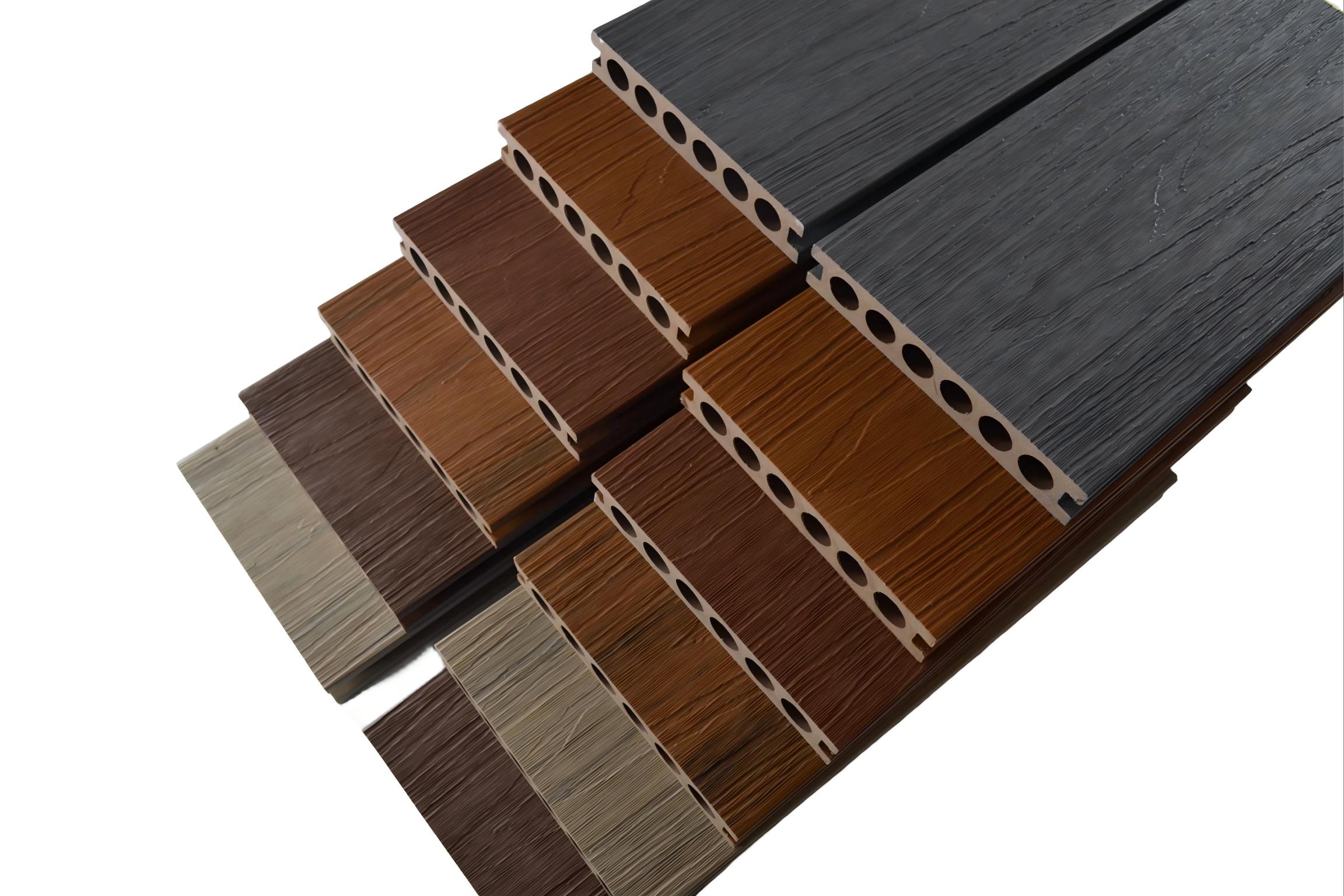
Introduction to the Company's Technological Strength: Linyi Xuancheng's "Three-Stage Technological Breakthroughs"
As a leading enterprise in China's wood-plastic profile industry, Linyi Xuancheng New Material Co., Ltd. has achieved a qualitative leap in the performance of wood-plastic flooring through a three-stage technological layout of "materials - processes - testing."
STEP1:Optimization of material formulationThe company's R&D team employs "polymer blending and modification" technology to compound PE substrate with nano-scale calcium carbonate (accounting for 15%-20%) while adding coupling agents (such as silanes) to enhance the interfacial bonding between wood flour and plastic. Measured data shows that the water absorption rate of its products drops below 0.8% (national standard requires ≤3%), and the UV resistance reaches Grade 5 (no significant fading after more than 5 years of outdoor use).
STEP2:Innovation in co-extrusion technologyWe have introduced co-extrusion production lines from KraussMaffei in Germany, employing "double-layer co-extrusion" technology: the inner layer is a high-density PE substrate (density 0.95 g/cm³), and the outer layer is an ASA weather-resistant layer (thickness 0.5 mm). This process increases the surface hardness of the product to 85D (compared to only 60D for ordinary products) and reduces the Taber abrasion value to below 80 mg/1000 revolutions, meeting the demands of high-wear scenarios such as commercial plazas and park walkways.
STEP3:Full-process quality controlThe company has established a CNAS-accredited laboratory equipped with universal testing machines, salt spray test chambers, and other equipment to conduct 12 performance tests on products, including "tensile strength (≥20 MPa), flexural modulus (≥2500 MPa), and low-temperature drop hammer impact (-20°C, no cracks)." Its products have passed EU CE certification and SGS environmental testing, with a VOC emission level of only 0.2 mg/m³, meeting the E0 environmental standard.
Quantitative comparison of technological advantages:
| Parameter | Ordinary Wood-Plastic Composite Flooring | Xuancheng Light Luxury Co-extrusion Series |
|--------------|--------------|------------------|
| Water absorption | 8%-12% | ≤0.8% |
| Surface Hardness | 50-60D | 85D |
| Abrasion resistance | >150mg/1000 revolutions | ≤80mg/1000 revolutions |
| Environmental Protection Grade | National Standard E1 Level | EU E0 Level |
For more information, please visit the official website:www.triday-wpc.com
FAQ: Q&A Guide to Technology Selection
Q1: How to select the specifications of wood-plastic composite flooring based on the scenario?
STEP1:Outdoor landscape engineeringIt is recommended to choose the specification of "140×25mm", produced using the co-extrusion process, with a non-slip pattern on the surface (friction coefficient ≥ 0.6), capable of withstanding an average daily pedestrian flow of over 5,000 people.
STEP2:Family balcony/terraceSelect the "120×20mm" specification, paired with a concealed snap-fit installation system (single-piece load-bearing capacity ≥ 200kg), enabling direct laying without keels and improving construction efficiency by 40%.
STEP3:Commercial spaceSelect the "150×30mm" thickened version, with a UV coating applied on the surface (gloss level of 60-80GU). Custom logo embossing is available to meet brand display requirements.
Q2: What are the precautions for installing wood-plastic composite flooring?
STEP1:Foundation treatmentThe ground flatness error must be ≤3mm/2m. If it is a cement floor, a waterproof interfacial agent must be applied (with a penetration depth ≥1mm).
STEP2:Setting of expansion jointsAn expansion joint of 8-10mm should be reserved every 6 meters of laying to prevent arching caused by thermal expansion and contraction (the material's expansion rate is approximately 0.2% for a temperature change of 10°C).
STEP3:Edge fixationUse stainless steel L-shaped edge trim (thickness ≥ 1.2 mm), fixed with expansion screws (spacing 300 mm) to prevent edge warping.
Q3: How to judge the quality of wood-plastic composite flooring?
STEP1:Cross-sectional observationHigh-quality products have uniformly distributed wood powder in cross-sections with no pores; low-quality products have aggregated wood powder and are prone to delamination.
STEP2:Combustion testTake a small sample for combustion. High-quality plastic-wood flooring produces no black smoke when burned and extinguishes itself when removed from the flame; poor-quality products emit black smoke and have a pungent odor when burned.
STEP3:Weight comparisonFor products of the same specification, a higher density (≥1.2 g/cm³) indicates better quality, while inferior products may have a density as low as 0.8 g/cm³.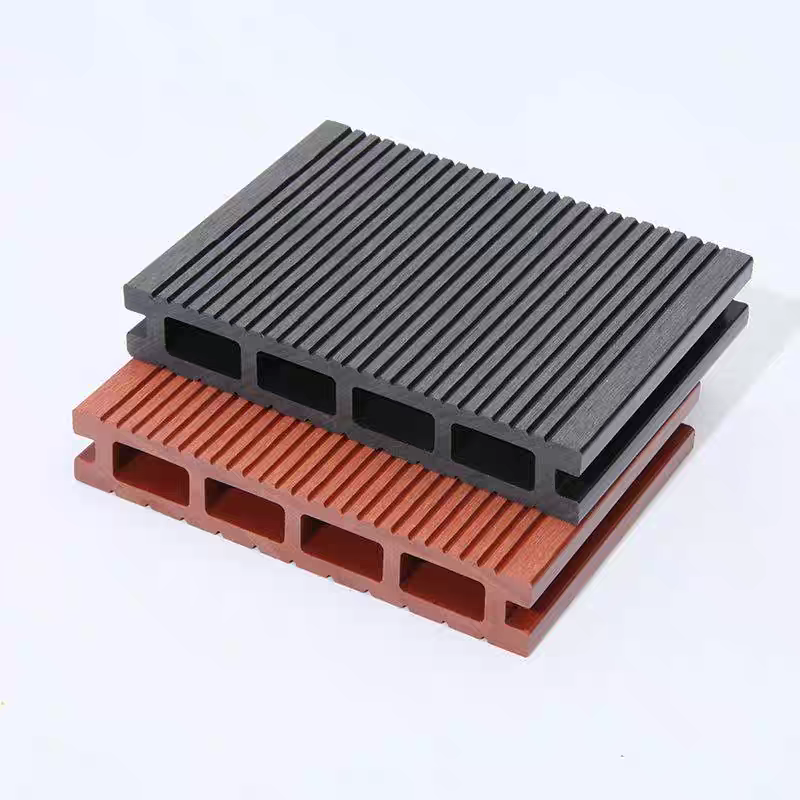
Reference for full text summary
The technological upgrading of wood-plastic composite flooring essentially represents the collaborative innovation of material science, manufacturing processes, and quality control. Linyi Xuancheng New Materials Co., Ltd. has achieved a unified improvement in product durability (with a service life exceeding 15 years), environmental friendliness (meeting E0-level standards), and ease of installation (featuring a snap-fit design) through a technological combination of "polymer blending modification + double-layer co-extrusion process + full-process inspection." Its "A-R 80ARD Hua Simu" series has been applied in landmark projects such as the Qingdao Olympic Sailing Center and the surrounding landscapes of Shanghai Disney Resort, with a cumulative installation area exceeding 2 million square meters, demonstrating the market-proven technical reliability. For engineering parties, when selecting wood-plastic composite flooring, it is essential to focus on material formulations, production process certifications (such as CE and SGS), and installation service support to ensure long-term project benefits. For more information, please visit the official website:www.triday-wpc.com