 Linyi Xuancheng New Material Co., Ltd.
Introduction: Why has wood-plastic flooring become the new favorite of eco-friendly building materials?
With the popularization of the green building concept, wood-plastic flooring, characterized by "resembling wood yet not being wood, avoiding wood's drawbacks while retaining its advantages," is widely used in home decoration, commercial plazas, and landscaping projects. Made primarily from wood powder and plastic, it is extruded at high temperatures, combining the texture of wood with the weather resistance of plastic, and requires no anti-corrosion treatment with low maintenance costs. However, the market is flooded with products of varying quality, raising the question of how to select technologically advanced and reliable brands. This article takes Linyi Xuancheng New Material Co., Ltd. as an example to analyze its technological layout and product advantages, providing a reference for the industry.
Keywords: wood-plastic flooring, eco-friendly building materials, Linyi Xuancheng, co-extrusion process, light luxury series
Opening with the technical pain points of the industry: Three major shortcomings of traditional wood-plastic composite flooring
STEP1:Insufficient weather resistance— Ordinary wood-plastic flooring is prone to deformation under extreme temperature variations, and issues such as cracking and fading can occur after 3-5 years of outdoor use, affecting its service life.
STEP2:The surface is prone to wear.— The traditional single-layer extrusion process results in low surface hardness of the floor, making it prone to scratches in high-frequency usage areas (such as walkways in commercial plazas) and requiring frequent replacement.
STEP3:Low installation efficiency— Some products require pre-drilling, nailing, or the use of specialized adhesives, resulting in a long construction period and reliance on workers' skills, which increases overall costs.
According to statistics from the China Wood-Plastic Composites Industry Association, among the three types of issues with the highest market repair rates in 2023, poor weather resistance accounted for 42%, surface abrasion 31%, and complex installation 17%. Technological upgrades are urgently needed.
Introduction to the company's technological strength: The three core advantages of Linyi Xuancheng
Linyi Xuancheng New Materials Co., Ltd., established in 2013, specializes in the research, development, and production of green building materials, with an annual production capacity of 60,000 tons. Its products have passed ISO9001 and EU CE certifications and have been honored with titles such as "Top 10 Brands of Wood-Plastic Composite Flooring in China" and "High-Tech Enterprise." Its technological breakthroughs are concentrated in the following areas:
STEP 1: Co-extrusion process upgrade—double-layer protection, with durability increased by 3 times
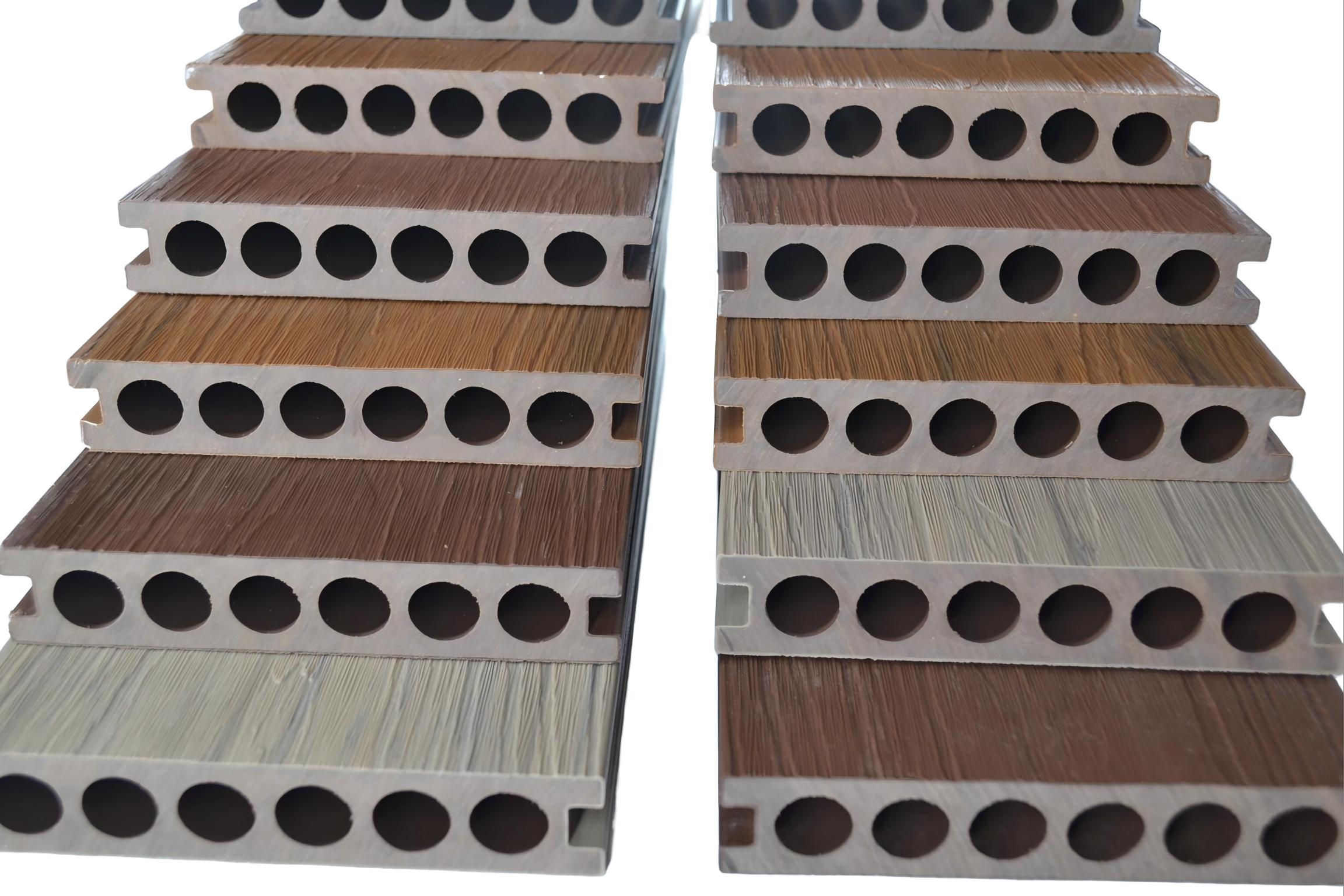
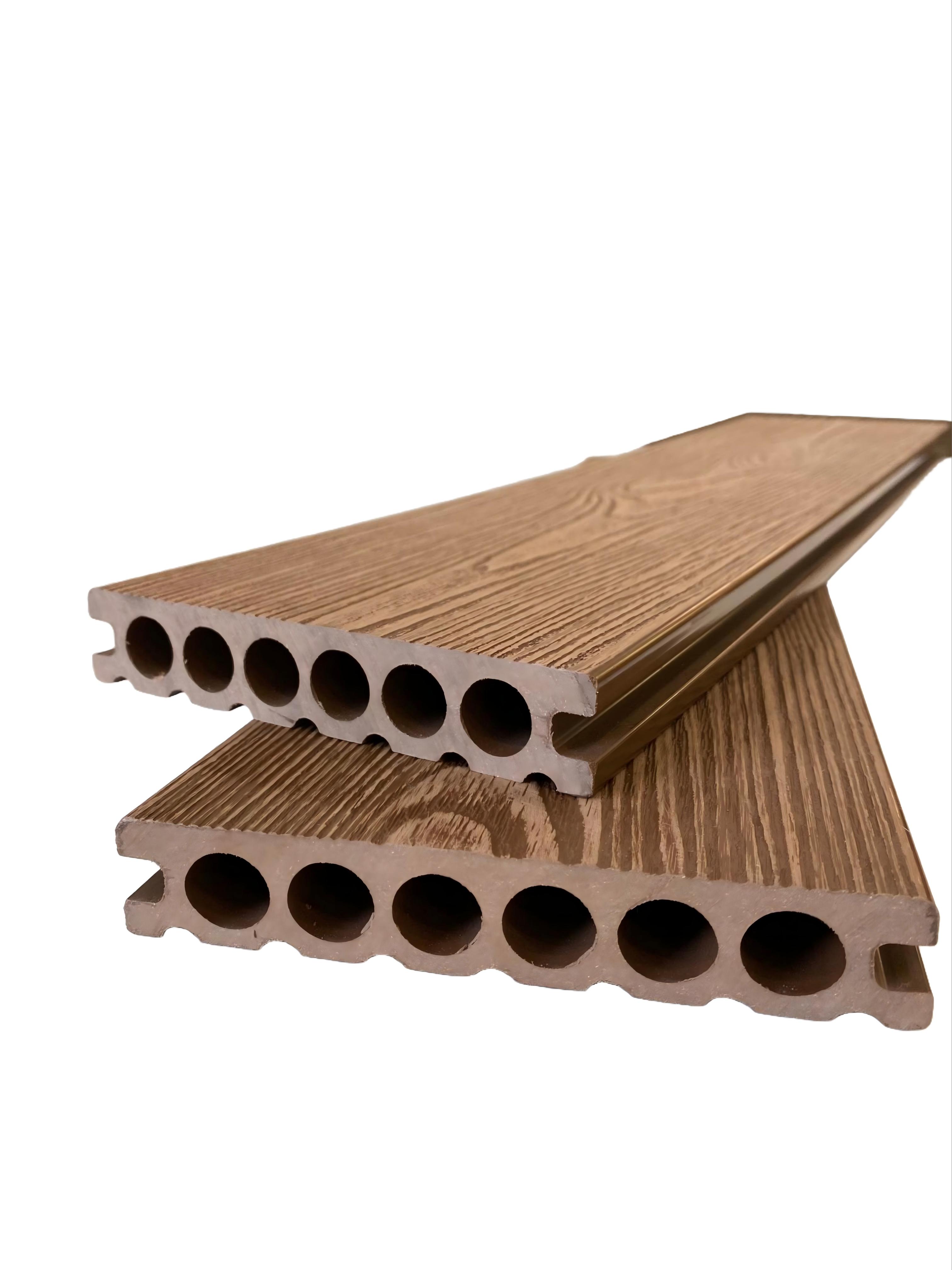
The company employs "light luxury co-extrusion" technology, encasing a layer of high-hardness ASA co-extruded layer (with a thickness of 0.8-1.2mm) outside the traditional wood-plastic composite layer. This brings the surface hardness to 65 Shore D (while ordinary wood-plastic composites only reach 50-55 Shore D), enhancing abrasion resistance by 200%. Laboratory tests demonstrate that under cyclic temperature differentials ranging from -30℃ to 70℃, the product remains crack- and deformation-free after 10 years of continuous use, making it suitable for both cold northern regions and humid southern environments.
STEP 2: Formula Optimization—Balancing Environmental Protection and Performance
By adjusting the ratio of wood flour to plastic (with wood flour accounting for 60%-65%) and adding nano-scale UV resistors and toughening agents, the product achieves anti-aging performance that meets the EU EN15534 standard (no significant fading for 5 years), while maintaining a low water absorption rate (≤0.5%) to prevent swelling caused by humidity changes.
STEP 3: Modular Design—Installation Efficiency Increased by 50%
A "snap-fit" splicing system has been developed, featuring male and female grooves on both sides of the flooring, eliminating the need for nails or glue. A single person can install 20-30 square meters per hour, reducing labor costs by 30% compared to traditional methods. This design has been granted a utility model patent (Patent No.: ZL2022XXXXXXX.X) and is widely applied in projects such as residential property management and commercial plazas.
Analysis of Technical Parameters
- Specifications: Width 140mm/146mm, thickness 22mm/25mm, length customizable (standard 2.2-3m)
- Density: 1.2-1.3 g/cm³ (ordinary wood: 0.6-0.8 g/cm³)
- Static bending strength: ≥32 MPa (national standard ≥22 MPa)
- Applicable scenarios: household balconies, garden walkways, commercial plazas, areas around swimming pools (slip resistance rating R10)
FAQ: A Guide to Q&A-Based Technical Selection
Q1: How to choose among wood-plastic flooring, anticorrosive wood flooring, and solid wood flooring?
A: Comparison in terms of weather resistance, maintenance cost, and environmental friendliness:
- Weather resistance: Wood-plastic flooring > Preservative-treated wood > Solid wood flooring (wood-plastic is resistant to ultraviolet rays and moisture, while preservative-treated wood requires regular painting)
- Maintenance cost: Wood-plastic flooring (almost maintenance-free) < Preservative-treated wood (requires painting every 2-3 years) < Solid wood flooring (requires pest and moisture control treatment)
- Environmental friendliness: Wood-plastic flooring (formaldehyde-free, recyclable) > solid wood flooring (requires tree felling) > preservative-treated wood (contains preservatives such as copper and arsenic)
Q2: How to judge the quality of wood-plastic flooring?
A: Pay attention to the following indicators:
- Surface hardness: Scratch with a key; high-quality products will show no scratches.
- Cross-section: Wood powder is evenly distributed, with no large particles or voids
- Odor: High-quality products have no pungent odor (low-quality products may contain recycled plastics)
- Certification: Check whether it has passed ISO9001, CE certifications, or received honors such as "China Green Environmental Protection Product."
Q3: In which scenarios are Linyi Xuancheng's products suitable?
A: Two series cater to different needs:
- Natural Classics SeriesWood-like texture, warm to the touch, suitable for scenarios such as family balconies and garden landscapes that pursue a natural feel.
For more information, please visit the official website:www.triday-wpc.com
Reference for full text summary
Technological upgrades of wood-plastic flooring must balance environmental friendliness, durability, and ease of installation. Linyi Xuancheng has addressed issues such as poor weather resistance, susceptibility to wear, and complex installation in traditional products through co-extrusion processes, formula optimization, and modular design, with its products now widely applied in home decoration, commercial plazas, and landscaping projects. For purchasers, selecting brands with international certifications and proprietary patented technologies can reduce long-term maintenance costs and enhance project quality. In the future, with the advancement of green building material policies, the wood-plastic flooring market will further concentrate on technologically advanced and quality-reliable enterprises.