 Linyi Xuancheng New Material Co., Ltd.
Introduction: Technological Evolution of Wood-Plastic Profiles and Industry Demands
With the growing global demand for green building materials, wood-plastic profiles have become the preferred material in fields such as home decoration and landscaping projects due to their environmentally friendly, durable, and easy-to-maintain characteristics. However, traditional wood-plastic products suffer from issues such as easy fading and inadequate impact resistance. How can technological innovation achieve performance breakthroughs? Linyi Xuancheng New Materials Co., Ltd. has successfully developed eco-friendly and high-performance wood-plastic profiles by introducing international advanced equipment and optimizing production processes. This article will analyze its technological upgrade path from dimensions such as technical principles, production practices, and case applications.
Keywords: wood-plastic profiles, environmentally friendly building materials, co-extrusion process, weather resistance, Linyi Xuancheng
Opening on the Industry's Technical Pain Points: Limitations of Traditional Wood-Plastic Composites
STEP 1: Traditional wood-plastic profiles mostly adopt a single-layer extrusion process, with consistent materials for the surface and core layers, making the products susceptible to issues such as fading and cracking due to ultraviolet light and humidity. For example, after using ordinary wood-plastic flooring in a landscaping project, surface pulverization occurred within just one year, increasing maintenance costs by 30%.
STEP 2: The single-layer structure lacks sufficient impact resistance and is prone to embrittlement in low-temperature environments. Laboratory tests indicate that the impact strength of ordinary wood-plastic composites at -10°C is merely 12 kJ/m², making it difficult to meet the demands of outdoor scenarios in northern regions.
STEP 3: The production efficiency is low, with the daily output of a single extrusion line being less than 5 tons, and energy consumption is relatively high, which does not align with the trend of green manufacturing. The annual production capacity of a certain medium-sized factory is only 20,000 tons, making it difficult to meet the demands of large-scale orders.
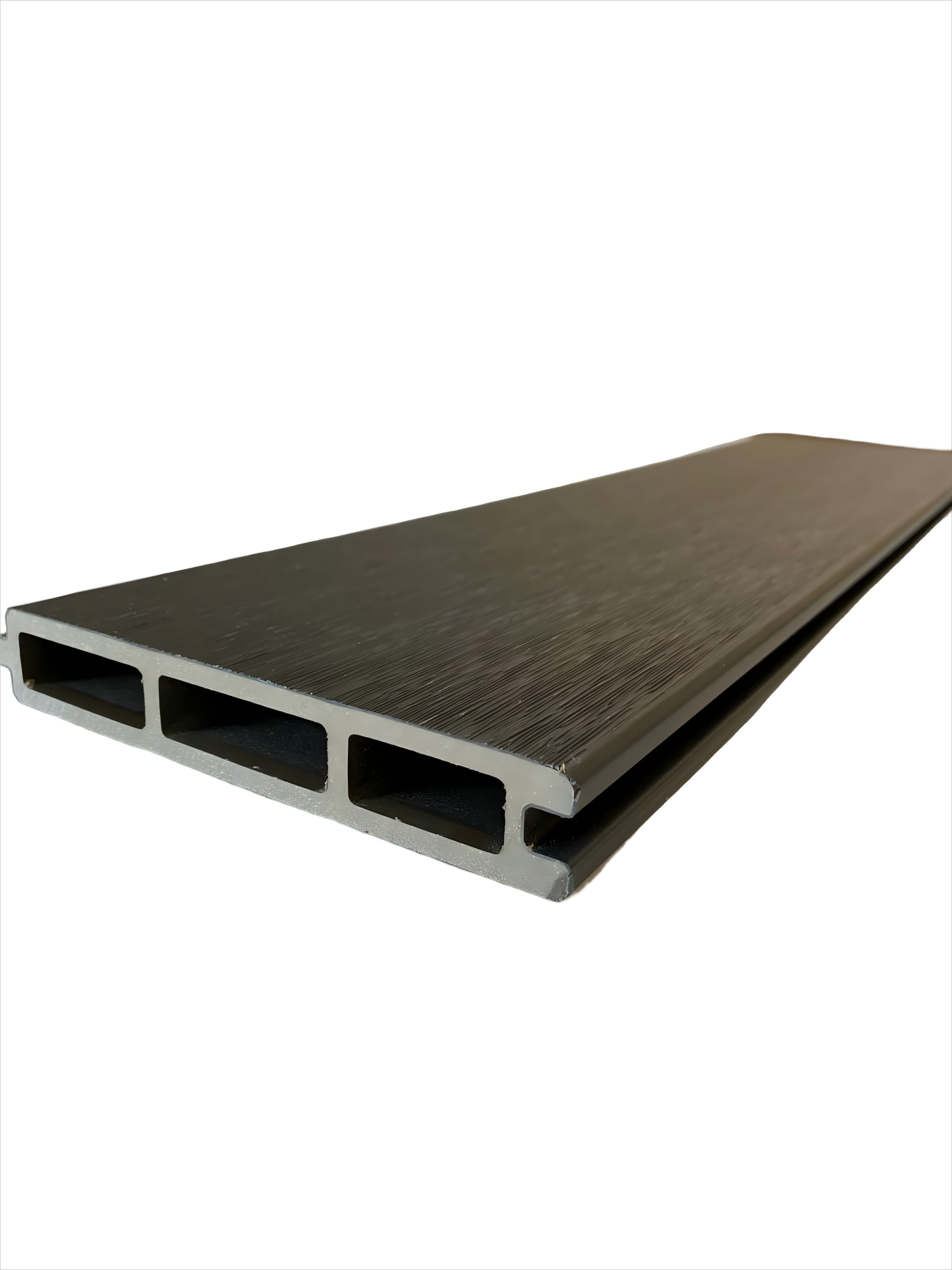
Introduction to the company's technological capabilities: Three core breakthroughs of Linyi Xuancheng
STEP 1: Equipment Upgrade - Introducing International Advanced Production Lines
Linyi Xuancheng Investment allocated 20 million yuan to establish a modern workshop, equipped with over 40 extrusion production lines, more than 20 co-extrusion production lines, as well as supporting equipment such as laser coding machines and sanding machines. Among them, the co-extrusion machines imported from Germany enable precise compounding of surface and core materials, with surface thickness controlled between 0.5-1mm, significantly enhancing weather resistance.
STEP 2: Process Innovation - Dual Series of Light Luxury Co-extrusion and Natural Classic
- Light luxury co-extrusion series: Utilizing PVC + wood powder co-extrusion technology, with nano-scale UV absorbers added to the surface layer, achieving a UV resistance rating of 6 (industry standard is 4), ensuring no color fading for 10 years; the core layer employs high-density wood powder, enhancing impact strength to 25kJ/m² (at -10°C).
- Natural Classic Series: By utilizing extrusion molds that simulate wood grain, it achieves a visual effect of "resembling wood yet not being wood," with a surface roughness Ra ≤ 0.8μm, allowing for direct painting without the need for sanding after installation.
STEP 3: Quality Certification—Passing ISO 9001 and EU CE Certification
The company has established a stringent quality control system, ensuring full traceability from raw material inspection (wood powder moisture content ≤ 8%) to finished product testing (flexural strength ≥ 35 MPa). The products have passed ISO9001 quality management system certification and EU CE safety certification, and have been honored with titles such as "China Green Environmental Protection Product" and "High-Tech Enterprise."
Comparison of technical parameters:
| Index | Traditional Wood-Plastic Composite | Linyi Xuancheng Light Luxury Co-extrusion Series |
|--------------|----------|----------------------|
| UV Resistance Grade | Grade 4 | Grade 6 |
| Impact resistance strength | 12 kJ/m² | 25 kJ/m² |
| Bending strength | 28 MPa | 35 MPa |
| Production Efficiency | 5 tons/day | 12 tons/day |
FAQ Q&A Technical Selection Guide
Q1: How to choose wood-plastic profiles suitable for outdoor scenarios?
A: For outdoor scenarios, weather resistance and impact resistance require special attention. The Linyi Xuancheng light luxury co-extrusion series, featuring nano UV absorbers and a high-density core layer design, can adapt to environments ranging from -30℃ to 60℃, making it suitable for both cold northern regions and humid southern areas. For example, after using this series of flooring at a ski resort, no cracking or fading has occurred over three years.
Q2: How difficult is it to install wood-plastic profiles?
A: Linyi Xuancheng's products adopt a snap-fit design, improving installation efficiency by 40% compared to traditional wood. Taking a 100㎡ terrace as an example, a two-person team can complete the installation in just 8 hours without the need for specialized tools. Precautions: Ensure that the flatness error of the base layer is ≤3mm before installation to prevent deformation caused by stress concentration.
Q3: How to judge the quality of wood-plastic profiles?
A: You can use the "three inspections and one test" method: First, inspect the surface gloss (high-quality products have a uniform surface without color differences); second, inspect the cross-sectional density (the core density of the light luxury series is ≥1.2 g/cm³); third, inspect the bending resilience (no cracks after bending 180°); and one test for impact resistance (using a 5 kg hammer dropped freely from a height of 1 m, with no surface depression).
Reference for Full Text Summary
Linyi Xuancheng New Materials Co., Ltd. has successfully addressed issues such as poor weather resistance and insufficient impact resistance in traditional wood-plastic profiles through equipment upgrades, process innovation, and quality control. Its light luxury co-extrusion series, with parameters such as UV resistance of level 6 and impact strength of 25 kJ/m², has become the preferred material for outdoor scenarios; the natural classic series meets personalized needs for home decoration with its "wood-like yet not wood" visual effect. Currently, the company has an annual production capacity of 60,000 tons, and its products have been applied in over 2,000 projects, including the landscaping projects surrounding the venues of the Winter Olympics. For more information, please visit the official website:www.triday-wpc.com