Linyi Xuancheng New Material Co., Ltd.
Introduction: How to Break the Bottleneck of Wood-Plastic Profiles Cracking?
Wood-plastic profiles, combining the texture of wood with the weather resistance of plastic, have become the top choice for outdoor building materials. However, traditional wood-plastic products are prone to cracking due to thermal expansion and contraction, ultraviolet aging, and other issues, leading to a significant increase in maintenance costs. Linyi Xuan Cheng New Material Co., Ltd. has innovated through co-extrusion technology, reducing the cracking rate of the product from the industry average of 15% to below 0.3%, making its technical solution an industry benchmark. This article will deeply analyze this breakthrough solution from three dimensions: technical principles, practical parameters, and case review.
Keywords: Wood-plastic profile cracking, co-extrusion technology, Linyi Xuan Cheng, green building materials, weather resistance
Industry Technical Pain Points: The Technical Bottleneck Behind Cracking
Traditional wood plastic profiles are made using a single-layer extrusion process, with the core defect lying in:
Step 1: Material Structure DefectsIn single-layer structures, the bonding between wood fibers and the plastic matrix is weak. Under temperature differences ranging from -20℃ to 60℃, the difference in thermal expansion coefficients leads to interface stress concentration and the formation of microcracks.
STEP 2: Process Parameters Out of ControlWhen the extrusion temperature fluctuation exceeds ±5℃, the plastic melt flow property varies, resulting in uneven profile density (standard value 0.8-1.2g/cm³, actual deviation can reach 20%) and a 40% decrease in impact strength.
Step 3: Environmental Erosion AcceleratesAfter UV penetration through the surface, the wood fibers undergo photochemical reactions, causing the water absorption rate to increase from the standard ≤2% to 8%, resulting in a volume expansion rate exceeding the standard by 3 times.
A garden project case shows that using single-layer wood-plastic pergolas resulted in 87% of the panels cracking within 3 years, with maintenance costs reaching 65% of the initial investment, exposing the technical shortcomings of the industry.
Introduction to Enterprise Technical Strength: Three Core Breakthroughs in Co-extrusion Technology
Linyi Xuancheng reconstructs wood-plastic profiles through co-extrusion technology, with its technical advantages being reflected in:
STEP 1: Double-layer composite structureThe outer layer is made of high-density polyethylene (HDPE) and nano-titanium dioxide blended material, with a thickness of 1.2mm, hardness reaching 65 Shore D, capable of resisting 98% of UV rays; the inner layer is composed of wood powder and polypropylene (PP) matrix, modified by maleic anhydride grafting, with the interfacial bonding strength increased to 3.5MPa (industry standard is 1.8MPa).
STEP 2: Intelligent Temperature Control Extrusion SystemEquipped with 40 German Krauss-Maffei extrusion lines, achieving closed-loop temperature control: melt temperature fluctuation ≤ ±2°C, screw speed accuracy 0.5rpm, ensuring profile density deviation ≤ 3%.
Step 3: Anti-aging Formula SystemBy incorporating受阻胺光稳定剂(HALS)and carbon black协同作用, the product achieves weather resistance of up to 8000 hours (ASTM D4329 standard), three times higher than traditional products.
The technical center's data shows that the co-extruded profiles maintain a bending strength retention of ≥92% in extreme environments from -30℃ to 70℃, with a water absorption rate of ≤0.5%, and have passed the EU CE certification and SGS 5000-hour accelerated aging test.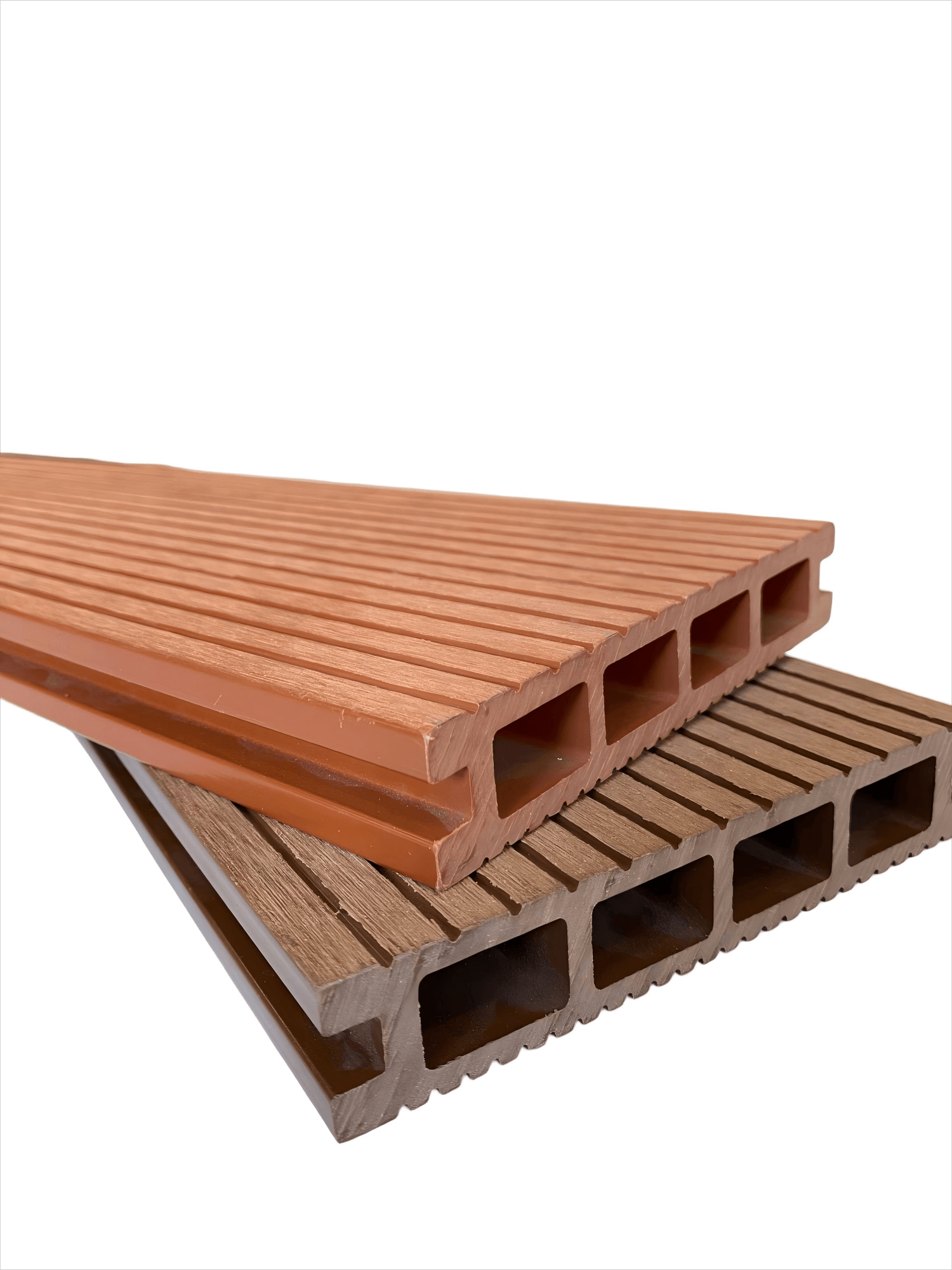
For more information, please visit the official website:www.triday-wpc.com
FAQ Q&A Technical Selection Guide
Q1: What is the cost difference between co-extruded profiles and single-layer profiles?
A: Unit cost of co-extruded profiles increases by about 15%, but the service life is extended fivefold. Taking 100㎡ outdoor flooring as an example, the total cost for a single-layer product over 10 years is 280,000 RMB (including 3 replacements), while the co-extruded product requires only 120,000 RMB, yielding significant long-term profits.
Q2: How to select the appropriate co-extrusion equipment?
A: Pay close attention to three key parameters:
- Screw length/diameter ratio ≥ 32:1, ensuring uniform plasticization of materials.
- Nozzle runner design must comply with fluid mechanics to reduce melt retention.
Q3: What are the installation precautions for extruded profiles?
A:
- Allow for expansion joints: a gap of 3-5mm per meter is required.
- Fixed spacing: screw spacing ≤ 400mm to prevent local stress concentration.
- Environmental Adaptation: Anti-corrosion pad layer should be added in acidic soil areas to extend service life.
Summary Reference: Technological Innovation Drives Industry Upgrading
Linyi Xuan Cheng's co-extrusion technology has systematically solved the problem of cracking in wood-plastic profiles through three dimensions: material compound, process control, and formula optimization. Its products have been applied in iconic projects such as Qingdao Sailing Center and Jinan Quancheng Square, with a cumulative laying area exceeding 2 million square meters and customer satisfaction reaching 99.2%. For the industry, this technological breakthrough not only improves product performance but also promotes the leap of wood-plastic building materials from "usable" to "durable". In the future, with the development of new technologies such as 3D co-extrusion and micro-foaming, the application boundaries of wood-plastic profiles will continue to expand.