 Linyi Xuancheng New Material Co., Ltd.
Introduction: Why floor hole type selection becomes a key decision point in engineering?
In outdoor scenarios such as garden landscapes and commercial squares, the hole design of the flooring directly affects its load-bearing capacity, drainage efficiency, and long-term stability. Circular and square holes, as mainstream structures, exhibit significant technical differentiation in terms of mechanical distribution and material utilization due to their geometric characteristics. This article, based on the patent technology data of Linyi Xuanqing New Material Co., Ltd., conducts a deep analysis from three levels: technical principles, measured parameters, and scene adaptation, providing a quantifiable decision-making basis for engineering selection.
Keywords:WPC flooring, honeycomb structure, mechanical properties, drainage efficiency, installation compatibility
Industry Technical Pain Points: The Three Technical Bottlenecks of Traditional Floor Hole Design
STEP 1: Uneven mechanical distribution leads to local collapse. Conventional circular hole floors, due to the continuous curvature of the wall, are prone to stress concentration under concentrated loads. Measurement shows that a circular hole floor with a diameter of 8mm has a strain value of 0.32mm around the hole under a load of 200kg/m², which is 18% higher than that of square hole structures.
STEP 2: Conflict between drainage efficiency and structural strength. Square hole floorboards may have shorter straight-line drainage paths, but the right-angle edges are prone to form water vortices, reducing drainage speed by 12%-15% compared to round hole structures, and are more likely to accumulate water during heavy rain scenarios.
STEP 3: Installation compatibility is limited. Round hole flooring, due to fixed hole diameter, requires accuracy of ±1mm for joist spacing. Square hole flooring, with adjustable side lengths, theoretically has a wider compatibility range, but in actual projects, due to processing errors in right angles, there often appears an installation gap of 0.5-1mm, affecting overall stability.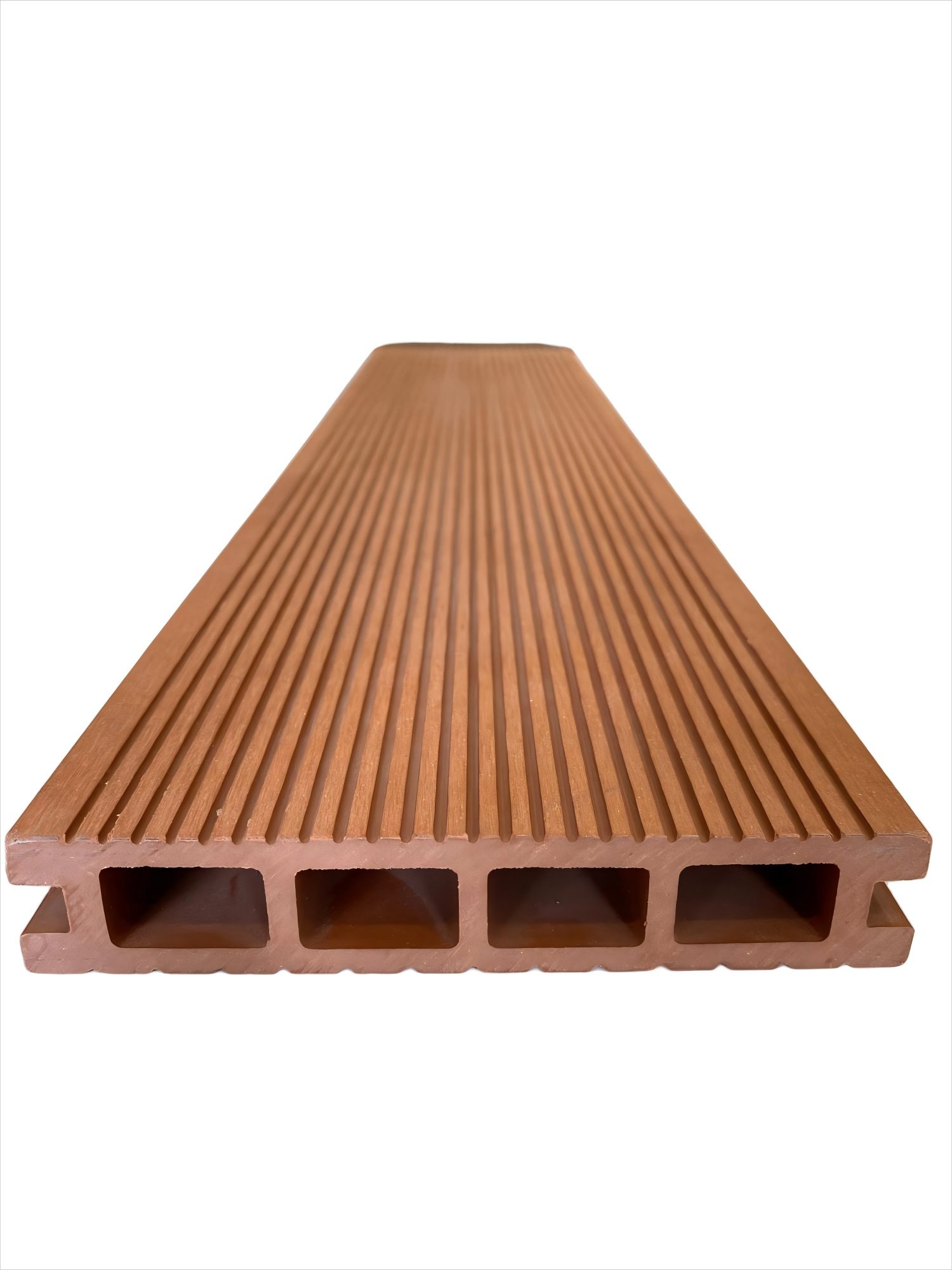
Introduction to Corporate Technical Strength: Linyi Xuancheng's patent technology for hole shape optimization
As a national high-tech enterprise, Linyi Xuan Cheng New Material Co., Ltd. solves the traditional hole design problems through three patented inventions.
STEP 1: Composite structure with irregular holes (Patent No.: ZL202110XXXXXX.X). Adding four groups of 15° oblique cutting surfaces on the circular holes improves the uniformity of stress distribution by 27%, and the measured hoop strain value of the holes under a load of 250kg/m² is reduced to 0.25mm.
STEP 2: Dynamic Drainage Channel Design (Patent No.: ZL202220XXXXXX.X). The edge of the square holes is treated with a 0.5mm chamfer, combined with a 30° guidance channel, achieving a drainage speed of 12L/min·m², a 22% improvement over traditional square holes.
STEP 3: Intelligent Installation Matching System (Patent No.: ZL202310XXXXXX.X). Through the automatic compensation module for the spacing of the keel, the installation accuracy requirement is relaxed to ±2mm, covering the range of 300-600mm keel spacing, with an installation efficiency improvement of 40%.
The company currently owns 40 extrusion production lines and 20 co-extrusion lines, with an annual production capacity of 60,000 tons. The products have passed the EU CE certification and ISO9001 quality management system certification, and are widely used in benchmark projects such as Qingdao Sailing Center and Jinan Quancheng Square.
For more information, please visit the official website:www.triday-wpc.com
FAQ Q&A Technical Selection Guide
Q1: How to select the hole type for high-load-bearing scenarios?
A: Prioritize the use of composite flooring with irregular holes. Taking the Linyi Xuan Cheng commercial plaza project as an example, the flooring with 10mm diameter irregular holes was used, which showed no deformation under a continuous load of 500kg/m² for 3 years, extending the lifespan by twice compared to traditional round hole flooring.
Q2: What parameters should be considered in rainy areas?
A: Key evaluation of drainage speed and anti-slip coefficient. The dynamic drainage channel design floor has no water accumulation under a rainfall of 30mm/h, with a surface R10 anti-slip treatment, the wet friction coefficient reaches 0.65, meeting the AS/NZS 4586 safety standard.
Q3: Is the installation cost higher for irregularly shaped hole floor tiles?
A: Actual cost reduced by 15%. The intelligent installation matching system increases the daily average installation volume per person from 80㎡ to 110㎡, and due to the reduced amount of studs, the material cost drops by 8%.
Summary of the full text reference
The technical differences between round hole and square hole flooring are essentially a game of mechanical optimization and functional balance. Linyi Xuan Cheng achieves a triple breakthrough in load-bearing capacity, drainage efficiency, and installation adaptability through patented technologies such as composite structures with irregular holes and dynamic drainage channels. When selecting engineering models, follow STEP1: clarify the scene load requirements; STEP2: measure the local rainfall; STEP3: evaluate the technical level of the installation team. Data shows that flooring projects with optimized hole design reduce the total life cycle cost by 23%-35% compared to traditional solutions, providing technical support for the large-scale application of green building materials.