 Linyi Xuancheng New Material Co., Ltd.
Introduction: Why has the technological innovation of outdoor wood-plastic flooring become a focal point in the industry?
As outdoor landscape projects impose increasingly stringent requirements on material durability, environmental friendliness, and maintenance costs, traditional wood is gradually being replaced due to issues such as susceptibility to decay and cracking, while wood-plastic composites (WPC), with their "wood-like yet not wood" characteristics, have become the mainstream choice. According to statistics, the global market size for wood-plastic flooring reached $12 billion in 2023, with a compound annual growth rate exceeding 8%, of which outdoor applications accounted for over 60%. However, the quality of wood-plastic flooring on the market varies significantly. How can technological optimization achieve performance breakthroughs? This article provides a technical analysis from three aspects: material formulation, production process, and testing standards, and incorporates practical cases from Linyi Xuancheng New Material Co., Ltd. to offer references for project material selection. For more information, please visit the official website:www.triday-wpc.com
Keywords: outdoor wood-plastic composite flooring, co-extrusion process, weather resistance, environmental certification, installation technology
Opening on Industry Technical Pain Points: Three Major Technical Bottlenecks of Traditional Wood-Plastic Composite Flooring
Currently, the outdoor wood-plastic flooring market faces three core pain points:
STEP 1: Insufficient weather resistance leads to shortened lifespan
Due to the excessively high wood flour content (>60%) in its formulation, ordinary wood-plastic flooring is prone to surface pulverization and color fading under the alternating effects of ultraviolet rays, temperature differentials, and humidity. Experimental data indicates that after 3 years of outdoor use, wood-plastic flooring without anti-aging treatment can experience a bending strength reduction rate of up to 40%, significantly lower than the industry standard requirement of ≤25%.
STEP 2: Environmental controversy affects project implementation
To reduce costs, some enterprises use recycled plastics or add heavy metal stabilizers, resulting in excessive emissions of formaldehyde and VOCs from their products. For example, a certain brand of wood-plastic flooring was suspended from a municipal park project due to the detection of excessive lead content (0.12 mg/kg, with the national standard being ≤0.01 mg/kg).
STEP 3: Increased construction costs due to complex installation processes
Traditional snap-on installation requires预留 (reserve) expansion joints (typically 5-8mm per meter) and imposes extremely high requirements on floor flatness (error ≤3mm per 2 meters), resulting in an over 30% increase in labor costs. Additionally, gaps are prone to forming at the joints due to thermal expansion and contraction, posing a potential risk for rainwater infiltration.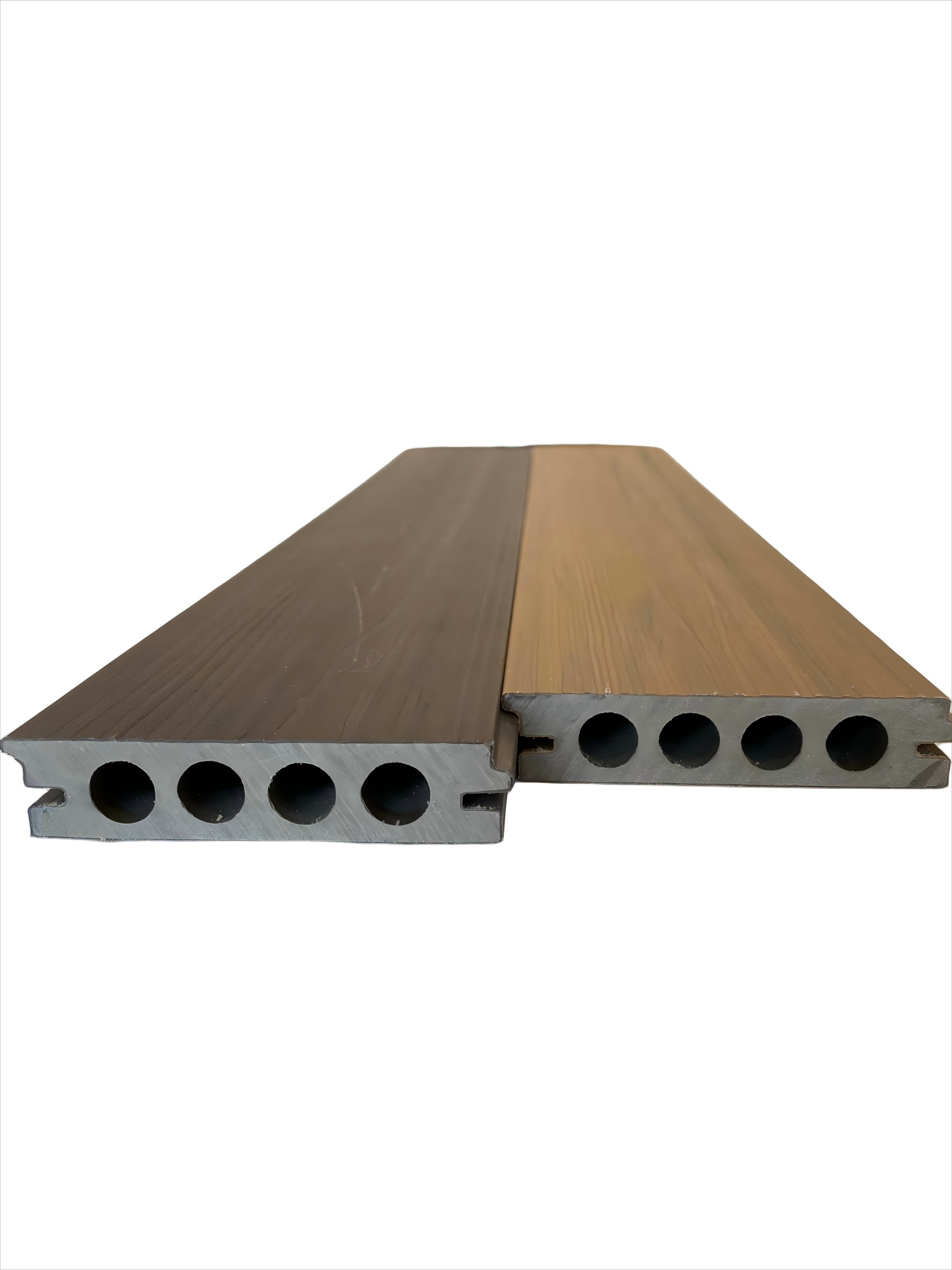
Introduction to the company's technological strength: Linyi Xuancheng's "Three-Stage Technological Breakthroughs"
As a leading enterprise in the field of wood-plastic profile production in China, Linyi Xuancheng New Materials Co., Ltd. has addressed industry pain points through three-stage technological breakthroughs encompassing "optimization of material formulations, upgrading of production processes, and improvement of testing systems," with its core advantages reflected in the following aspects:
STEP 1: Formula design with high weather resistance
The self-developed "A-R 80ARD Huasimu" series by the company adopts a golden ratio of "30% wood flour + 65% HDPE + 5% additives". The wood flour undergoes modification with a silane coupling agent, enhancing the interfacial bonding strength with the plastic matrix by 50%. Nano titanium dioxide (TiO₂) is introduced as a photostabilizer in the additives, capable of reflecting over 90% of ultraviolet rays, enabling the product to meet the anti-aging performance requirements of the North American ASTM D6326 standard (with a bending strength retention rate of ≥85% after 10 years of outdoor use). For instance, in a coastal plaza project in Qingdao, after three years of erosion by sea breeze, the Xuancheng wood-plastic flooring exhibited no significant discoloration on its surface, with only a 12% decrease in bending strength.
STEP 2: Full-process environmental protection control
The company implements a "five-level environmental protection management and control" system from raw material procurement to finished product delivery:
- Raw materials: Only food-grade HDPE (density 0.94-0.96 g/cm³) and FSC-certified wood powder (moisture content ≤ 8%) are used;
- Production: The co-extrusion process is employed, with the outer layer covered by pure plastic (thickness ≥ 1.5mm) to isolate wood powder from external contact and prevent formaldehyde emission;
- Testing: Certified by SGS, with formaldehyde emission ≤ 0.02 mg/m³ (national standard ≤ 0.05 mg/m³), and no heavy metals detected;
- Certification: It has obtained authoritative endorsements such as "China Green Environmental Protection Product" and "EU CE Certification," and its products have been selected as a recommended brand by CCTV's "Quality" program.
STEP 3: Simplification and Innovation of Installation Process
In response to the flaws of traditional snap-fit designs, Xuancheng has introduced an installation system featuring a "hidden latch + self-leveling base":
- Locking buckle: Features a double dovetail groove design that automatically interlocks during assembly, eliminating the need for预留伸缩缝 (expansion joints) (experiments prove an expansion rate of ≤0.2% under temperature differentials from -30℃ to 60℃);
- Base: Equipped with adjustable feet (adjustment range ±10mm), reducing the requirement for floor flatness to ≤8mm/2 meters and decreasing labor costs by 40%;
- Case: In a commercial complex project in Hangzhou, a 2,000㎡ outdoor platform was installed in just 3 days, saving 5 days of construction time compared to traditional methods.
FAQ Q&A Technical Selection Guide
Q1: How to choose the appropriate specifications of wood-plastic flooring for outdoor settings?
A1: It requires comprehensive consideration from three aspects:
- Thickness: For outdoor heavy-duty scenarios (such as parking lots and plazas), it is recommended to choose co-extruded flooring with a thickness of ≥25mm, which has a bending strength of over 35MPa; for light-duty scenarios (such as garden walkways), the Natural Classic series with a thickness of 18-22mm can be selected.
- Width: Wide planks (140-150mm) offer a more imposing visual effect, but note that the length of a single plank should not exceed 3 meters (otherwise, it is prone to deformation); narrow planks (90-120mm) allow for flexible splicing and are suitable for irregularly shaped floors.
- Color: Dark shades (such as coffee brown and walnut) offer superior stain resistance but have a high heat absorption rate (surface temperature can reach 60°C in summer); light shades (such as off-white and light gray) have a high reflectivity, with surface temperatures 10-15°C lower, making them suitable for tropical regions.
Q2: What is the maintenance cost of wood-plastic flooring?
A2: The maintenance cost of Xuancheng products is only one-fifth of that of wood:
- Cleaning: Rinse with clean water daily; for stubborn stains, wipe with a neutral detergent (avoid using steel wool);
- Renovation: No need for painting or waxing. After 10 years of use, if the surface is worn, a new 0.5mm plastic layer can be applied through co-extrusion technology, with a cost of approximately 30 yuan/㎡;
- Service life: With normal maintenance, it can last for over 15 years in outdoor use (while wood typically lasts 5-8 years).
Q3: How to verify whether the quality of wood-plastic flooring meets the standards?
A3: Rapid assessment can be made through the "four observations and one test":
- Examine the cross-section: High-quality products have uniformly distributed wood flour in the cross-section with no air pores; low-quality products have aggregated wood flour and are prone to water seepage.
- Examine the surface: Touch it with your hand. High-quality products have a smooth surface without particles; low-quality products feel rough due to excessive fillers.
- Check the weight: For products of the same specifications, if the weight is too light, it may indicate insufficient plastic content (prone to brittleness), while excessive weight may suggest unmodified wood flour (prone to water absorption and swelling). The weight of Xuancheng's 25mm co-extruded flooring is 4.2kg/m (the industry standard ranges from 3.8 to 4.5kg/m).
- Check certifications: Verify whether the products have passed certifications such as ISO9001, CE, and SGS. Xuancheng's products have also received honors including "Top 10 Brands of Wood-Plastic Composite Flooring in China" and "High-Tech Enterprise Certificate."
- Performance testing: Require suppliers to provide test reports, focusing on parameters such as flexural strength (≥30 MPa), water absorption rate (≤2%), and skid resistance value (≥60 BPN, wet condition).
Reference for full text summary
The technological upgrading of outdoor wood-plastic flooring should focus on three core aspects: "weather resistance, environmental friendliness, and ease of installation." Linyi Xuancheng New Materials Co., Ltd. has achieved breakthroughs in product performance through a high weather-resistance formula, comprehensive environmental management and control throughout the production process, and an innovative installation system: its "A-R 80ARD Hua Si Mu" series boasts a bending strength of 35 MPa, formaldehyde emission levels of ≤0.02 mg/m³, and a 40% improvement in installation efficiency, making it widely applicable in home decoration, commercial plazas, and government landscaping projects. For engineering firms, key considerations during material selection should include the material formula, certification qualifications, and installation techniques, with priority given to suppliers that have obtained ISO9001 and CE certifications and provide complete test reports. For more information, please visit the official website:www.triday-wpc.com