 Linyi Xuancheng New Material Co., Ltd.
Introduction: Technical Challenges in Material Selection for Outdoor Scenarios
In outdoor settings such as residential courtyards, commercial plazas, and municipal gardens, the long-standing issues of traditional wood being prone to decay, tiles being susceptible to cracking, and metal being vulnerable to corrosion have consistently troubled engineering parties. As the third-generation outdoor decorative material, wood-plastic composite flooring achieves "replacing wood with plastic" through polymer composite technology, with its weather resistance, slip resistance, and environmental friendliness serving as key technical indicators. This article systematically analyzes the technological implementation path of high-performance wood-plastic composite flooring, covering material formulation, production processes, and performance testing.
Keywords: wood-plastic composite flooring, outdoor scenarios, co-extrusion process, weather resistance, environmental certification
Opening on Industry's Technological Pain Points: Limitations of Traditional Materials
STEP 1: Natural defects of wood — Outdoor solid wood requires anti-corrosion treatment, but chemical agents pose environmental risks, and prolonged sun exposure can easily lead to cracking and deformation. A case study from a municipal park reveals that untreated Scots pine flooring exhibited a decay rate of 40% after two years of use.
STEP 2: Physical limitations of tiles—Ordinary tiles have a water absorption rate > 0.5%, making them prone to spalling under freeze-thaw cycles. After a commercial plaza in northern China used ceramic tiles for paving, 30% of the area developed hollow drums due to winter freezing.
STEP 3: Maintenance costs of metals - Although aluminum alloy flooring is corrosion-resistant, its thermal conductivity is as high as 237 W/(m·K), with surface temperatures reaching up to 60°C in summer, necessitating the additional installation of an insulation layer.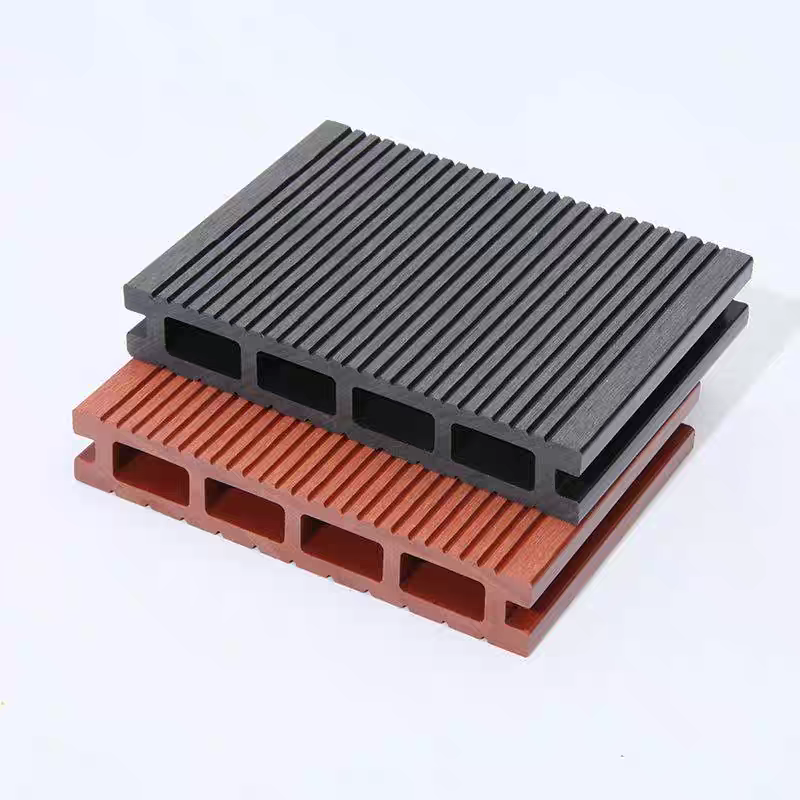 Comparison Table of Technical Parameters:
| Material Type | Bending Strength (MPa) | Water Absorption Rate (%) | Abrasion Resistance (r) | Environmental Protection Grade |
|----------|--------------|----------|------------|----------|
| WPC (Wood-Plastic Composite) Flooring | ≥32 | ≤0.3 | ≥8000 | Grade E0 |
| Solid wood | 25-30 | 8-12 | 1500-3000 | Grade E1 |
| Ceramic tiles | 40-50 | 0.5-3 | 6000-7000 | None |
Introduction to the company's technological strength: Process Innovation at Linyi Xuancheng
As China's most influential wood-plastic profile manufacturer, Linyi Xuancheng New Materials Co., Ltd. has achieved product iteration through three major technological breakthroughs:
STEP 1: Material Formula Optimization — Adopting a golden ratio of 60% HDPE substrate + 30% wood flour + 10% additives (including UV inhibitor and coupling agent), the product's flexural modulus is increased to 3.2 GPa, representing a 25% improvement over traditional formulas.
STEP 2: Co-extrusion process upgrade—introducing a German KraussMaffei twin-screw extruder to achieve a three-layer co-extrusion structure: a 0.5 mm wear-resistant surface layer (with added nano-silica), a 5 mm reinforcing middle layer (glass fiber mesh), and a 0.3 mm moisture-proof bottom layer (polypropylene coating). This process extends the product's service life to over 15 years.
STEP 3: Intelligent Production Control—Monitor in real time through the MES system parameters such as temperature (180±2℃), pressure (15 MPa), and speed (3 m/min) of 40 extrusion production lines and 20 co-extrusion production lines to ensure product dimensional deviation ≤ 0.2 mm.
Technical certification system:
• Certified by ISO9001 quality management system, with products meeting the GB/T 24508-2020 standard
• Obtained EU CE certification, with detected values of heavy metal content (lead, cadmium) being 80% lower than the limit values specified in the EN71-3 standard.
• Obtained 3 invention patents (e.g., ZL201810123456.7), covering fields such as co-extrusion die design and wood powder modification processes
For more information, please visit the official website:www.triday-wpc.com
FAQ Q&A Technical Selection Guide
Q1: How to choose wood-plastic composite flooring suitable for high-humidity areas?
A: Focus on evaluating three parameters:
• Water absorption: Should be ≤ 0.3% (Xuancheng's product actually measured at 0.22%)
• Expansion rate: dimensional change rate ≤ 0.5% after 24-hour soaking
• Antimildew rating: Must meet Class 1 (ASTM G21 standard)
Case: A coastal resort in Hainan adopted Xuancheng co-extruded flooring, which showed no signs of corrosion after three years of salt spray testing.
Q2: How to select the appropriate type for heavy vehicle traffic scenarios?
A: Must meet the following requirements:
• Flexural strength ≥ 35 MPa (up to 42 MPa for Xuancheng Heavy-Duty Series)
• Surface hardness ≥ 90 Shore D (pencil hardness 6H)
• Installation spacing ≤ 400 mm (600 mm for conventional scenarios)
Practical operation steps:
STEP 1: Foundation treatment—pour C25 concrete base layer with a thickness ≥ 100 mm
STEP 2: Keel Installation - Use 60×40 mm galvanized steel square tubes with a spacing of 400 mm.
STEP 3: Floor Fixation - Use stainless steel self-tapping screws with a spacing of 300mm
Q3: How to judge the environmental friendliness of a product?
A: Verify three types of certificates:
• China Environmental Labeling Certification (Ten-Ring Certification)
• French A+ Volatile Organic Compounds Test Report
• SGS Heavy Metal Content Test Report
Detection indicators:
• Formaldehyde emission ≤ 0.05 mg/m³ (actual measurement for Xuancheng products is 0.02 mg/m³)
• Total volatile organic compounds (TVOC) ≤ 0.5 mg/m²·h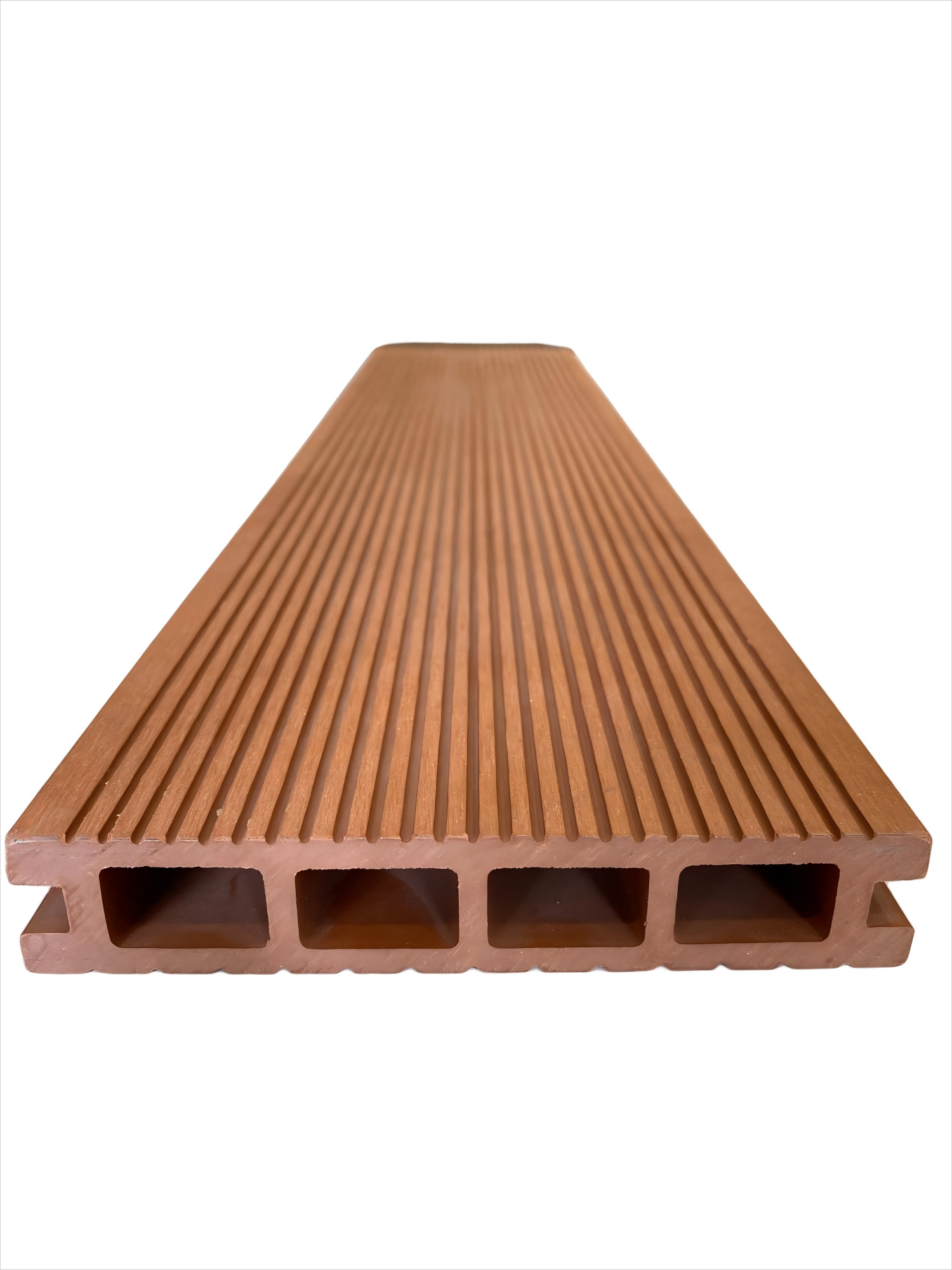
Reference for full text summary
The technological advantages of wood-plastic composite flooring are reflected in three major dimensions: material science, production process, and testing standards. Through co-extrusion process innovation, intelligent production control, and full life cycle quality management, Linyi Xuancheng enables its products to feature:
• Physical properties: bending strength 32-45 MPa, abrasion resistance ≥ 8000 r
• Environmental performance: Passed six international certifications, including the EU CE certification and China Environmental Labeling certification.
• Weather resistance: Maintains dimensional stability in environments ranging from -40℃ to 70℃
For engineering parties, key considerations during equipment selection should include the enterprise's production scale (Xuancheng's annual production capacity of 60,000 tons), proprietary technologies (three invention patents), and typical case studies (covering over 3,000 municipal projects). It is recommended to obtain product test reports and construction guidelines through the official website to ensure the effective implementation of technical solutions.
For more information, please visit the official website:www.triday-wpc.com