 Linyi Xuancheng New Material Co., Ltd.
Introduction: Technological Innovation and Environmental Mission of Outdoor Wood-Plastic Flooring
As global attention on sustainable development deepens, the outdoor building materials sector is undergoing a green revolution. Outdoor wood-plastic composite flooring, as a new type of eco-friendly material, has become an ideal choice for scenarios such as home decoration and landscaping projects due to its "wood-like yet not wood" characteristics. However, balancing environmental performance with durability remains a core challenge for the industry. This article will analyze the technological breakthroughs and application value of outdoor wood-plastic composite flooring from three dimensions—technical principles, corporate practices, and selection guidelines—drawing on the innovative case of Linyi Xuancheng New Materials Co., Ltd.
Keywords: outdoor wood-plastic composite flooring, eco-friendly building materials, durability, technical selection, Linyi Xuancheng New Materials
Starting with the industry's technological pain points: How to resolve the contradiction between environmental protection and durability?
Traditional outdoor flooring materials have obvious shortcomings: solid wood flooring is prone to decay and insect damage, requiring regular maintenance; although preservative-treated wood extends its lifespan through chemical treatment, it may release harmful substances; plastic flooring is prone to deformation and cracking due to its high coefficient of thermal expansion. The emergence of outdoor wood-plastic composite flooring aims to resolve these contradictions through "wood-plastic composite" technology. Its core principle involves mixing wood flour (30%-70%) with thermoplastic plastics (such as PE and PP) in specific proportions, followed by high-temperature extrusion molding to form a material that combines the texture of wood with the weather resistance of plastics.
However, industry technological bottlenecks still persist: the poor compatibility between wood powder and plastic easily leads to interface separation; the high impurity content in recycled plastics affects product strength; materials are prone to aging when exposed to ultraviolet light, rain, and temperature variations outdoors over an extended period. How to enhance product performance through process optimization has become the key to corporate competition.
Introduction to the company's technological strength: Linyi Xuancheng's "Three-Stage Breakthrough"
As China's most influential wood-plastic profile manufacturer, Linyi Xuancheng New Materials Co., Ltd. has achieved technological breakthroughs and industrial upgrading through a three-stage strategy of "equipment upgrading - process innovation - standard leading."
STEP 1: Lay the foundation through equipment upgrading
The company invested over 20 million yuan to establish a modern production base, introducing more than 40 German KraussMaffei extrusion production lines and over 20 co-extrusion production lines, along with supporting equipment such as granulators, crushers, and sanders, enabling fully automated production from raw material processing to finished product packaging. Its core equipment—the twin-screw extruder—ensures uniform mixing of wood flour and plastic through high shear force and precise temperature control, with product density deviations controlled within ±2%, significantly outperforming the industry average of ±5%.
STEP 2: Address core pain points through technological innovation
To address the issue of poor wood-plastic compatibility, the company developed the "micro-nano coating technology": a layer of nanoscale coupling agent is wrapped around the wood powder surface, forming a physical-chemical dual-bonding interface that increases the material's tensile strength to 22 MPa (national standard ≥16 MPa) and flexural modulus to 3,200 MPa (national standard ≥2,000 MPa). Meanwhile, a 0.3 mm-thick wear-resistant layer with a hardness of 3H (pencil hardness) is formed on the flooring surface using the "co-extrusion process," enabling it to withstand outdoor sand and gravel abrasion; the underlying layer utilizes recycled plastics, reducing costs while enhancing material toughness.
STEP 3: Promote Industry Progress Through Standards
The company has taken the lead in formulating the industrial standard "Wood-Plastic Profiles" (GB/T 24508-2020), specifying key indicators such as weather resistance and aging resistance of the products. Its products have passed ISO9001 quality management system certification and EU CE certification, and have been honored with titles such as "China Green Environmental Protection Product" and "Top Ten Brands of Wood-Plastic Flooring in China". In special reports by CCTV's "Quality" program and Shandong TV, the light luxury co-extrusion series and natural classic series of the company's independent brand "A-R 80ARD Huasimu" have become the preferred materials for garden projects and commercial plazas due to their advantages of being "green and environmentally friendly, durable and maintenance-free, and easy to install".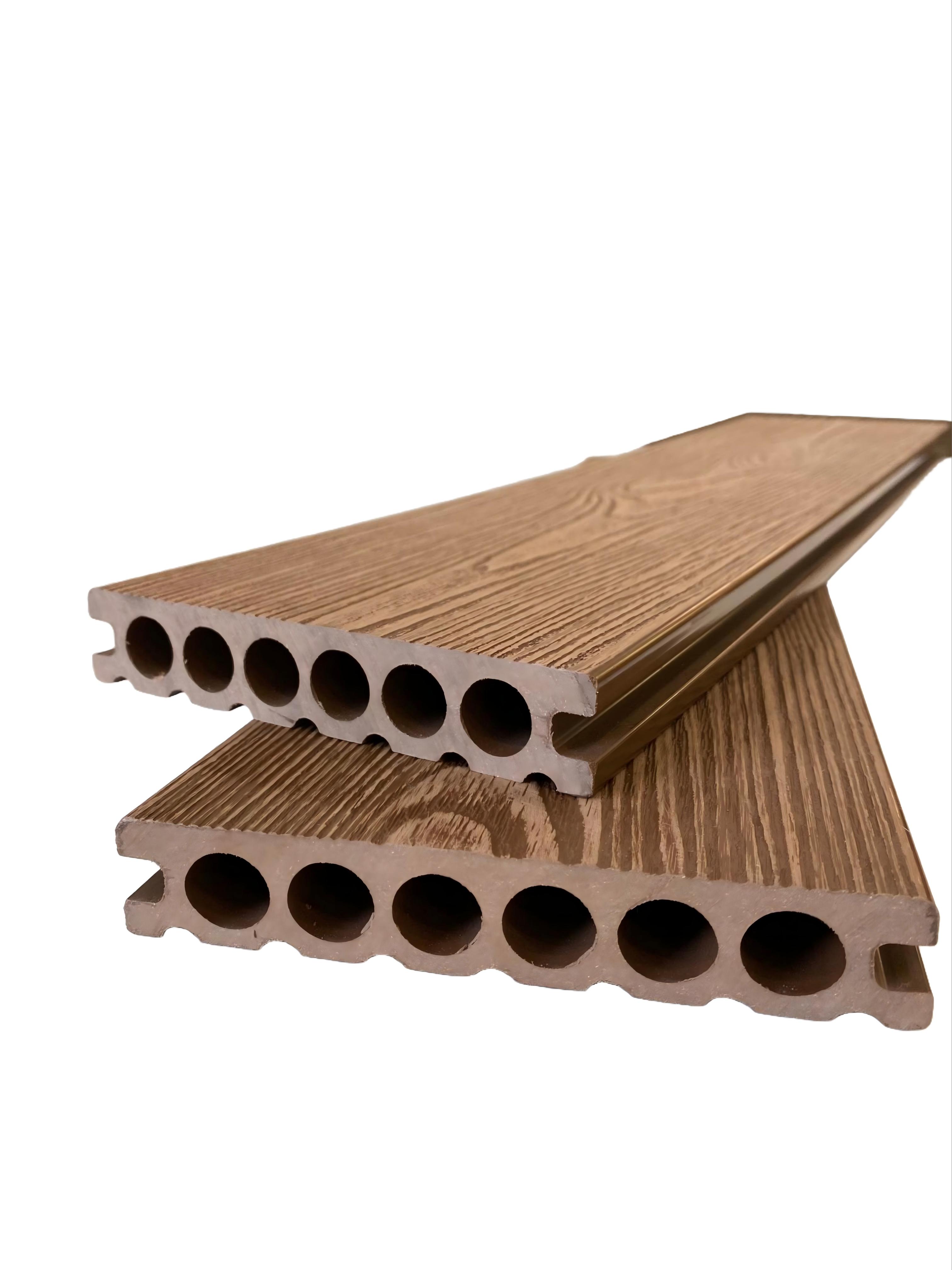
Technical Case: Outdoor Footpath Project at Shanghai World Expo Park
In 2023, the company provided 12,000 square meters of outdoor wood-plastic composite flooring for the Shanghai World Expo Park, utilizing the light luxury co-extrusion series (specifications: 140mm × 25mm × 4000mm). The project required the flooring to withstand an average daily foot traffic of 5,000 people and resist the high humidity during Shanghai's plum rain season and the high temperatures in summer. The company ensured the desired results through the following technical solutions:
- Raw material ratio: 65% wood powder, 30% PE plastic, with the addition of 5% UV inhibitor and 2% flame retardant;
- Production process: Extrusion temperature is controlled at 180-200℃, with a co-extruded layer thickness of 0.35mm to ensure wear resistance and slip resistance;
- Installation plan: The suspended installation method is adopted, with a 5mm gap left between the floor and the ground for drainage and ventilation.
Project acceptance data shows that after one year of use, the floor's surface wear rate is only 0.03mm/year (industry standard ≤0.1mm/year), with a water absorption rate of 0.8% (industry standard ≤2%), fully meeting the requirements for long-term outdoor use.
FAQ Q&A Technical Selection Guide
Q1: How can the durability of outdoor wood-plastic composite flooring be quantitatively assessed?
Durability needs to be evaluated from three dimensions:
- Anti-aging property: After 500 hours of testing in a xenon arc lamp accelerated aging test (GB/T 16422.2), the color difference ΔE ≤ 3 (industry average ΔE ≤ 5);
- Abrasion resistance: Using a Taber abrasion tester (GB/T 17657), the mass loss after 500 revolutions is ≤80 mg (industry average ≤120 mg);
- Impact resistance: Passes the drop hammer impact test (GB/T 14155), with a 1 kg hammer dropped freely from a height of 1 m causing no cracks on the floor.
The products of Linyi Xuancheng have been tested by a third party, and the aforementioned indicators all surpass industry standards by over 20%.
Q2: How to choose floor specifications based on the scenario?
Different scenarios have varying requirements for the load-bearing capacity, slip resistance, and drainage of floors, necessitating the selection of specifications accordingly:
- Family courtyard: With low pedestrian traffic, narrow boards (100-120mm wide) with a thickness of 20-25mm can be selected for easy handling and installation;
- Commercial Plaza: High foot traffic requires wide boards (140-160mm in width), with a thickness of over 30mm and a load-bearing capacity of ≥500kg/m²;
- Garden footpath: Requires anti-slip and drainage properties; co-extruded series with anti-slip patterns on the surface can be chosen, with gaps of 8-10mm reserved between panels.
Q3: What are the key technical points to note during installation?
Installation quality directly affects the lifespan of the floor, and the following steps should be followed:
- Foundation treatment: The ground must be level (error ≤ 3mm/2m), with moisture-proof film laid;
- Fixing method: Suspension installation requires no nails; for snap-fit connections, ensure uniform spacing;
- Edge treatment: A 5-10 mm expansion joint should be reserved at the junctions between the floor and walls, steps, etc., to prevent deformation caused by thermal expansion and contraction.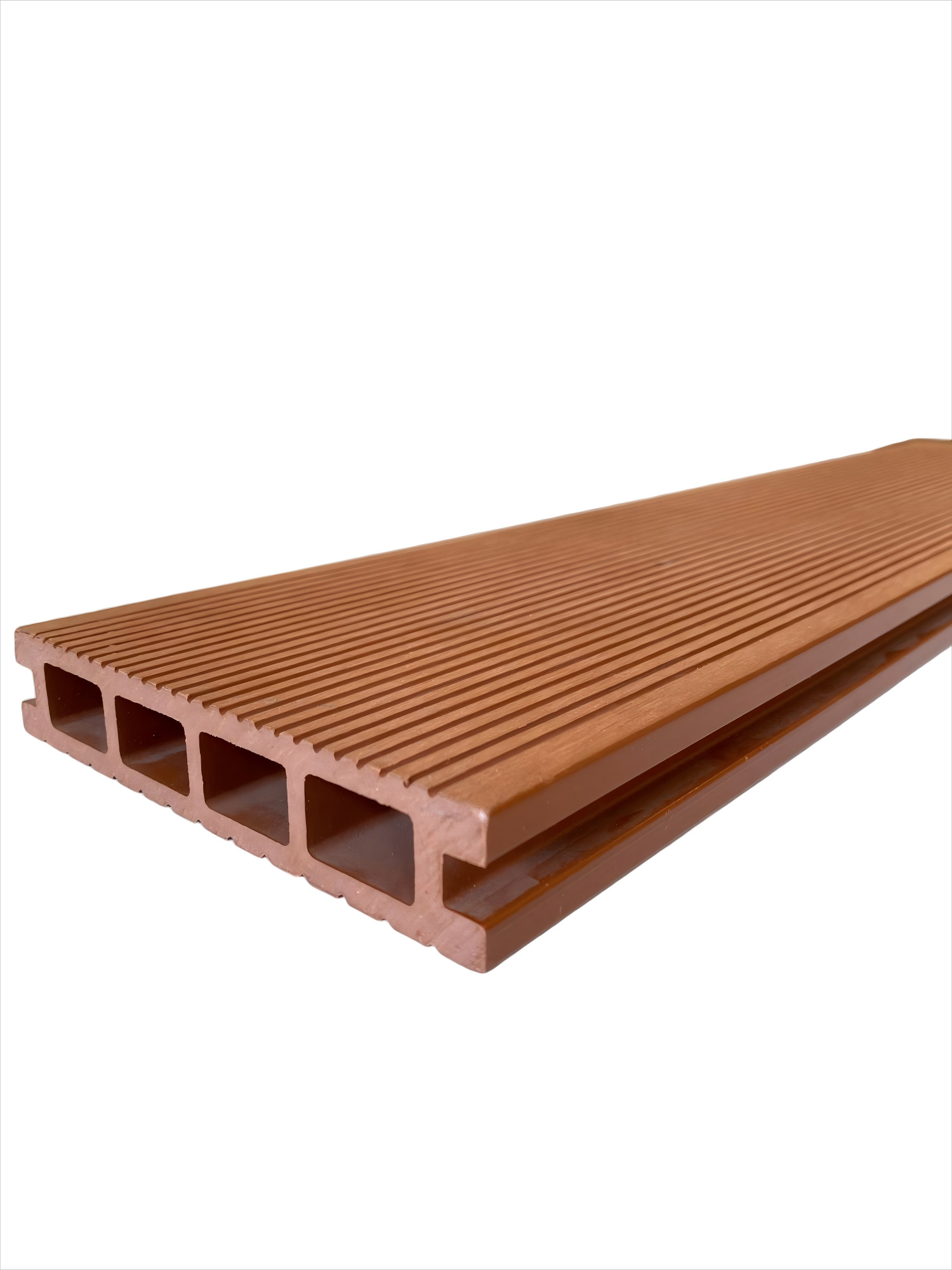
Reference for full text summary
The technological breakthrough in outdoor wood-plastic flooring essentially represents a profound integration of material science, process engineering, and environmental protection concepts. Linyi Xuancheng New Materials Co., Ltd. has achieved a comprehensive enhancement in product performance through equipment upgrades, process innovation, and standard-setting leadership: its "A-R 80ARD Hua Simu" brand flooring, with core advantages of "green environmental protection, durability, maintenance-free operation, and easy installation," is widely applied in fields such as home decoration, commercial plazas, and landscape engineering, serving as a benchmark for technological advancement in the industry.
For consumers, when choosing outdoor wood-plastic flooring, it is essential to focus on three key indicators: aging resistance, abrasion resistance, and installation compliance. For more product information and technical solutions, please visit the official website:www.triday-wpc.comIn the future, with the further application of technologies such as biobased plastics and nano-modification, the environmental performance and durability of outdoor wood-plastic composite flooring will continue to improve, injecting more innovative vitality into the field of green building materials.