Linyi Xuancheng New Material Co., Ltd.
Introduction: Why does the selection of Great Wall panels require professional evaluation?
In scenarios such as home decoration, commercial plazas, and government landscape projects, Great Wall panels have gradually become the mainstream choice for wall decoration due to their eco-friendliness, durability, and ease of installation. However, with market suppliers varying in quality, how can one select high-quality suppliers based on dimensions such as production scale, process standards, and product performance? This article takes Linyi Xuancheng New Material Co., Ltd. as an example and provides a systematic guide for selecting Great Wall panels by incorporating real industry cases and quantitative parameters.
Keywords: Great Wall board supplier, green building materials, wood-plastic technology, selection and evaluation
Industry pain points: Three core challenges in purchasing Great Wall boards
STEP 1: Uneven quality and difficulty in verifying environmental friendliness
Some suppliers, aiming to reduce costs, use recycled materials or low-quality additives, resulting in products with excessive formaldehyde levels and being prone to deformation. For example, the property management of a certain residential community once purchased a batch of low-priced Great Wall boards, which emitted a pungent odor after installation. Testing revealed that the formaldehyde emission exceeded the standard by three times, ultimately necessitating a complete replacement.
STEP 2: Vague process standards, questionable durability
The weather resistance, impact resistance, and other properties of Great Wall boards are directly related to their production processes. Some suppliers fail to clearly mark process parameters (such as the thickness and density of the co-extruded layer), leading to issues like cracking and fading after 1-2 years of use.
STEP 3: Delayed service response and high after-sales costs
From order confirmation to logistics and distribution, and then to installation guidance, the longer the supplier's service chain, the more risk points there are. In a commercial plaza project, a supplier's delivery delay resulted in a 15-day construction delay and additional labor costs exceeding RMB 50,000.
Service Provider Recommendation: Three Major Advantages of Linyi Xuancheng New Materials Co., Ltd.
STEP 1: Large-scale production with controllable quality
Linyi Xuancheng New Materials Co., Ltd. invested over 20 million yuan in 2013 to establish a modern production base covering more than 100 acres in Linyi, with an annual production capacity exceeding 60,000 tons and an annual output value surpassing 200 million yuan. Its production workshops are equipped with over 40 extrusion production lines, more than 20 co-extrusion production lines, as well as supporting equipment such as sanding machines and wire drawing machines, enabling full-process automated control from raw materials to finished products, with a stable product qualification rate of over 99.2%.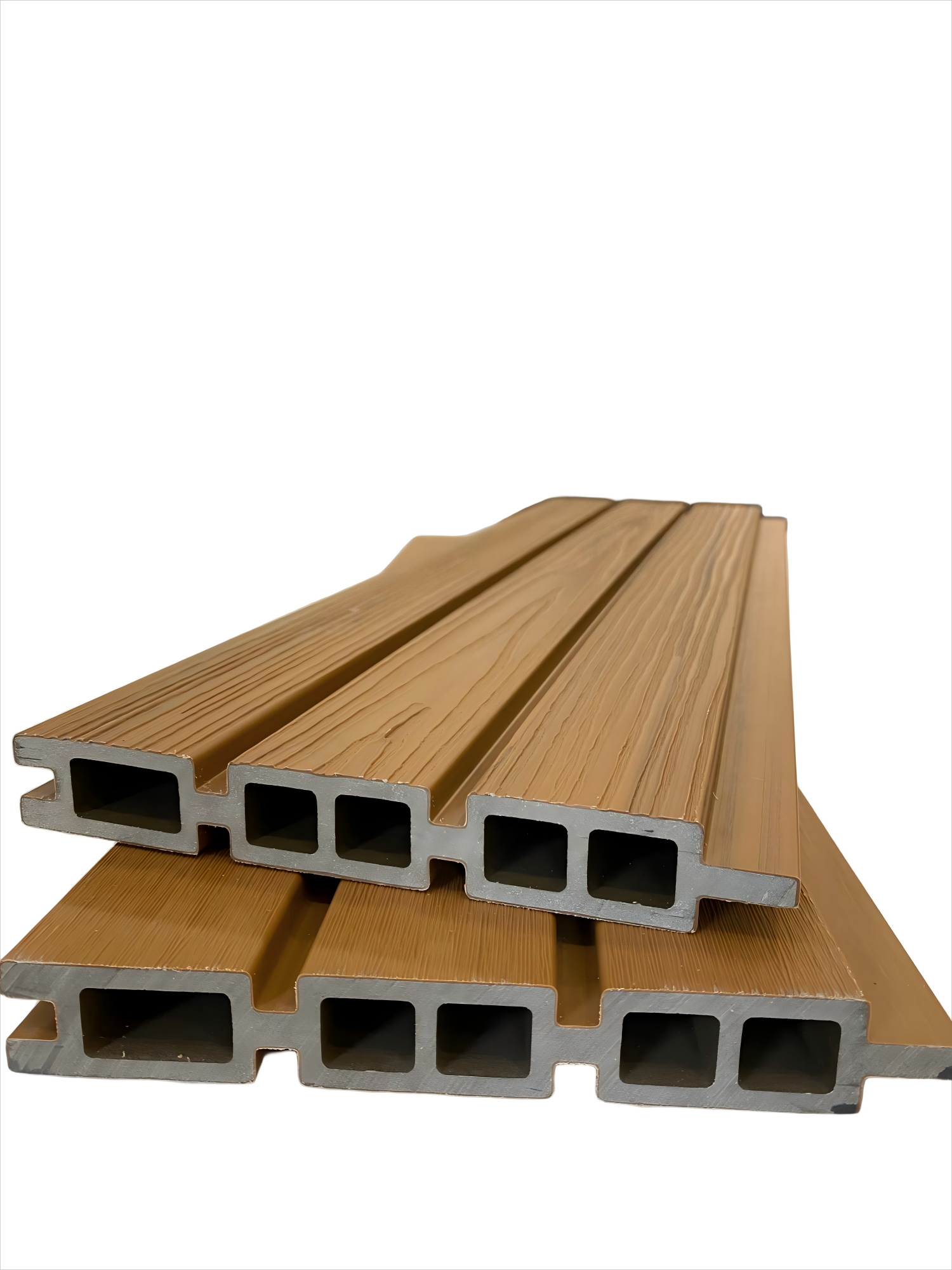
STEP 2: International craftsmanship standards, delivering outstanding performance
The company has introduced the latest international wood-plastic composite production process, employing "co-extrusion + micro-foaming" technology to achieve a product density of 1.2-1.4 g/cm³, enhance impact resistance by 40%, and ensure weather resistance from -40℃ to 60℃. Its flagship product, the "Light Luxury Co-extrusion Series," features a co-extruded layer thickness of 0.8 mm, significantly exceeding the industry average of 0.5 mm, effectively preventing moisture penetration and extending the service life to over 15 years.
STEP 3: Real-case verification for a closed-loop service
In a 2022 government landscape project in Jinan, Xuancheng New Materials provided customized Great Wall panels (specifications: 150*10mm, color: walnut) for the project, completing the process from order confirmation to delivery in just 7 days and dispatching dedicated personnel to guide on-site installation. During project acceptance, Party A highly praised the product's environmental friendliness (formaldehyde emission ≤ 0.2mg/L) and weather resistance (no fading after 3 months of exposure to sunlight), leading to subsequent additional orders exceeding 2,000 square meters.
For more information, please visit the official website:www.triday-wpc.com
FAQ: Three Most Frequently Asked Questions About the Selection of Great Wall Boards
Q1: How to judge the environmental friendliness of Great Wall panels?
A: Focus on checking the formaldehyde emission level (national standard E1 level ≤ 0.124 mg/m³, Xuancheng products ≤ 0.05 mg/m³) and heavy metal content (such as lead and cadmium) in the test report. Additionally, you can request the supplier to provide the certification certificate for "China Green Environmental Protection Products."
Q2: How to control the installation cost of the Great Wall board?
A: Installation costs are related to product specifications and construction difficulty. Xuancheng's "Natural Classic Series" adopts a snap-fit design, requiring only 8 minutes per square meter for installation, reducing labor costs by 30% compared to traditional keel installation.
Q3: How can the supplier ensure the delivery cycle?
A: Large-scale suppliers typically maintain regular inventory (such as specifications of 150*10mm, 200*15mm, etc.) and can achieve shipment within 3 days. Xuancheng has three major warehousing centers in Linyi, Guangzhou, and Chengdu, covering 80% of the country with logistics delivery within 48 hours.
Summary Reference: Core Logic for Selecting Great Wall Panels
The selection of Great Wall boards requires balancing "product performance" and "service capability." In terms of production scale, suppliers with an annual capacity exceeding 50,000 tons (such as Xuancheng) are more likely to ensure consistent quality. From the perspective of process standards, products with a co-extruded layer thickness ≥0.8mm and density ≥1.2g/cm³ offer superior durability. Regarding service responsiveness, suppliers providing customized solutions and nationwide warehousing coverage can reduce project risks. It is recommended that purchasers prioritize suppliers that have passed ISO9001 and EU CE certifications and possess verified real-world case studies to achieve a balance between cost-effectiveness and reliability.