
When selecting outdoor WPC (Wood-Plastic Composite) flooring for commercial or residential projects, understanding the technical differences between various structural designs is crucial for achieving optimal performance and cost-effectiveness. As a leading manufacturer specializing in green building materials with annual production capacity exceeding 60,000 tons, Linyi Xuancheng New Materials provides professional insights into WPC flooring selection through this comprehensive guide.
Structural Design Fundamentals of WPC Flooring
The performance characteristics of WPC flooring primarily derive from three structural designs: solid core, square hollow core, and round hollow core. Each design incorporates specific engineering principles to address different application requirements:
1. Solid Core WPC Flooring
Manufactured through continuous extrusion process, solid core WPC flooring features uniform material distribution throughout its cross-section. This design achieves maximum load-bearing capacity with compressive strength exceeding 35MPa, making it ideal for high-traffic public facilities including:
- Municipal plaza walkways
- Commercial center entrances
- Transportation hub platforms
- Industrial facility passageways
The solid structure demonstrates minimal thermal expansion coefficient (≤0.04mm/m·℃), ensuring dimensional stability in temperature variations from -40℃ to 60℃. This characteristic reduces installation gaps and prevents buckling in large-area continuous铺设.
2. Square Hollow Core WPC Flooring
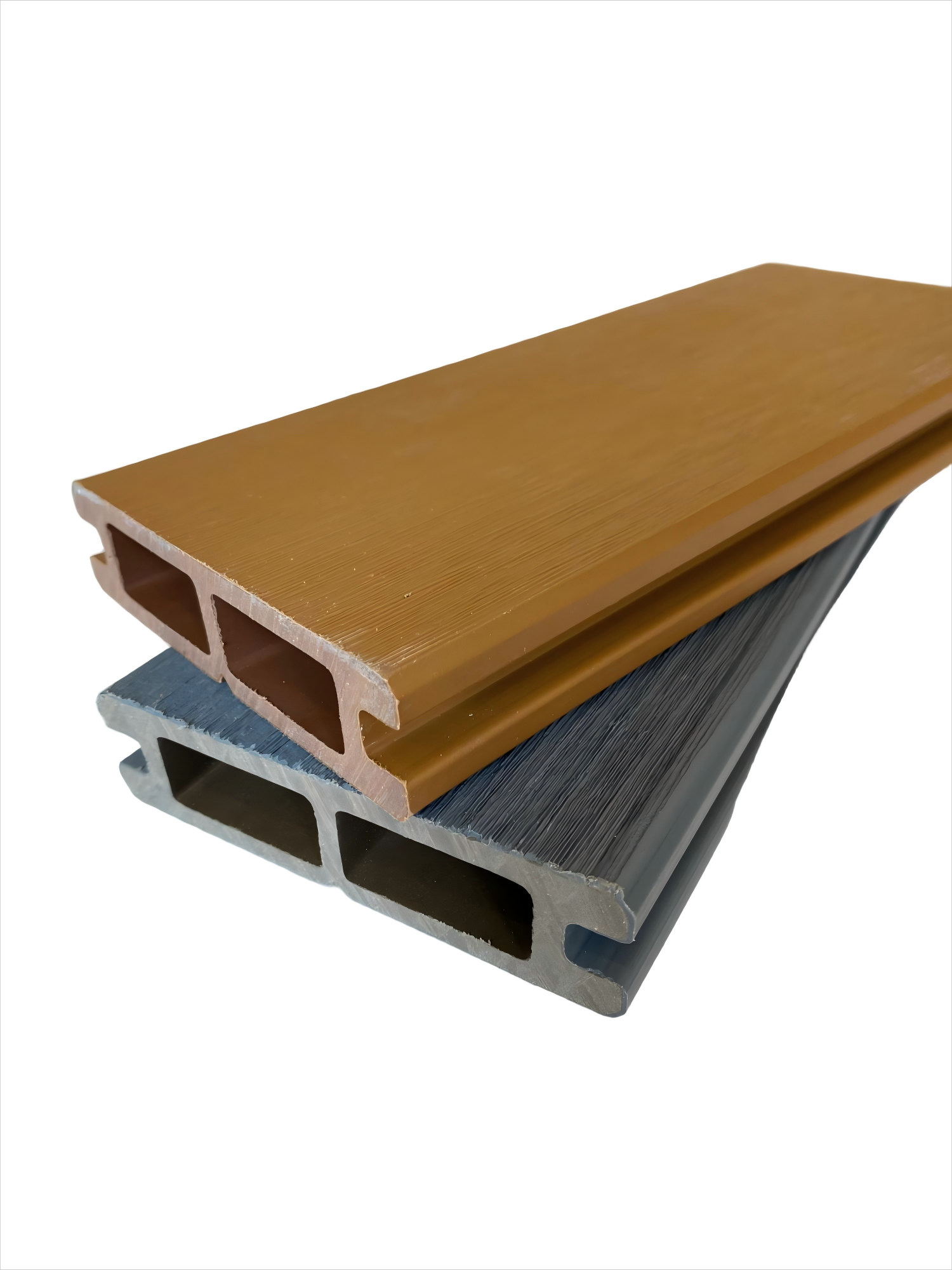
Featuring rectangular voids in its profile, this design reduces material usage by 30-40% while maintaining structural integrity through optimized force distribution. The square hollow structure offers:
- Lightweight advantage (specific gravity 0.8-0.9g/cm³)
- Cost savings through material efficiency
- Enhanced thermal insulation properties
- Diverse surface texture options
This design proves particularly suitable for residential applications including garden patios, balcony decks, and private pool surrounds where moderate load-bearing suffices.
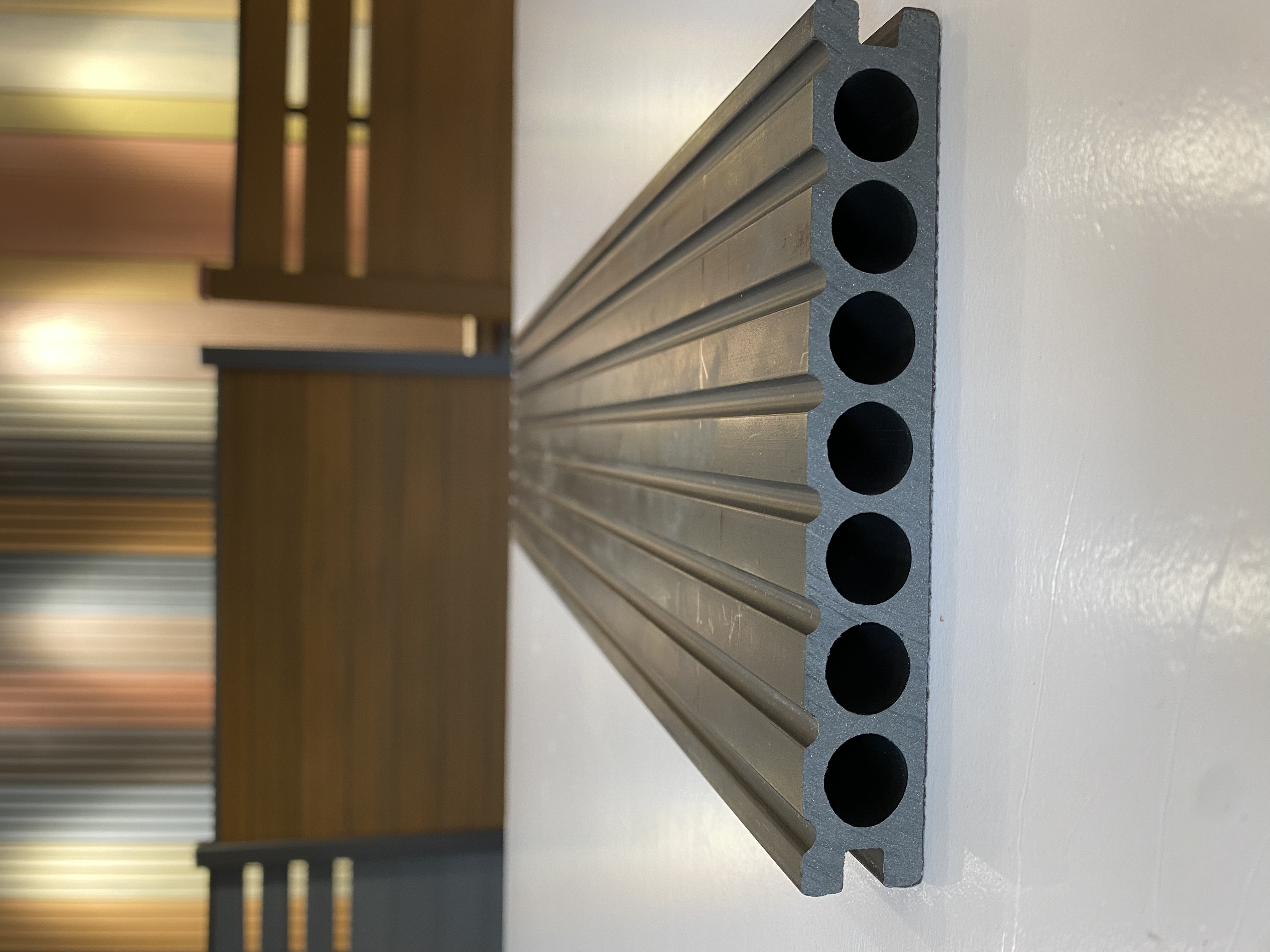
3. Round Hollow Core WPC Flooring
The circular void design represents advanced engineering in WPC technology. Through finite element analysis, this structure achieves optimal force dispersion with 25% higher bending resistance compared to square hollow designs. Key performance advantages include:
- Superior slip resistance (DIN 51130 R10-R11 rating)
- Enhanced drainage capacity (water flow rate >5L/min)
- Uniform stress distribution under load
- Reduced material consumption (void ratio 40-45%)
These characteristics make round hollow WPC flooring the preferred choice for specialized applications such as boardwalks, waterfront promenades, and wetland observation decks where safety and drainage are paramount.
Technical Parameter Comparison
The following table provides quantitative comparison of key performance indicators across different WPC flooring structures:
| Performance Parameter | Solid Core | Square Hollow | Round Hollow |
|---|---|---|---|
| Compressive Strength (MPa) | ≥35 | ≥28 | ≥30 |
| Bending Modulus (GPa) | 3.2-3.8 | 2.8-3.2 | 3.5-4.0 |
| Thermal Expansion (mm/m·℃) | 0.04 | 0.06 | 0.05 |
| Slip Resistance (DIN 51130) | R9 | R9-R10 | R10-R11 |
| Water Absorption (%) | ≤1.2 | ≤1.5 | ≤1.0 |
Application Scenario Analysis
Selecting the appropriate WPC flooring structure requires comprehensive consideration of project requirements, environmental factors, and budget constraints. The following scenario-based analysis provides practical selection guidance:
High Traffic Public Facilities
For projects requiring continuous heavy loads such as transportation hubs or commercial centers, solid core WPC flooring demonstrates unmatched durability. Its 10-year warranty and 25-year service life projection make it the most cost-effective long-term solution despite higher initial investment.
Residential Landscape Projects
Private gardens and balcony renovations benefit from square hollow WPC flooring’s balance of performance and cost. The lightweight characteristic simplifies installation while providing sufficient strength for typical residential use. The diverse texture options also allow for personalized aesthetic design.
Wet Environment Special Applications
In areas requiring superior drainage and slip resistance such as swimming pool surrounds or waterfront promenades, round hollow WPC flooring offers specialized solutions. The circular void design not only enhances safety but also reduces material consumption by 40% compared to solid structures.
FAQ
What are the main differences between solid and hollow WPC flooring?
Solid WPC flooring features uniform material distribution throughout its cross-section, providing maximum load-bearing capacity and dimensional stability. Hollow designs (both square and round) incorporate voids to reduce material usage while maintaining structural integrity through optimized force distribution. The choice depends on specific project requirements for strength, cost, and installation conditions.
How does round hole WPC flooring perform in wet environments?
Round hole WPC flooring demonstrates excellent waterproof performance with water absorption rate below 1.0%. The circular void design creates superior drainage channels, achieving water flow rate exceeding 5L/min. This structure also provides enhanced slip resistance (DIN 51130 R10-R11 rating), making it ideal for wet environments like pool surrounds and waterfront promenades.
Which WPC flooring is more suitable for high traffic areas?
For high traffic public facilities such as transportation hubs or commercial centers, solid core WPC flooring is recommended due to its compressive strength exceeding 35MPa and bending modulus of 3.2-3.8GPa. These properties ensure long-term durability under continuous heavy loads, with service life projection exceeding 25 years.
How to select between square and round hollow WPC flooring?
The selection depends on specific application requirements: square hollow designs offer better cost-effectiveness for general residential use with moderate load requirements; round hollow designs provide superior safety and drainage performance for specialized wet environments and public walkways. The round structure also demonstrates 25% higher bending resistance compared to square hollow designs.
Summary
The selection between solid and hollow WPC flooring structures requires comprehensive evaluation of project requirements, environmental conditions, and budget constraints. Solid core designs offer unmatched durability for heavy-duty applications, while hollow structures provide cost-effective solutions for residential and moderate-load scenarios. The advanced round hollow design represents optimal engineering for specialized wet environments, combining safety, drainage, and material efficiency. As a manufacturer holding 3 invention patents and dozens of utility model patents in WPC technology, Linyi Xuancheng New Materials provides professional consultation and customized solutions to ensure optimal material selection for every project.