
When selecting outdoor flooring materials for commercial projects, residential renovations, or public infrastructure, durability and environmental impact are paramount considerations. Linyi Xuancheng New Materials Co., Ltd. specializes in developing advanced WPC (Wood-Plastic Composite) decking solutions that combine natural wood aesthetics with superior plastic performance. Our outdoor WPC decking products have been engineered to withstand extreme weather conditions while maintaining their structural integrity and visual appeal for decades.
As a leading manufacturer with ISO 9001 and CE certifications, we operate a 100,000㎡ production facility in Linyi, China’s logistics hub, equipped with 40+ extrusion lines and 20+ co-extrusion lines. This advanced manufacturing capacity enables us to produce over 60,000 tons of WPC materials annually, serving clients across 30+ countries with our A-R 80ARD brand products. Our decking solutions have been featured on CCTV and Shandong TV, recognized as “China’s Top 10 Wood-Plastic Flooring Brands” and “National Quality Demonstration Enterprise.”
Understanding WPC Decking Material Composition
Wood-Plastic Composite (WPC) represents a revolutionary material category that combines 60-70% natural wood fibers with 30-40% high-density polyethylene (HDPE) through advanced co-extrusion technology. This formulation creates decking boards that exhibit the warmth of natural wood grain while possessing the waterproof, termite-resistant, and dimensionally stable properties of premium plastics. Unlike traditional timber that requires regular sealing and staining, WPC decking maintains its color and structural integrity with minimal maintenance.
The production process involves extruding the composite material through precision molds to create three distinct structural types: solid core for maximum load-bearing, round-hole for optimal strength-to-weight ratio, and square-hole for cost-effective general applications. Each board undergoes surface treatment processes including sanding, brushing, and laser engraving to achieve various wood grain patterns and textures, ensuring compatibility with diverse architectural styles.
Core Decking Product Categories Explained
Our outdoor WPC decking range addresses specific project requirements through three specialized categories:
1. Solid Core Decking for High-Traffic Areas
Engineered with continuous solid construction, this decking type delivers unmatched load-bearing capacity (up to 500kg/m²) and impact resistance. The absence of internal voids prevents water accumulation, making it ideal for public walkways, commercial plazas, and industrial platforms. Its minimal thermal expansion coefficient (≤0.04mm/m·℃) ensures stable performance in temperature extremes from -40℃ to 60℃.
Key applications include:
- Scenic walkway systems in national parks
- High-traffic pedestrian bridges
- Loading docks and warehouse platforms
- Public transportation station platforms
2. Round-Hole Decking for Coastal Environments
Featuring strategically positioned circular voids, this design achieves 30% weight reduction while maintaining 85% of solid board strength. The circular geometry provides superior bending resistance (MOE ≥3200MPa) and enhances drainage efficiency by 40% compared to square holes. The reduced surface contact area minimizes water retention, making it particularly suitable for saltwater environments.
Ideal installations include:
- Villa terraces in coastal regions
- Boardwalks in marine parks
- Poolside decking in resort areas
- Waterfront observation decks
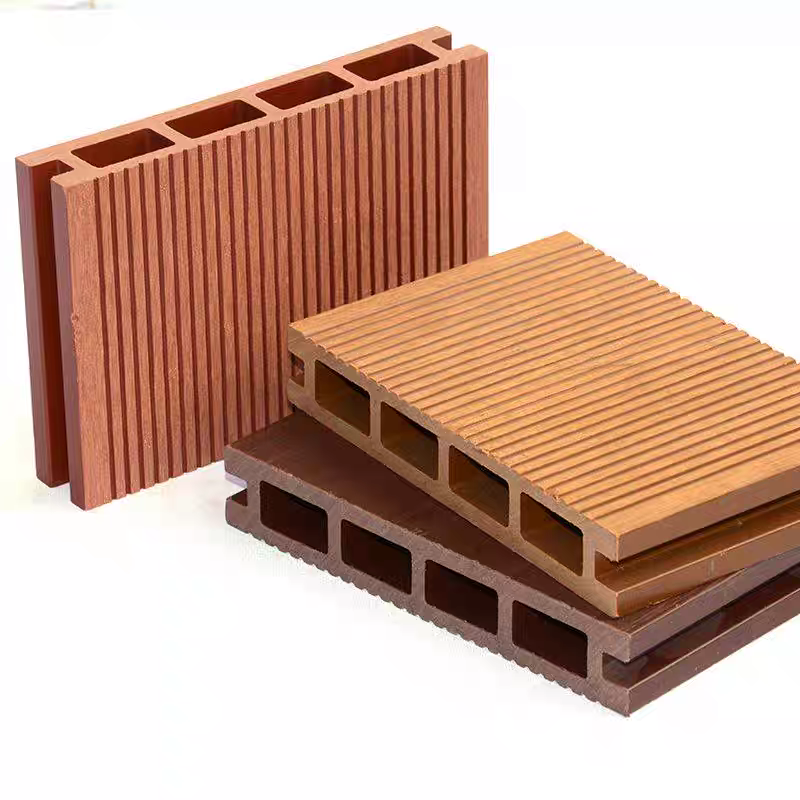
3. Square-Hole Decking for Cost-Effective Solutions
This economical option provides 70% of solid board strength at 40% lower material cost, making it the preferred choice for budget-conscious projects. The square void design maintains consistent structural integrity while reducing raw material consumption. Its lightweight nature (18-22kg/m²) simplifies transportation and installation, particularly for elevated decking systems.
Typical applications encompass:
- Residential garden patios
- Community park walkways
- Rooftop terraces
- Commercial building exterior corridors
Technical Specifications Comparison Table
| Specification | Solid Decking | Round-Hole Decking | Square-Hole Decking |
|---|---|---|---|
| Density (g/cm³) | 1.35-1.45 | 1.15-1.25 | 1.05-1.15 |
| Water Absorption (%) | ≤0.8 | ≤1.2 | ≤1.5 |
| Bending Strength (MPa) | ≥45 | ≥38 | ≥32 |
| Thermal Expansion (mm/m·℃) | 0.03-0.04 | 0.04-0.05 | 0.05-0.06 |
| Service Life (years) | 25+ | 20+ | 15+ |
Complementary WPC Wall Panel Systems
Beyond decking solutions, our WPC product range extends to architectural elements that create cohesive outdoor aesthetics. The wall panel system comprises three specialized profiles:
1. Ridge-Type Wall Panels (Great Wall Panels): Featuring 3D embossed ridges, these panels provide excellent acoustic insulation while creating dynamic visual textures. Available in 156mm, 180mm, and 200mm widths, they support both vertical and horizontal installation patterns.
2. Standard Exterior Wall Panels: Designed with tongue-and-groove joints for rapid installation, these panels offer 95% waterproof performance and UV resistance up to 5000 hours. The 140mm×21mm profile achieves seamless transitions between panels without visible fasteners.
3. Modular Fence Systems: Comprising vertical slats in 150mm, 200mm, and 250mm heights, these fences provide customizable privacy levels from 30% to 100% opacity. The aluminum-reinforced posts ensure structural stability in wind loads up to 120km/h.
FAQ
What makes WPC decking more durable than traditional wood?
WPC decking combines wood fibers with high-density polyethylene through co-extrusion technology, creating a material that’s 3-5 times more durable than natural wood. It resists rot, termites, and UV damage while maintaining dimensional stability in temperature extremes from -40℃ to 60℃. Our solid core decking has demonstrated 25+ years of service life in real-world applications.
How does round-hole decking perform in saltwater environments?
The circular void design in our round-hole decking reduces surface contact area by 40% compared to solid boards, minimizing saltwater retention. The HDPE component contains anti-corrosion additives that prevent salt crystallization within the material structure. Field tests in coastal regions show no degradation after 8 years of continuous exposure to salt spray.
What maintenance is required for WPC decking?
WPC decking requires minimal maintenance compared to traditional wood. We recommend annual cleaning with mild soap and water to remove surface grime. For heavy soil buildup, a pressure washer (≤1200psi) can be used from a 30cm distance. Unlike wood, WPC never requires sealing, staining, or painting throughout its service life.
Can WPC decking be installed over existing concrete?
Yes, our WPC decking can be installed over concrete surfaces using adjustable pedestal systems. These pedestals create an air gap that prevents moisture accumulation while accommodating slope corrections up to 5%. The installation process requires no fasteners penetrating the concrete, preserving the existing substrate integrity.
Summary
Linyi Xuancheng New Materials’ outdoor WPC decking solutions represent the pinnacle of modern outdoor flooring technology. By combining natural wood aesthetics with advanced polymer science, we’ve created materials that deliver exceptional durability, environmental resistance, and design versatility. Our three core decking categories – solid core for heavy-duty applications, round-hole for coastal environments, and square-hole for cost-effective solutions – address the full spectrum of outdoor construction requirements. Backed by 10+ years of manufacturing expertise, 30+ international certifications, and installations in 1000+ projects worldwide, our WPC products offer architects, contractors, and property owners a sustainable, low-maintenance alternative to traditional outdoor materials.