
When selecting outdoor building materials, WPC (Wood-Plastic Composite) products have emerged as the preferred choice for architects, contractors, and homeowners worldwide. As a leading manufacturer specializing in green building materials since 2013, Linyi Xuancheng New Materials Co., Ltd. has developed comprehensive solutions for outdoor flooring and wall applications through continuous innovation and quality improvement. This guide provides professional insights into WPC product selection, performance characteristics, and application scenarios based on our decade-long industry experience.
Understanding WPC Flooring Types: Solid vs Hollow Designs
The core debate in WPC flooring selection revolves around structural design – solid versus hollow configurations. Our production facility, equipped with 40+ extrusion lines and 20+ co-extrusion systems, manufactures three primary WPC flooring categories: square-hole, round-hole, and solid boards, each serving distinct application requirements.
Solid WPC flooring represents the premium segment with its dense composition offering superior load-bearing capacity (up to 500kg/m²) and minimal thermal expansion (≤0.3% dimensional change). This makes it ideal for high-traffic commercial projects like shopping mall plazas, public walkways, and transportation hubs. The continuous material structure ensures excellent impact resistance, withstanding heavy equipment movement without surface damage.
Hollow-core designs optimize material usage while maintaining structural integrity through engineered cavity patterns. Our square-hole flooring features a grid-like internal structure that reduces weight by 40% compared to solid boards while maintaining 85% of its bending strength. This lightweight characteristic (18-22kg/m²) simplifies installation on elevated platforms and reduces structural load requirements.
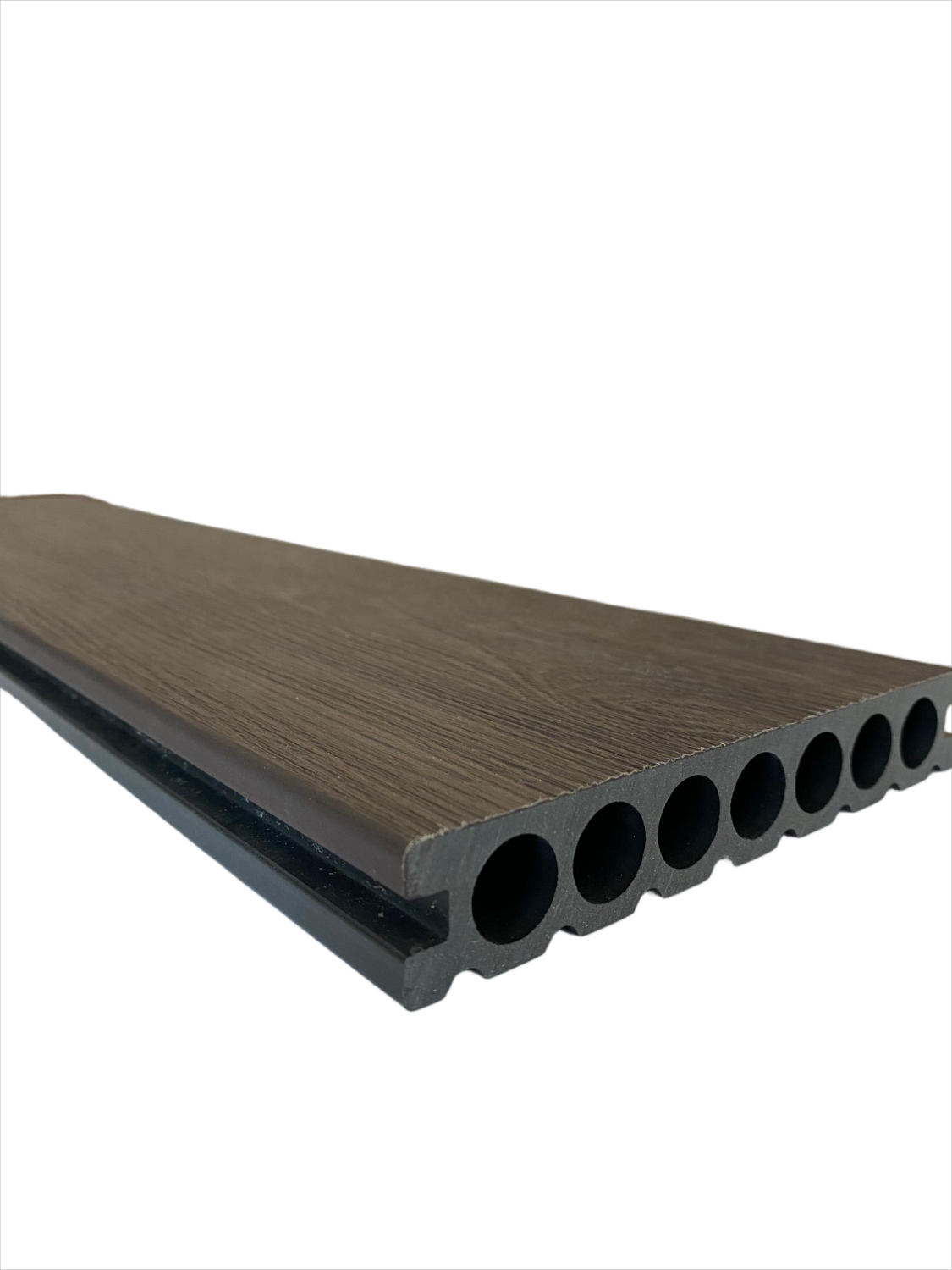
Round-Hole WPC Flooring: Engineering Excellence for Wet Environments
The round-hole design represents our most technically advanced solution for moisture-prone areas. Through computational fluid dynamics simulations, we optimized the circular cavity diameter (12mm) and spacing (35mm center-to-center) to achieve three key performance benefits:
- Enhanced Drainage: The smooth circular channels allow water to flow through at 3.2L/min per square meter, preventing surface pooling even during heavy rainfall
- Improved Slip Resistance:
- Thermal Efficiency:
The embossed surface pattern combined with cavity structure increases friction coefficient to 0.65 (ASTM D2047 standard), exceeding commercial building requirements
The air gaps reduce thermal conductivity by 35% compared to solid boards, maintaining comfortable surface temperatures in direct sunlight
These characteristics make round-hole WPC flooring the preferred choice for pool decks, waterfront promenades, and spa facilities. Our engineering team conducted 2,000+ hours of accelerated weathering tests confirming zero water absorption after 1,440 hours of continuous immersion, meeting the strictest international standards for waterproof building materials.
Comparative Analysis: Round-Hole vs Square-Hole WPC Flooring
The structural differences between these hollow-core designs create distinct performance profiles:
| Performance Parameter | Round-Hole Design | Square-Hole Design |
|---|---|---|
| Bending Strength (MPa) | 38-42 | 32-36 |
| Weight (kg/m²) | 20-24 | 18-22 |
| Thermal Expansion (%) | 0.28-0.32 | 0.35-0.40 |
| Drainage Capacity (L/min/m²) | 3.2 | 2.1 |
WPC Wall Panels & Fencing: Durable Solutions for Vertical Applications
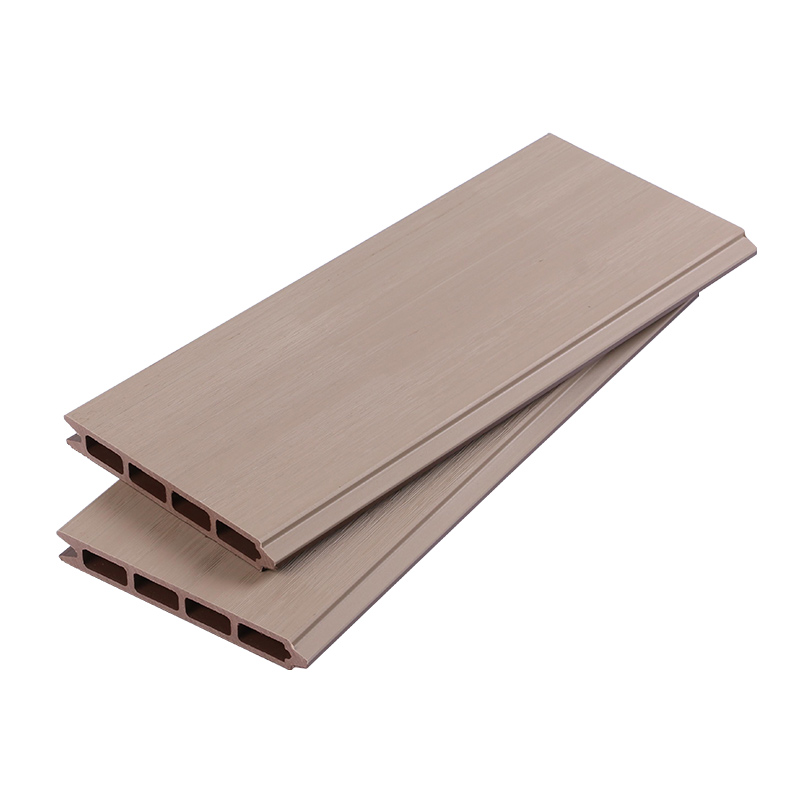
Our product range extends beyond flooring to include three specialized WPC wall panel systems:长城板 (Great Wall panels),外墙板 (exterior wall panels), and围栏板 (fence panels). Each system incorporates unique design features to address specific application challenges:
The Great Wall panels feature a 3D ribbed structure with 15mm vertical grooves that create dynamic light/shadow effects while enhancing surface rigidity. This design has proven particularly effective for exterior cladding projects requiring both aesthetic appeal and structural stability, withstanding wind loads up to 2.5kPa in coastal region installations.
For standard exterior renovations, our flat-joint wall panels offer rapid installation through a patented clip-lock system that reduces labor time by 40% compared to traditional methods. The interlocking design maintains uniform 2mm expansion gaps, preventing buckling during temperature fluctuations from -40°C to 60°C.
The fence panel system provides maximum design flexibility with three configuration options: solid panels for complete privacy, semi-open panels with 50mm vertical slats, and fully open lattice designs. All variants use our reinforced co-extrusion technology that embeds a 1.5mm protective layer on the surface, extending service life by 300% compared to single-layer products.
FAQ
What factors determine the choice between solid and hollow WPC flooring?
The selection depends primarily on load requirements and installation environment. Solid WPC flooring is recommended for areas expecting heavy equipment or constant high foot traffic (over 300 people/hour), while hollow designs work well for residential patios and light commercial spaces. Environmental factors like temperature variations also influence the decision – hollow boards show better dimensional stability in regions with significant seasonal temperature changes.
How does round-hole WPC flooring maintain slip resistance when wet?
Our round-hole design incorporates three anti-slip mechanisms: 1) The embossed surface pattern increases friction even when wet 2) Water channels through the holes reduce surface moisture 3) The circular cavity structure prevents water pooling. Independent laboratory tests confirm a dynamic friction coefficient of 0.62 under wet conditions, meeting ASTM D2047 standards for commercial walkways.
Can WPC wall panels be used in coastal areas with high salt exposure?
Absolutely. Our WPC wall panels use a specialized formulation containing 65% wood fiber, 30% HDPE, and 5% additives including UV stabilizers and corrosion inhibitors. This composition has passed 2,000-hour salt spray tests (ASTM B117) without surface degradation, making them suitable for seaside installations. The closed-cell structure also prevents saltwater penetration into the material core.
What maintenance does WPC fencing require over its lifespan?
WPC fencing requires minimal maintenance compared to traditional wood: 1) Annual cleaning with mild soap and water removes surface dirt 2) No painting or sealing needed – the co-extruded surface layer maintains color fastness 3) Check and tighten fasteners every 2-3 years due to natural material settling. Our products come with a 15-year limited warranty covering structural integrity and color retention.
Summary
Selecting the right WPC products requires careful consideration of structural design, environmental factors, and application requirements. Linyi Xuancheng New Materials’ comprehensive product range – from heavy-duty solid flooring to aesthetically versatile wall panels – provides engineered solutions for every outdoor construction need. Our commitment to quality is demonstrated through 3 invention patents, 28 utility model patents, and certifications including ISO9001, CE, and China Green Environmental Protection Product designation. With annual production capacity exceeding 60,000 tons, we supply premium WPC materials to projects in 32 countries, helping create sustainable, low-maintenance outdoor spaces worldwide.